Abstract
A healthy 30-yr-old woman carrying an insect that had been caught in her living room visited the International Clinic at Severance Hospital, Seoul, in December 2007. The insect she brought was identified to be a nymph of a bedbug, Cimex lectularius, and her skin rashes looked typical bedbug's bites. Her apartment was investigated, and a dead body of a bedbug, cast skins, and hatched eggs were found in her rooms and neighbors' rooms in the same building. She was living in that apartment in Seoul for 9 months since she had moved from New Jersey, USA. We assume that the bedbugs were introduced from abroad, since there had been no report on bedbugs in Seoul for more than 2 decades at least. This is a report of a reemergence of the common bedbug, C. lectularius in Seoul, Korea.
-
Key words: Cimex lectularius, bedbug, reemergence, Seoul, Korea
INTRODUCTION
Bedbugs are well known nocturnal hematophagous insects. The common human bedbug,
Cimex lectularius, is distributed worldwide [
1,
2]. The bedbug bite is painless and the skin reaction varies from small macules to significant bullous eruptions [
3-
5].
Bedbug infestations are common in the developing world, occurring in settings of unsanitary living conditions and overcrowding. Bedbug infestations became rare during the second half of the 20th century and have been viewed as a condition that occurs in travelers returning from developing countries [
4]. However, an increasing incidence of bedbug infestations has been widely reported in the recent medical literature, for example, in Germany [
5], USA [
6-
9], Canada [
10], Italy [
11], and Australia [
12]. The increased prevalence has been attributed to an increased international travel and trade, and a use of less noxious pesticides [
6].
In Korea, the prevalence of bedbugs is believed to be dramatically decreased after the New Village Movement which was started in the 1960's (Saemaul Undong) due to the social and economic development and wide use of pesticides. It is generally believed that bedbugs have disappeared completely in Seoul.
CASE RECORD
A healthy 30-yr-old woman visited the International Clinic at Severance Hospital, Seoul, in December 2007 with a chief complaint of reddish itchy skin rashes on her arms and legs for 10 days. She also brought a dead insect that had been caught in her living room 2 days before she visited the hospital.
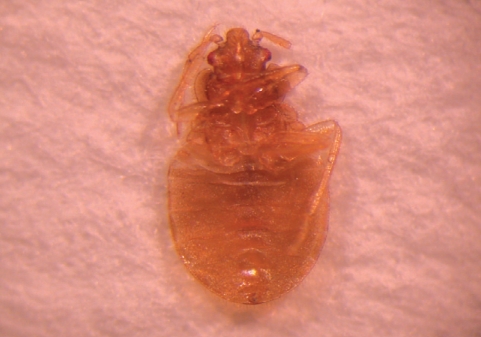
The insect she brought was observed using a stereomicroscope. The insect was found to be a wingless, flat, and light reddish-brown colored, ranging 4 mm, so that it was identified to be a nymph of the bedbug,
C. lectularius, showing the prominent lateral protuberance of the pronotum (
Fig. 1).
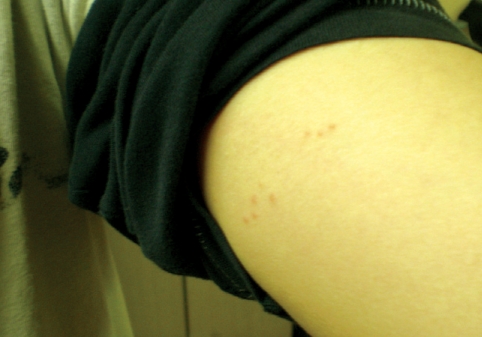
Physical examinations of the patient revealed skin rashes looking like typical bedbug's bites, which were distributed in a linear arrangement with small rashes and itching (
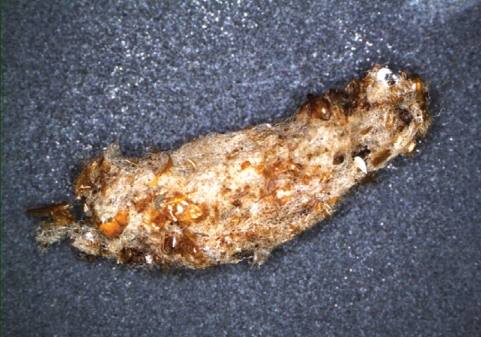
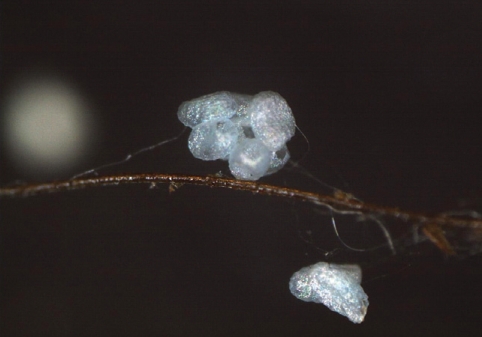
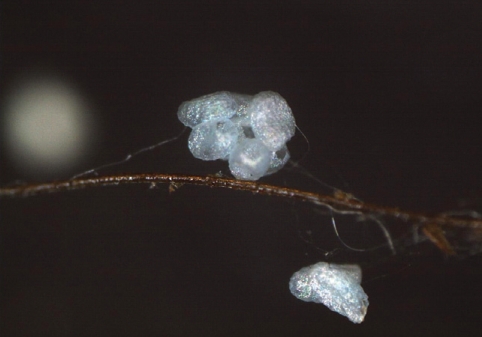
Fig. 2). A few discrete papules were found along the neck, trunk, arms, and legs. We were allowed to investigate her apartment and 3 neighbors' apartments in the same building. We found a dead body and a cast of an egg-ball of the bedbug (
Figs. 3,
4). One of her neighborhood also showed dozens of itchy skin rashes in her arms, legs, back, and abdomen. She complained that she was unable to sleep at night because of the insect bites. No dogs, cats, or other pets were found in any apartment. Disinfestation was achieved by treatment with insecticides (deltamethrin and dichlorvos) to the rooms. Three days after investigation, fumigation treatment was done to eliminate bedbugs from the apartment with a success.
As far as we know, there had been no official report on bedbugs in Seoul for more than 2 decades. She lived in that apartment in Seoul for the last 9 months since she had moved from New Jersey, USA. Several outbreaks of bedbug infestations were reported recently in the vicinity of New York City, USA, where these cases and previous residents in the building had lived [
9]. Although we cannot completely eliminate the possibility that the bedbugs we detected were not recently introduced, we assume that the bedbugs were introduced from abroad, maybe from USA.
DISCUSSION
The bedbug is one of the medically important insects. Confirming the diagnosis of a bedbug bite is sometimes difficult unless to obtain a detailed history of the home environment. However, bedbugs are not considered a serious disease threat. Their medical significance is mainly limited to itching and inflammation from their bites. Localized but occasionally systemic cutaneous reactions such as erythema, wheals, and vesicle formation are brought. Bedbug bites can also create considerable anxiety. The bedbug is perhaps a vector for hepatitis B, and also for american trypanosomiasis (Chagas' disease) in endemic areas [
9,
10,
13].
There are 2 main species that bite humans. The common bedbug,
C. lectularius, has the most widespread and worldwide distribution; the other species,
C. hemipterus, is usually confined to tropical regions. The tropical bedbug bites mostly humans, whereas the common bedbug also attacks domestic animals and bats [
1,
2,
14].
Bedbug infestations may go a long time unnoticed, and can become quite large before being detected. Bedbugs are one of the great travelers of the world and are readily transported via clothing, baggage, bedding, and furniture. This infestation is a common and worldwide problem, particularly in poor regions of the world.
An increasing incidence of bedbug infestations has been widely reported recently in the popular press. Infestations of the bedbug seem to be increasing around the world at an alarming rate. Infestations have been reported in North America, Western Europe, and Australia [
4,
9].
Bedbug infestations were common in USA before the World War II. But with improvements in hygiene, and especially the widespread use of DDT during the 1940s-1950s, the bugs all but vanished. In recent years, bedbugs have also made a comeback in USA. They are increasingly being encountered in homes, apartments, hotels, motels, dormitories, shelters, and modes of transport. International travel and immigration have undoubtedly contributed to the resurgence of bedbugs in USA [
6,
9].
In Korea, for some 30 yr ago bedbugs were considered a minor public health pest. However, no single case of bedbug bites was diagnosed at the hospitals in Korea recently. In the present case there was circumstantial evidence for an association with international travels.
References
Fig. 1A nymph of a bedbug Cimex lectularius brought by the patient (×16).
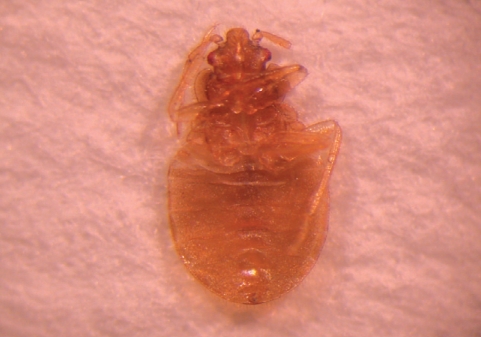
Fig. 2Skin rashes of the patient due to bedbug bites.
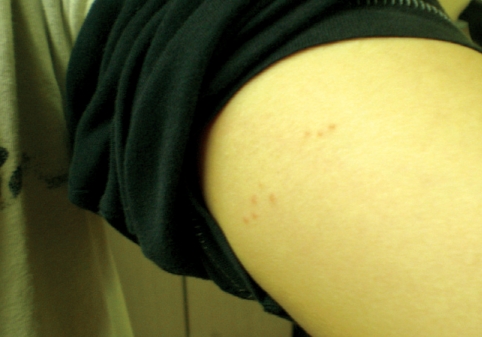
Fig. 3Bedbug cast skins and hatched eggs (×15).
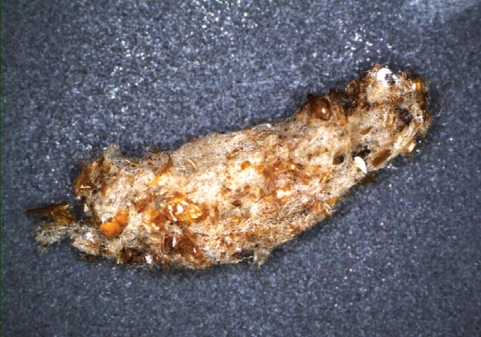
Fig. 4
Citations
Citations to this article as recorded by

- Toxicodynamic and toxicokinetic mechanisms underlying deltamethrin resistance and dinotefuran cross-resistance in two resistant strains of common bed bug, Cimex lectularius
Susie Cho, Hyun Kyu Shin, Heung Chul Kim, J. Marshall Clark, Si Hyeock Lee, Ju Hyeon Kim
Pesticide Biochemistry and Physiology.2026; 217: 106874. CrossRef - Clinical manifestations of bed bug bites: A systematic review of case reports
Julian Felipe Porras-Villamil, Zachary C. DeVries, Jose Pietri
PLOS One.2026; 21(4): e0341398. CrossRef - Response Surface Methodology–Based Optimization of Localized Heat Treatment for Managing Cimex lectularius (Hemiptera: Cimicidae) Infestations
Fitsum Dejene, Solomon Abera, P. R. Jeyaramraja, Yonas Syraji, Lipi Buch
Veterinary Medicine International.2026;[Epub] CrossRef - Species identification and pyrethroid resistance genotyping of recently resurgent Cimex lectularius and Cimex hemipterus in Korea
Susie Cho, Heung Chul Kim, Hoonsik Eom, Jae Rok Lee, Chung Hyun Ko, E-hyun Shin, Won Kyu Lee, Si Hyeock Lee, Ju Hyeon Kim
Parasites, Hosts and Diseases.2024; 62(2): 251. CrossRef - 2023–2024년 국내에서 발생한 빈대의 분포 조사
기훈 김, 선란 조, 희일 이
Public Health Weekly Report.2024; 17(45): 1956. CrossRef - The first recent case ofCimex hemipterus(Hemiptera: Cimicidae) withsuper-kdrmutations in the Republic of Korea
Susie Cho, E-hyun Shin, Ho Cheol Ju, Eui Seok Jeong, Si Hyeock Lee, Ju Hyeon Kim, Warren Booth
Journal of Medical Entomology.2023; 60(4): 822. CrossRef - Comparison of Heat Treatments by Floor Heating and Fan Heating for Bed Bug Control
Taesoon Kim, Suhyeon Park
Korean Journal of Health Promotion.2023; 23(4): 217. CrossRef - Geographical patterns and mechanisms of Cimex lectularius Linnaeus, 1758, and Cimex hemipterus Fabricius, 1803 (Hemiptera: Cimicidae) resistance to insecticides: a systematic review and meta-analysis
Ali Moshaverinia, Amene Raouf-Rahmati, Lida Jarahi, Robert Bergquist, Andres Zorrilla-Vaca, Fatemeh Kiani, Abbas Jadidoleslami, Stephen L. Doggett, Mehdi Zarean, Amirhosein Majma, Mohammad Reza Youssefi, Elham Moghaddas, Behzad Kiani
Parasitology Research.2022; 121(7): 1817. CrossRef - Bed bugs shape the indoor microbial community composition of infested homes
Madhavi L. Kakumanu, Zachary C. DeVries, Alexis M. Barbarin, Richard G. Santangelo, Coby Schal
Science of The Total Environment.2020; 743: 140704. CrossRef - Population Genetic Structure and Breeding Pattern of Cimex hemipterus (F.) (Hemiptera: Cimicidae) in Malaysia
Siti Nor Ain Seri Masran, Abdul Hafiz Ab Majid
Journal of Medical Entomology.2019; 56(4): 942. CrossRef - A Novel Simulated-Use Test for Determining the Efficacy of Insecticides Against Bed Bugs (Hemiptera: Cimicidae)
Arlette Vander Pan, Erik Schmolz, Jürgen Krücken, Carola Kuhn, Michael Rust
Journal of Economic Entomology.2019; 112(5): 2345. CrossRef - Insecticidal activity of an essential oil of Tagetes patula L. (Asteraceae) on common bed bug Cimex lectularius L. and molecular docking of major compounds at the catalytic site of ClAChE1
Flávio Augusto Sanches Politi, Juliana Damieli Nascimento, Alexander Alves da Silva, Isabela Jacob Moro, Mariana Lopes Garcia, Rafael Victório Carvalho Guido, Rosemeire Cristina Linhari Rodrigue Pietro, Antônio Francisco Godinho, Maysa Furlan
Parasitology Research.2017; 116(1): 415. CrossRef - Insecticide resistance and resistance mechanisms in bed bugs, Cimex spp. (Hemiptera: Cimicidae)
Kai Dang, Stephen L. Doggett, G. Veera Singham, Chow-Yang Lee
Parasites & Vectors.2017;[Epub] CrossRef - ECTOPARASITE BED BUG (CIMEX LECTULARIUS) HAS ONCE AGAIN RETURNED TO HUMAN HABITATS ALSO IN SLOVAKIA
Anna Totková, Ľudmila Ševčíková, Ľubica Argalášová, Daniel Böhmer, Vanda Repiská, Jana Malová, Andrej Karkalík, Adrián Totka
Hygiena.2017; 62(3): 77. CrossRef - Bedbugs, Cimex spp.: their current world resurgence and healthcare impact
Andrés Zorrilla-Vaca, Melissa M. Silva-Medina, Kevin Escandón-Vargas
Asian Pacific Journal of Tropical Disease.2015; 5(5): 342. CrossRef - Competence of Cimex lectularius Bed Bugs for the Transmission of Bartonella quintana, the Agent of Trench Fever
Hamza Leulmi, Idir Bitam, Jean Michel Berenger, Hubert Lepidi, Jean Marc Rolain, Lionel Almeras, Didier Raoult, Philippe Parola, Michael J Turell
PLOS Neglected Tropical Diseases.2015; 9(5): e0003789. CrossRef - Bed bugs reproductive life cycle in the clothes of a patient suffering from Alzheimer’s disease results in iron deficiency anemia
Marcela Sabou, Delphine Gallo Imperiale, Emmanuel Andrès, Ahmed Abou-Bacar, Jacinthe Foeglé, Thierry Lavigne, Georges Kaltenbach, Ermanno Candolfi
Parasite.2013; 20: 16. CrossRef - Don’t let the bedbugs bite: the Cimicidae debacle and the denial of healthcare and social justice
Julie M. Aultman
Medicine, Health Care and Philosophy.2013; 16(3): 417. CrossRef - A 454 Survey Reveals the Community Composition and Core Microbiome of the Common Bed Bug (Cimex lectularius) across an Urban Landscape
Matthew Meriweather, Sara Matthews, Rita Rio, Regina S. Baucom, Colin Dale
PLoS ONE.2013; 8(4): e61465. CrossRef - Genetic Analysis of Bed Bug Populations Reveals Small Propagule Size Within Individual Infestations but High Genetic Diversity Across Infestations From the Eastern United States
Virna L. Saenz, Warren Booth, Coby Schal, Edward L. Vargo
Journal of Medical Entomology.2012; 49(4): 865. CrossRef - RNA-Seq and molecular docking reveal multi-level pesticide resistance in the bed bug
Praveen Mamidala, Asela J Wijeratne, Saranga Wijeratne, Karl Kornacker, Babu Sudhamalla, Loren J Rivera-Vega, Andrew Hoelmer, Tea Meulia, Susan C Jones, Omprakash Mittapalli
BMC Genomics.2012;[Epub] CrossRef - Prevention, identification, and treatment options for the management of bed bug infestations
Daniel Fong, Constance Bos, Taz Stuart, Stèphane Perron, Tom Kosatsky, Mona Shum
Environmental Health Review.2012; 55(04): 89. CrossRef - Bed Bugs: Clinical Relevance and Control Options
Stephen L. Doggett, Dominic E. Dwyer, Pablo F. Peñas, Richard C. Russell
Clinical Microbiology Reviews.2012; 25(1): 164. CrossRef - Bed Bugs: The Australian Response
Stephen L. Doggett, Christopher J. Orton, David G. Lilly, Richard C. Russell
Insects.2011; 2(2): 96. CrossRef - Stress Tolerance of Bed Bugs: A Review of Factors That Cause Trauma to Cimex lectularius and C. Hemipterus
Joshua B. Benoit
Insects.2011; 2(2): 151. CrossRef - Bedbugs (Cimicidae infestation): the worldwide renaissance of an old partner of human kind
Paulo Ricardo Criado, Walter Belda Junior, Roberta Fachini Jardim Criado, Roberta Vasconcelos e Silva, Cidia Vasconcellos
The Brazilian Journal of Infectious Diseases.2011; 15(1): 74. CrossRef - Surface contact toxicity and synergism of several insecticides against different stages of the tropical bed bug, Cimex hemipterus (Hemiptera: Cimicidae)
Yee‐Fatt How, Chow‐Yang Lee
Pest Management Science.2011; 67(6): 734. CrossRef - Dermite aux punaises de lit (Cimex lectularius)
A. Levy Bencheton, F. Pagès, J.-M. Berenger, E. Lightburne, J.-J. Morand
Annales de Dermatologie et de Vénéréologie.2010; 137(1): 53. CrossRef - Effects of Life Stages and Feeding Regimes on Active Movement Behavior of the Tropical Bed Bug,Cimex hemipterus(Hemiptera: Cimicidae)
Yee-Fatt How, Chow-Yang Lee
Journal of Medical Entomology.2010; 47(3): 305. CrossRef - Effects of Life Stages and Feeding Regimes on Active Movement Behavior of the Tropical Bed Bug, Cimex hemipterus (Hemiptera: Cimicidae)
Yee-Fatt How, Chow-Yang Lee
Journal of Medical Entomology.2010; 47(3): 305. CrossRef - Survey of bed bugs in infested premises in Malaysia and Singapore
Yee-Fatt How, Chow-Yang Lee
Journal of Vector Ecology.2010; 35(1): 89. CrossRef - Insight into the Sialome of the Bed Bug,Cimex lectularius
Ivo M. B. Francischetti, Eric Calvo, John F. Andersen, Van M. Pham, Amanda J. Favreau, Kent D. Barbian, Alvaro Romero, Jesus G. Valenzuela, José M. C. Ribeiro
Journal of Proteome Research.2010; 9(8): 3820. CrossRef - Bedbugs and Healthcare-associated Dermatitis, France
Pascal Delaunay, Véronique Blanc, Marc Dandine, Pascal Del Giudice, Michel Franc, Christelle Pomares-Estran, Pierre Marty, Olivier Chosidow
Emerging Infectious Diseases.2009; 15(6): 989. CrossRef