Abstract
In February 2010, dermatitis characterized by scale and self-trauma due to puritis was recognized in a group of 22 four-toed hedgehogs (Atelerix albiventris Wagner, 1841) from a local pet shop in Gwangju, Korea. Microscopic examinations of skin scraping samples showed numerous mites of all developmental stages. Morphologically, pedicels of adult mites were short and unjointed. Tarsal caruncles were bell-shaped on all legs of males while they were absent on legs III and IV of females. Three long setae on the third pair of legs in both sexes were present. Adult males had posterior end of the abdomen with trilobate projection on each side, each lobe with a long seta. Based on these features, the mites were identified as Caparinia tripilis. This is the first report of caparinic mite infestation in hedgehogs from Korea. Identification keys for the family Psoroptidae and the genus Caparinia are provided.
-
Key words: Caparinia tripilis, hedgehogs, Atelerix albiventris, case report
INTRODUCTION
Psoroptid mites of the genus
Caparinia affect hedgehogs and a few other mammals causing skin disease. The mite passes all stages on the host and feeds on sloughed skin cells and epidermal debris, similar to
Chorioptes species [
1]. Among 5 species of the genus
Caparinia that have previously been classified, 2 species are known to infest hedgehogs;
C. tripilis and
C. erinacei. Among them,
C. tripilis shows higher pathogenicity than
C. erinacei and may burrow into the skin of the head, ears, flanks, and inner sides of the legs where they form clusters [
2,
3]. It can cause irritation, dermatitis, and self-trauma due to pruritus which can lead to a secondary infection and the host may eventually die [
1,
4].
First reported in England in 1889 by Michael who found very active mites on the surface of hedgehogs and described "running up and down the spines of hedgehogs with great rapidity", the mite was introduced to New Zealand but received little attention until Brokie examined 100 hedgehogs from Wellington between 1954 and 1957 [
4,
5]. In relatively recent years,
C. tripilis has also been introduced to New Mexico, United States, through breeding colonies of African hedgehogs for sale as pets [
6]. So far, the mite has not been reported in Asia, possibly because the animal has neither been popular as pet nor has been considered as endangered species.
Although there has been a great increase in the population of hedgehogs as pets, limited studies on the ectoparasitic diseases of hedgehogs are available. We report in this paper an outbreak of dermatitis in hedgehogs caused by C. tripilis with description of keys for the identification of the Family Psoroptidae and the genus Caparinia.
CASE DESCRIPTION
In February 2010, dermatitis characterized by scale and self-trauma due to pruritus was recognized in a group of 22 four-toed hedgehogs (
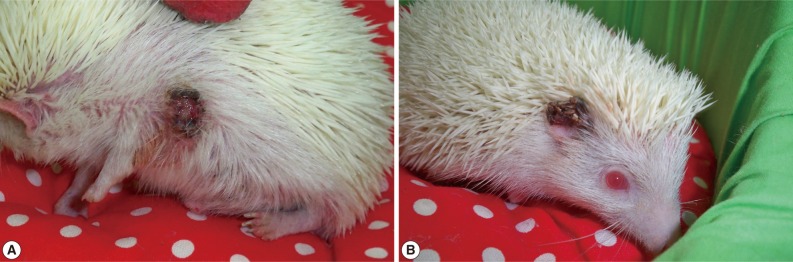
A. albiventris Wagner, 1841) from a local pet shop in Gwangju, Korea. Three of the hedgehogs were males and the rest were females with an average weight of 339.3 g. The mantle of the skin was flaking, and scales and crusts were present. Many hedgehogs were scratching themselves leading to self-elicited trauma (
Fig. 1). Upon otoscopic examination, the ear canal contained numerous live mites along with crusted exudate and scabs. Two of the severely affected hedgehogs died of self-trauma and secondary bacterial infections. For parasitological examinations, skin scraping samples from severely affected areas of the skin were collected and preserved in 70% methanol. For morphological comparison, adult male mites of
Otodectes cynotis and of
Chorioptes texanus were obtained from naturally-infested dogs and a Holstein cow, respectively. Mites were mounted on slides using Downs' PVA solution [
7].
The identification of the genus
Caparinia was based on the key provided by Lawrence [
8] and description by Fain [
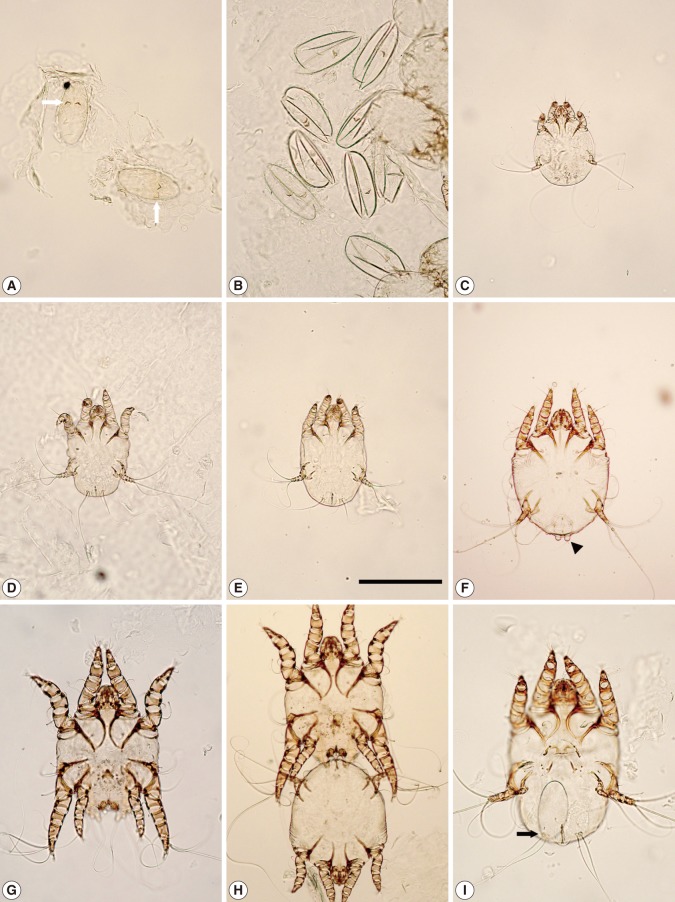
9]. Body length and width of 5 mites per each developmental stage were measured (
Table 1;
Fig. 2). Morphologically, pedicels of adult mites were short and unjointed. Tarsal caruncles were bell-shaped on all legs of male while they were absent on legs III and IV of females. There were 3 long setae on the third pair of legs in both sexes (
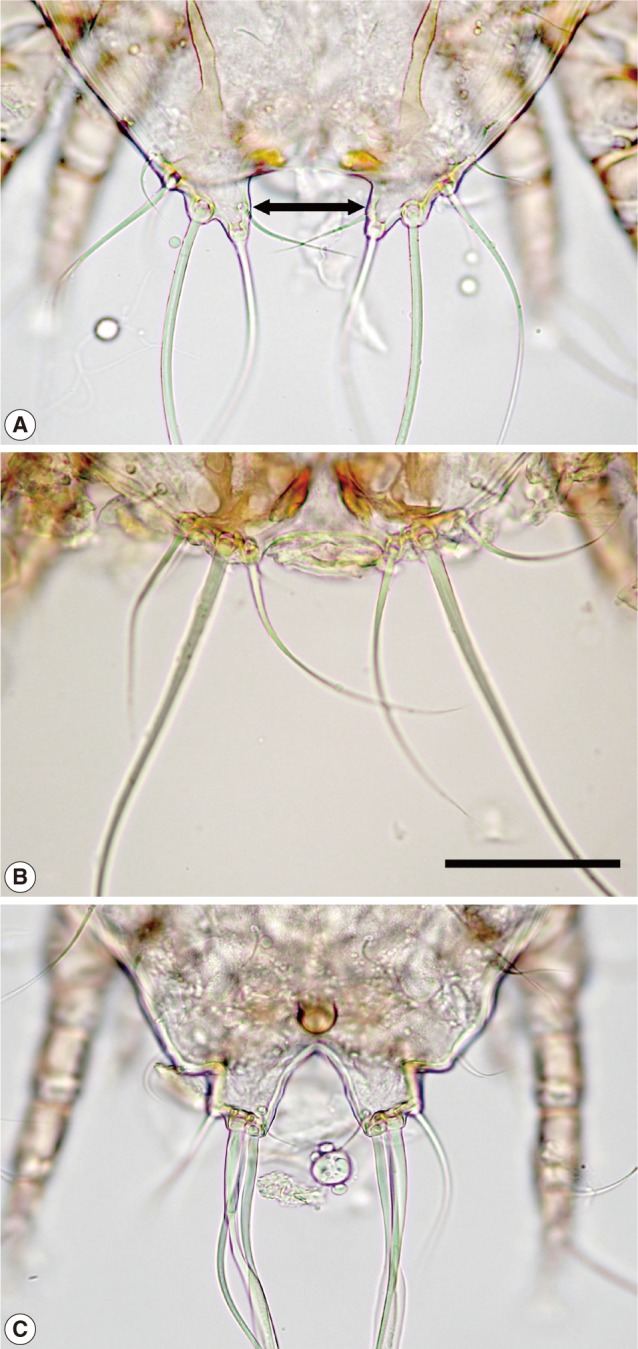
Fig. 2G, I). Adult males had a posterior end of the abdomen with a trilobate projection on each side, each lobe with a long seta (
Fig. 3A). Average length and width of adult males and females were 313.6×240.5 µm and 418.6×287.1 µm, respectively. Based on these morphological features, the mite was identified as the genus
Caparinia.
In adult males, the posterior dorsal scutum was wider than its length (
Fig. 4), and the quadrilateral space (
Fig. 3A, double-sided arrow) of the abdomen of males was wider than its length. The side of the body was rounded. In adult females, a distinctive feature was that they had 3 long setae both on the third and fourth pairs of legs. Two pairs of long setae which were present at the posterior end of the body were well separated from the posterior margin (
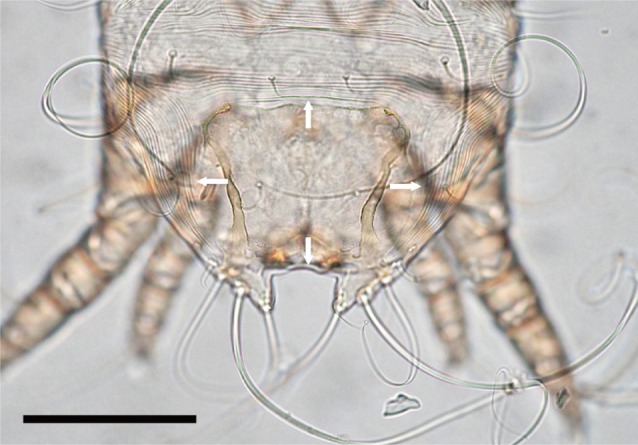
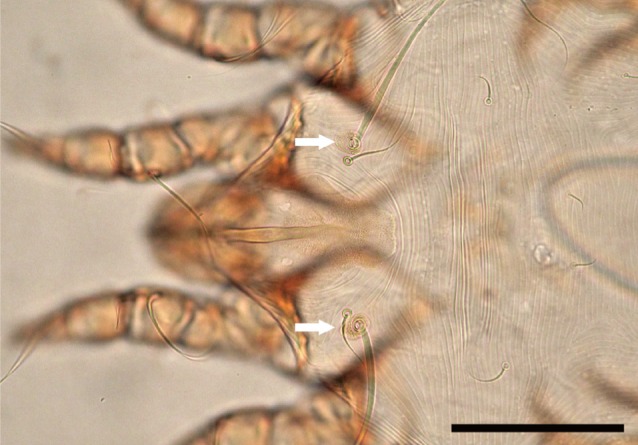
Fig. 2I). Long humeral seta of the dorsal surface was inserted in a small distinct oval scutum (
Fig. 5, arrows). Based on these features, the species of the mite was identified as
C. tripilis.
DISCUSSION
This study reports the first outbreak of
C. tripilis infestation in a colony of African pygmy hedgehogs in Korea. The genus
Caparinia belongs to the family Psoroptidae and is closely related to
Chorioptes except for the presence of a caruncle on leg IV of female mites [
10] and to
Otodectes except for the presence of posterior lobate projections in male mites (
Fig. 3B).
Caparinia spp. infest hedgehogs and some other mammals, including the cape polecat, hyena and European fox leading to skin diseases. Two species which have been isolated from hedgehogs are
C. tripilis and
C. erinacei. Since this is the first report of caparinic mite infestation in Korea, identification keys for the family Psoroptidae and the genus
Caparinia that have been modified from Lawrence [
8], Fain [
9], and Michael [
5] are provided at the end of the discussion.
The genus
Caparinia have been classified into 3 well-documented species;
C. tripilis,
C. erinacei, and
C. ictonyctis. Two additional species,
C. setifera (Mégnin, 1880) and
C. vulpis (Mégnin, 1880), were mentioned by Lawrence [
8] but his description was based only on females and were too brief to differentiate between these 2 species and
C. tripilis. For this reason, the diagnostic key provided in this paper includes features of female mites of 5 species, while features of male mites of
C. setifera and
C. vulpis are not provided. The taxonomic status of
C. tripilis and
C. ictonyctis is based on the mophological characteristics of adult male mites which differ from
C. erinacei by the number of lobes on each laminate projection on the posterior end of the body and the number of the setae attached on each lobe. Male mites of
C. tripilis and
C. ictonyctis have 3 paired posterior lobes, each equipped with a long seta, whereas
C. erinacei has 2 paired lobes with a long seta on each lobe. The presence of posterior lobate projections is also an important feature when it is needed to be distinguished from the genus
Otodectes which does not have these lobate projections (
Fig. 3B). The posterior dorsal scutum is wider than its length in
C. tripilis, whereas that in
C. ictonyctis is longer than its width (
Fig. 4). Furthermore, while the 2 posterior projections of males enclose a quadrilateral space which is as long as its width in
C. ictonyctis and wider than its length in
C. tripilis (
Fig. 3A).
Features of adult female mites of
C. tripilis are very similar to those of both
C. ictonyctis and
C. erinacei. Legs III and IV do not have a caruncle, which is a characteristic feature to distinguish from
Chorioptes spp. Female mites have 3 long setae at the end of the third and fourth pairs of legs whereas male mites have those on only Leg III. On the other hand,
Otodectes has 2 long setae at the end of Leg III. Two pairs of long setae were present at the posterior end of the body of adult females (
Fig. 2I, black arrow). Furthermore, 1 of the distinctive features of
C. tripilis females is that the insertion of posterior abdominal setae is well separated from the posterior margin. By contrast, both
C. ictonyctis and
C. erinacei had posterior abdominal setae inserted on the edge of the posterior margin [
8,
9].
The life cycle of
C. tripilis includes an egg, larva, protonymph, deutonymph (including pubescent female), and either an adult male or an adult female. Two bosses are present on the surface of an egg and are on the same side of the cleavage (
Fig. 2A, B, arrows). By means of suckers, the adult males and pubescent females form an attachment pair which is more or less permanent up until the time of emergence of the adult females from the deutonymphal exuviae (
Fig. 2H). Except for the presence of a couple of copulatory tubercles at the posterior end of a pubescent female (female deutonymph,
Fig. 2F, arrow head), egg, larvae, protonymph, and deutonymph stages of
Caparinia do not show sexual dimorphism. Observations suggest that the complete life cycle encompass about 3 weeks [
10].
C. tripilis may burrow into the skin of hedgehogs, and symptoms may include pruritus, hair loss, spine loss, deformation of the ears, and scaly, encrusted skin lesions, leading to secondary infections. Severely infected animals become feeble, lose weight, scratch the affected skin, and may abandon their normal nocturnal behavior to become active in the daytime [
4].
C. erinacei, on the other hand, has low pathogenicity and does not form clusters on its hosts [
3]. A sarcoptic mange mite,
Notoedres muris, may also be found in mixed infestations with
C. tripilis [
11].
One of the most common pet breed of hedgehogs is the African pygmy hedgehog or 4-toed hedgehog (
A. albiventris). It is smaller than the Western European hedgehog, has a white abdomen, and is characterized by lacking the first toe of the hind leg. The animal had previously been classified in the genus
Erinaceus (Macdonald, 1986) like Western European hedgehogs, but recently it has been reclassified as part of the genus
Atelerix (Wilson, 1993). Hedgehogs are becoming popular pet animals but relatively little research has been carried out on their ectoparasitic diseases. As previously stated, this is the first outbreak of
C. tripilis in a colony of hedgehogs in Korea. Some identification key aspects regarding the morphological features of the Family Psoroptidae and the genus
Caparinia are provided. The identification keys in this article are adapted from Lawrence [
8], Fain [
9], and Michael [
5].
Key to the genera of the Family Psoroptidae
-
Pedicel of tarsal caruncles segmented and long -- Psoroptes
Pedicle of tarsal caruncles not segmented, short ----------- 2
-
Only leg III of the female without a caruncle ---- Chorioptes
Legs III and IV of the female without a caruncle ----------- 3
Posterior of abdomen of male with paired lobate projections; tarsus III in both sexes with 3 long setae - Caparinia
Posterior of abdomen of male without lobate projections; tarsus III in both sexes with 2 long setae ----------- Otodectes
Key to the species of Caparinia (Male)
-
Posterior end of abdomen with bilobate laminate projection on either side, each lobe with a long seta, host hedgehog ----------------------------------------------------------- C. erinacei
Posterior end of abdomen with two trilobate laminate projections, each lobe with a long seta ----------------------- 2
-
Posterior dorsal scutum is wider than it is long, quadrilateral space of abdomen is wider than it is long, side of the body are rounded, larger than C. ictonyctis, host hedgehog -------------------------------------------------------------------- C. tripilis
Posterior dorsal scutum is longer than it is wide, quadrilateral space of abdomen is as long as it is wide, side of the body are parallel, smaller than C. tripilis, host cape polecat ----------------------------------------------------------- C. ictonyctis
Key to the species of Caparinia (Female)
-
Abdomen with 2 pairs of posterior setae --------------------- 2
Abdomen with 1 pair of posterior setae ---------------------- 4
-
Insertion of posterior abdominal setae well separated from posterior margin; long humeral seta of dorsal surface inserted in a small distinct oval scutum --------------- C. tripilis
Insertion of posterior abdominal setae on the edge of posterior margin; humeral seta of dorsal surface not inserted in a scutum, or this scutum very indistinct ------------------ 3
-
Host: cape polecat -------------------------------------- C. ictonyctis
Host: hedgehog ------------------------------------------- C. erinacei
-
Length and width of body 360×280 µm; posterior abdominal setae as long as body; host, Hyena --------- C. setifera
Length and width of body 450×400 µm; posterior abdominal setae half as long as those of C. setifera; host, European fox -------------------------------------------------------- C. vulpis
References
- 1. Mullen GR, Durden LA. Medical and Veterinary Entomology. 2009. 2nd ed. Boston, USA. Academic Press; p. 464-467.
- 2. Reeve N. Hedgehogs. 1994. London, UK. T & AD Poyser Ltd; p. 220-223.
- 3. Gregory M. Mites of the hedgehog Erinaceus albiventris Wagner in Kenya: Observations on the prevalence and pathogenicity of Notoedres oudemansi Fain, Caparinia erinacei Fain and Rodentopus sciuri Fain. Parasitology 1981;82:149-157.
- 4. Brockie RE. The hedgehog mange mite, Caparinia tripilis, in New Zealand. N Z Vet J 1974;22:243-247.
- 5. Michael AD. On some unrecorded parasitic Acari found in Great Britain. J Linn Soc London, Zool 1889;20:400-406.
- 6. Staley EC, Staley EE, Behr MJ. Use of permethrin as a miticide in the African hedgehog (Atelerix albiventris). Vet Hum Toxicol 1994;36:138.
- 7. Downs WG. Polyvinyl alcohol: A medium for mounting and clearing biological specimens. Science 1943;97:539-540.
- 8. Lawrence RF. A new mange-mite from the Cape polecat. Ann Trop Med Parasitol 1955;49:54-62.
- 9. Fain A. Un nouvel Acarien psorique du hérisson Sud-Africain: Caparinia erinacei n. sp. Revue de Zool Bot Afr 1962;65:204-210.
- 10. Sweatman GK. Parasitic mites of non-domesticated animals in New Zealand. NZ Entomol 1962;3:15-23.
- 11. Heath ACG, Rush-Munro RM, Rutherford DM. The hedgehog: A new host record for Notoedres muris (Acari: Sarcoptidae). NZ Entomol 1971;5:100-103.
Fig. 1Self-trauma of a hedgehog (Atelerix albiventris) showing crusts and scabs in the armpit (A) and outer ear (B) due to Caparinia tripilis infestation.
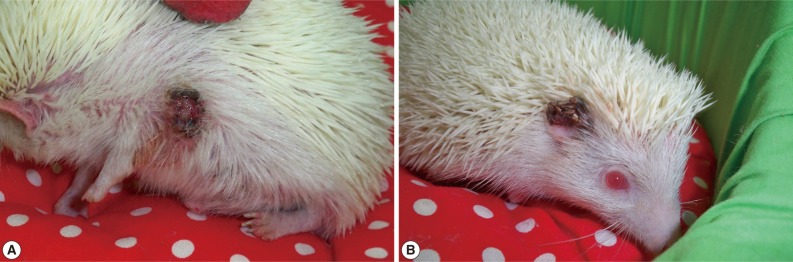
Fig. 2Light micrographs of various developmental stages of Caparinia tripilis. (A) Embryonated eggs. (B) Empty egg shells. (C) Ventral view of a larva. (D) Ventral view of a protonymph. (E) Ventral view of a deutonymph male. (F) Dorsal view of a pubescent female. (G) Ventral view of an adult male. (H) An attachment pair. Adult male above and pubescent female below. (I) Ventral view of an ovigerous female (adult female) containing an egg. Egg, larvae, protonymph and deutonymph do not show sexual dimorphism except for the pubescent female (female deutonymph) which has a couple of copulatory tubercles at the posterior end of the body (F, arrowhead). Bar=200 µm.

Fig. 3Posterior end of adult male mites of the Family Psoroptidae. (A) Caparinia tripilis showing trilobate laminate projection on each side, each lobe with a long seta. The quadrilateral space is wider than its length (double-sided arrow). (B) Otodectes cynotis does not have projections. (C) Chorioptes texanus showing V-shaped space between the 2 posterior projections. Bar=100 µm.
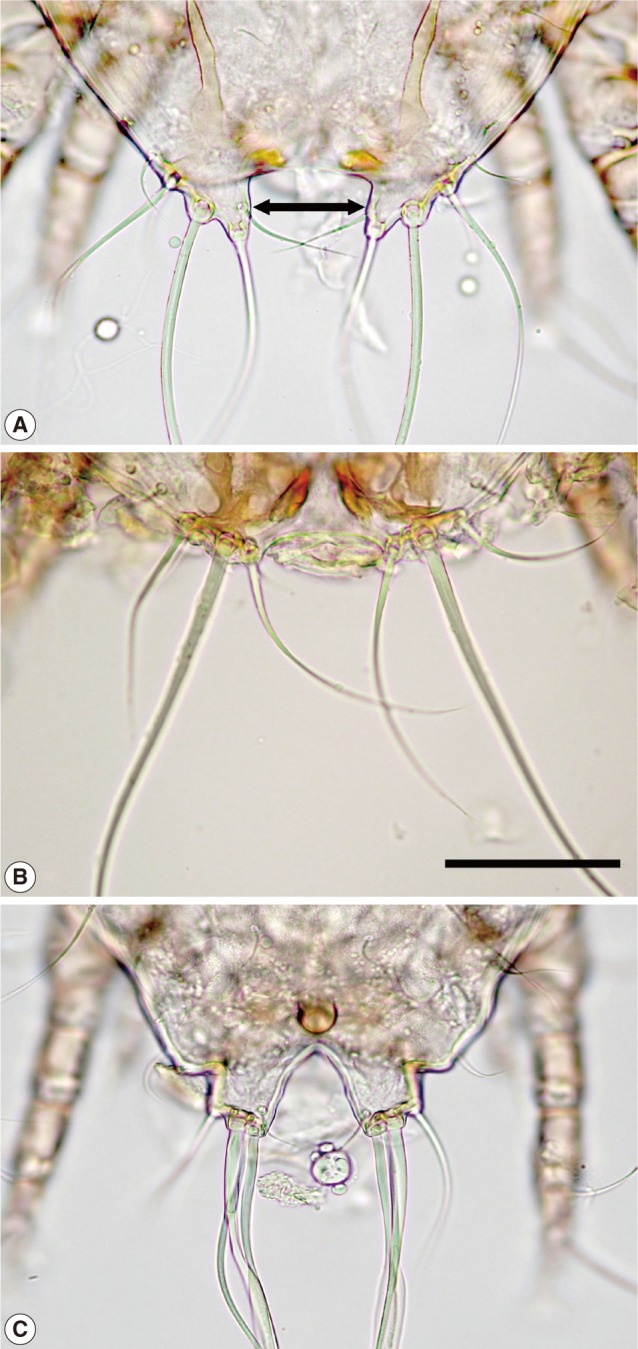
Fig. 4Posterior dorsal scutum of Caparinia tripilis adult male is wider than its length (arrows). Bar=100 µm.
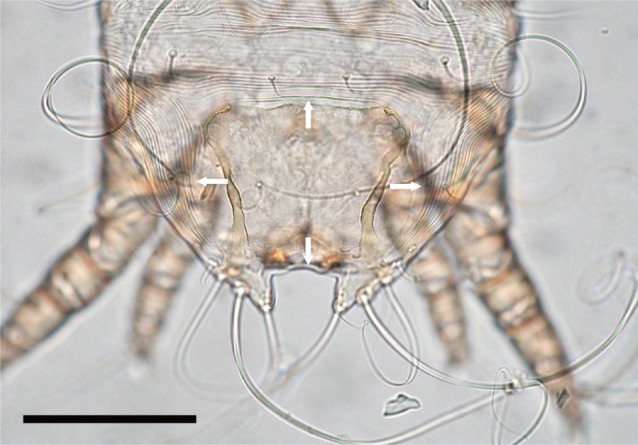
Fig. 5Dorsal surface of Caparinia tripilis adult female. Humeral seta is inserted in an oval-shaped scutum (arrows). Bar=100 µm.
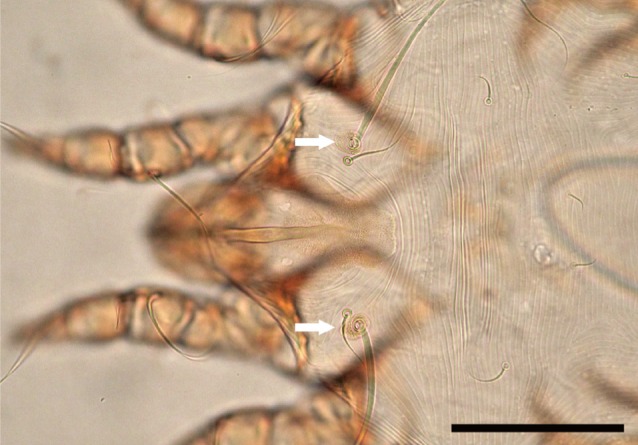
Table 1.Measurements of each life cycle stage of Caparinia tripilis isolated from the hedgehogs from Korea
Table 1.
|
Egg |
Larvae |
Protonymph |
Deutonymph |
Pubescent femalea
|
Adult male |
Adult female |
|
Length |
158.5 ± 4.7 |
190 ± 15.4 |
242.3 ± 24.8 |
255.7 ± 6.7 |
322.9 ± 21.6 |
313.6 ± 8.1 |
418.6 ± 33.4 |
|
(150-165) |
(175-220) |
(205-270) |
(250-270) |
(295-360) |
(300-320) |
(380-460) |
|
Width |
84.0 ± 11.3 |
135 ± 9.3 |
175.0 ± 21.7 |
170.7 ± 10.2 |
243.6 ± 24.3 |
240.5 ± 10.6 |
287.1 ± 28.7 |
|
(70-100) |
(125-155) |
(140-210) |
(160-190) |
(205-280) |
(230-260) |
(250-320) |