Abstract
This paper describes a new species of chigger mite (Acari: Trombiculidae), Gahrliepia cangshanensis n. sp., from rodents in southwest China. The specimens were collected from Yunnan red-backed voles, Eothenomys miletus (Thomas, 1914), and a Chinese white-bellied rat, Niviventer confucianus (Milne-Edwards, 1871) in Yunnan Province. The new species is unique mainly in its number of dorsal setae (n=21), and it has the following features: fT (formula of palpotarsus)=4B (B=branched), fp (formula of palpal seta)=B/N/N/N/B (N=naked), a broad tongue-shaped scutum with an almost straight posterior margin, and 17 PPLs (posterior posterolateral seta) with a length of 36-43 µm. This chigger mite may also infect other rodent hosts and may be distributed in other localities.
-
Key words: Gahrliepia cangshanensis, new species, chigger mite, Acari, Trombiculidae, China
INTRODUCTION
Chigger mites (trombiculid mites) belong to the family Trombiculidae in the subclass Acari of the class Arachnida. More than 3,000 species have been recorded globally, and more than 400 species have been recorded in China [
1]. In the life cycle of chigger mites, only their larvae are parasitic. Larvae are ectoparasites on other animals [
1-
4]. Specimens of chigger mites are mostly collected from their hosts; therefore, the taxonomic identification is based mainly on larval characteristics [
5-
8].
Ewing [
9] first reviewed the superfamily Trombiculidae Ewing, 1944, which included 2 families; Trombiculidae Ewing, 1929 and Leeuwenhoekiidae Womersley, 1944 [
1]. In China, the family Trombiculidae consists of the subfamily Trombiculinae Ewing, 1929 and Gahrliepiinae, 1952, whereas Leeuwenhoekiidae consists of the subfamily Leeuwenhoekiinae Womersley, 1944 and Apoloniinae Wharton, 1947. The subfamily Gahrliepiinae includes the genera
Walchia Ewing, 1931,
Schoengastiella Hirst, 1915,
Gahrliepia Oudemans, 1912,
Intermedialia Yu et al., 1979, and
Wuella Wang, 1997 [
10]. In the process of identifying specimens of chigger mites collected from small mammals in Yunnan Province, southwest China, we found a new species of the genus
Gahrliepia. This paper describes this new chigger mite species,
Gahrliepia cangshanensis n. sp.
MATERIALS AND METHODS
The specimens were collected from the Yunnan red-backed vole (also called the Yunnan Chinese vole or large oriental vole) Eothenomys miletus (Thomas, 1914) in the family Cricetidae (order Rodentia), and the Chinese white-bellied rat (also called the white-bellied rat or sulphur bellied rat) Niviventer confucianus (Milne-Edwards, 1871) in the family Muridae (order Rodentia). These 2 rodent hosts, together with other small mammals in the order Soricomorpha and Scandentia, were trapped in the Cangshan Mountains (100°11' E, 25°36' N, 2,250 m) in Yunnan Province, southwest China, between April and May in 2010. Small mammals were trapped in 3 different habitats; 1) farmlands, 2) woodlands, and 3) scrublands using live-traps (Guixi Mousetrap Apparatus Factory, Guixi, Jiangxi, China). Live-traps were set in the evening and then checked the following morning. The trapped small mammals were placed in white cloth bags and brought to the laboratory, and then chigger mites were collected from them. In the laboratory, small mammals were placed in a plastic pail and anesthetized with ether. All research was approved by the local wildlife service authority in Dali Prefecture, Yunnan Province, China. The capture and use of animals was also approved by the Institute of Pathogens and Vectors, Dali University.
Chigger mites, together with other ectoparasites (fleas, sucking lice, and gamasid mites), were collected from each host over a large white plate [
1-
13]. Specifically, chigger mites were collected from the auricles and external auditory canals of each host's ears, where chigger larvae are usually attached, using a curette and a lancet [
1,
3]. Chigger mites were stored individually in vials containing 70% ethanol [
1,
10-
12]. Between examining each small mammal, the white plate and other instruments were cleaned using disposable paper towels to reduce the chance of cross-contamination. Living small mammal hosts were identified based on external morphology, measurements, and visible characters of dentition. Small mammals were sacrificed, and their species identity was determined by examining their skulls in cases where we could not determine the species while they were alive [
14]. Chigger mites were mounted on glass slides in Hoyer's medium and were identified to species using a light microscope [
1,
3].
Specimens of the new chigger mite species were measured, photographed, and drawn from the microscope images. The terminology and nomenclature used in the morphological descriptions followed Wen et al. [
16-
18]. Voucher specimens of the new species, including the holotype and paratypes, were deposited in the specimen repository of the Institute of Pathogens and Vectors (Dali University) together with their representative small mammal hosts.
RESULTS
Overall, 379 of the small mammals that we trapped in the Cangshan Mountains were examined and identified to species. These small mammals belonged to 29 genera in the orders Rodentia, Soricomorpha, and Scandentia (
Table 1). A total of 6,466 chigger mites, consisting of 121 species, were collected from all the trapped small mammals. Of the 6,466 mites, 5 individual mites were identified as a new species,
Gahrliepia cangshanensis, n. sp. Four mites of the new species were collected from Yunnan red-backed voles (
E. miletus) and 1 mite was collected from the Chinese white-bellied rat (
N. confucianus). No specimens of the new species were collected from the remaining 27 species of small mammals.
DESCRIPTION
Gahrliepia cangshanensis n. sp. larva (Figs. 1-5)
Materials examined
The holotype, 1 larva, from the Yunnan red-backed vole, E. miletus, was collected in the Cangshan Mountains (100°11' E, 25°36' N, 2250 m) in Yunnan Province, southwest China. Of the 4 paratypes (4 larvae), 3 were collected from E. miletus, and 1 was collected from the Chinese white-bellied rat, N. confucianus, in the same region. The holotype and paratypes were deposited in the specimen repository of the Institute of Pathogens and Vectors, Dali University, Yunnan Province, China.
Holotype description
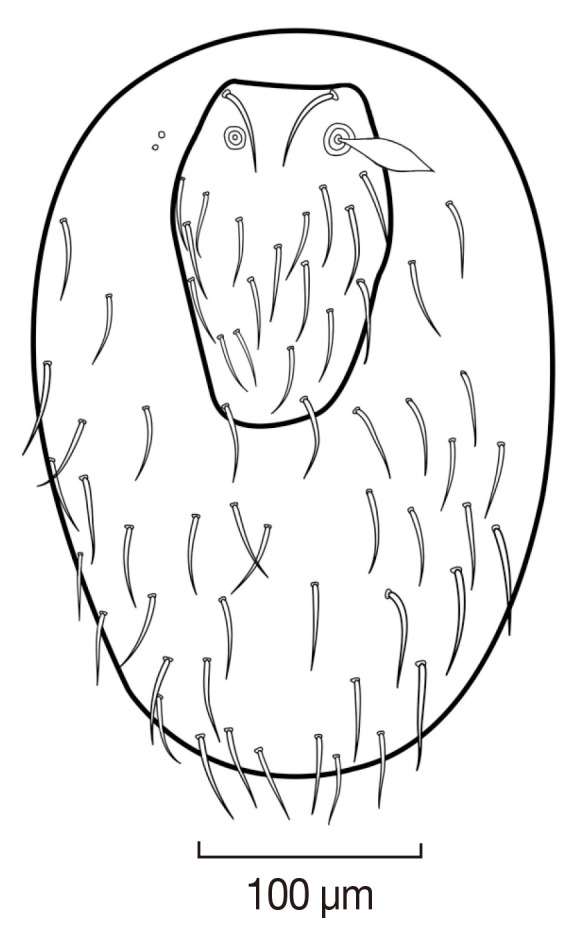
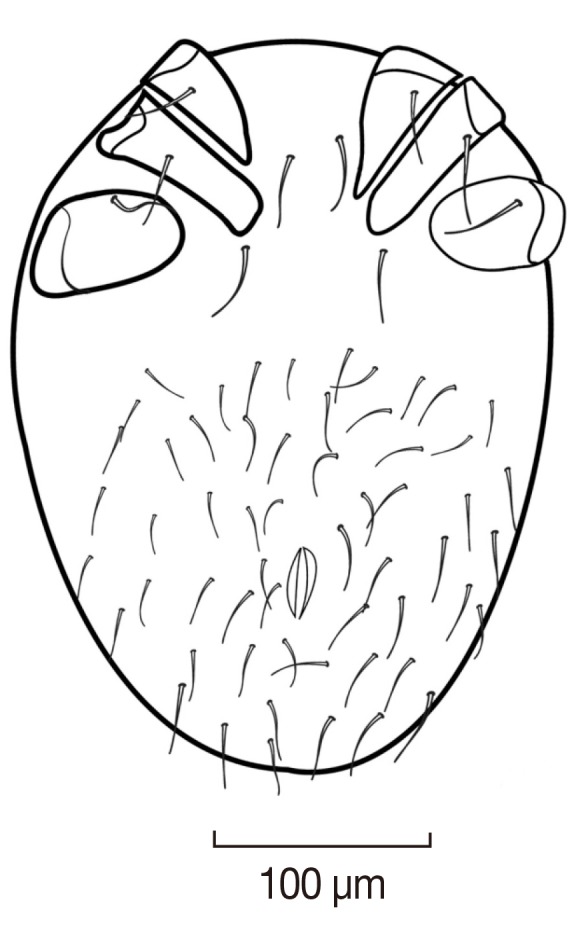
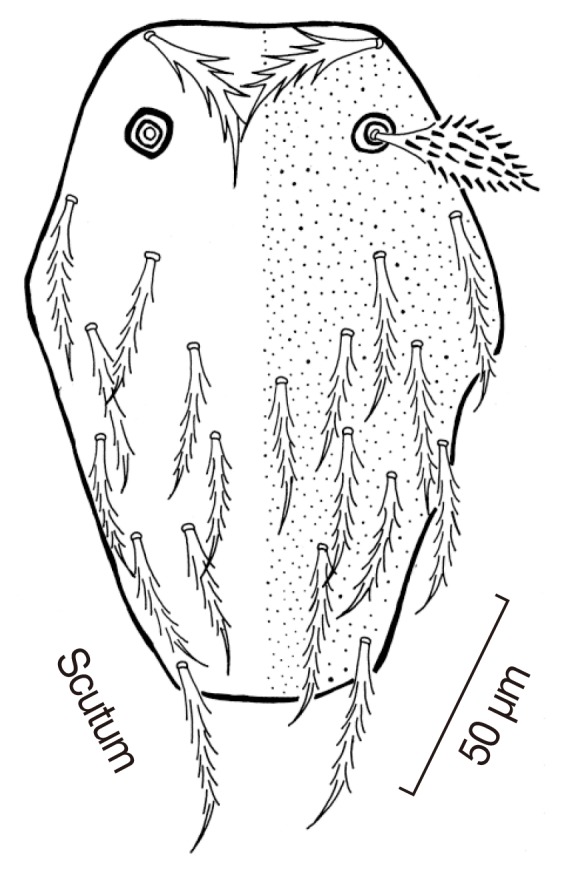
Idiosoma: Medium sized (232.5×377.5 µm), partially engorged specimen; eyes 1 pair, 5 µm in diameter, free of cuticle; humeral setae 1 pair, length 44-45 µm; approximately 40 dorsal idiosomal setae, length 34-45 µm, arranged in irregular rows; sterna setae 2 pairs, formula of sternal seta (fst)=2.2; anterior length 42 µm; formula of dorsal setation (fDS)=2.2.6.4.10.6.4.4.2; posterior length 36 µm; 58 ventral setae (VS), length 22.5-37.5 µm; 40 dorsal setae (DS), length 28-43 µm; total idiosomal tetae 118.
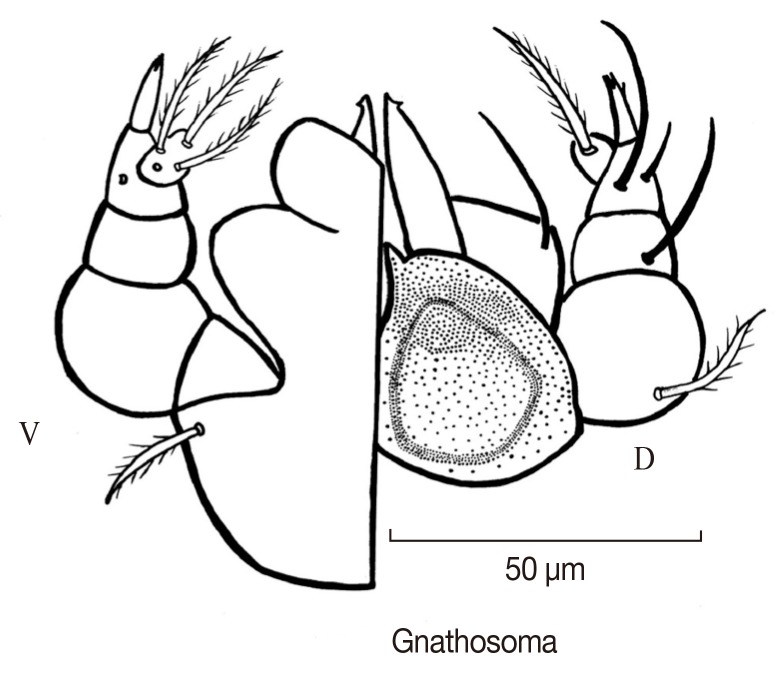
Gnathosoma: Formula of palpal seta (fp)=B/N/N/N/B (B means "branched", while N means "naked"); formula of palpotarsus (fT)=4B; palpal claw 3-pronged, length 12 µm; galeala N; cheliceral blade (length 32 µm), broad at base, with serrated tricuspid cap; gnathobase punctuate, bearing 1 barbed setae.
Scutum: broad and tongue-shaped, with an almost straight posterior margin. SD/PW=158 µm/90 µm=1.76; posterolateral angles rounded. PPLs=17 in numbers. SB near mid-point of AP; PL>AL. Sensillae clavate with barbs on shaft and expanded distal portion. Scutal measurements of the holotype and 2 paratypes with means in parentheses: AW (53 µm); PW (90 µm); SB (52 µm); ASB (26 µm); PSB (132 µm); AP (42 µm); AL (37 µm); PL (41 µm); sensilla (34×15 µm). Here, SD=scutum distance; PW=posterolateral seta width; SB=sensillary base distance; AP=distance between anterolateral seta and posterolateral seta; PL=posterolateral seta; AL=anterolateral seta; AW=anterolateral seta width; ASB=antero-sensillary base distance; PSB=postero-sensillary base distance.
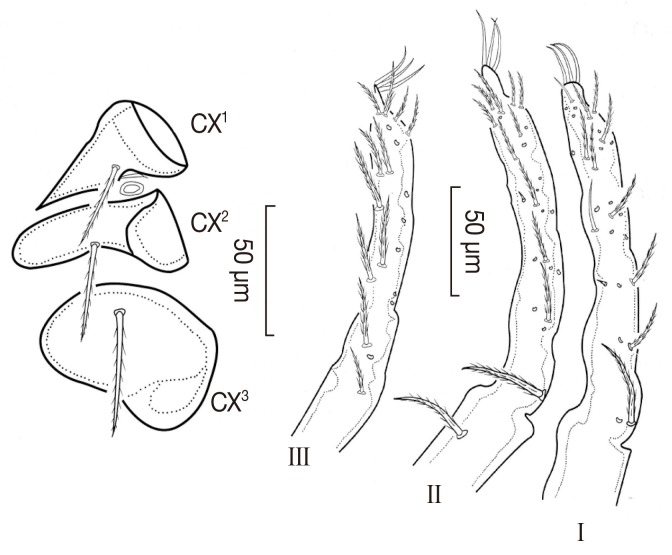
Legs: Leg I is 7-segmented. Legs II and III are 6-segmented, terminating in a pair with a claw and claw-like empodium. Leg I: 240-248 µm; coxa with 1 branched seta (1B); trochanter 1 B; basifemur 0; telofemur 5B; genu 4B, 2 genualae, microgenuala; tibia 8B, 1 tibialae; tarsus (58×20 µm), 12B, 1 spur. Leg II: SIF=4B-N-3-1100-0000; fP=B/N/N/N/B; IP=841-863 µm. Fsp=7.6.6; Oc=1/1; fcx=1.1.1; fst=2.2; fDS=40; fSc: 2AL+2PL+17PPL=21; NDV=118. Here, IP=index of poda; SIF=synthetic identification formula; fP=formula of poda; fsp=formula of segmented poda; Oc=ocellus; fcx=formula of coxa; fst=formula of sternal seta; fDS=formula of dorsal setation; fSc=formula of scutum setation; P=poda; NDV=numbers of dorsal and ventral setae.
The measurements (means; µm) of the holotype and 4 paratypes are shown in
Table 2.
Diagnosis
The new species is mainly characterized by the 21 dorsal setae. It has the following features: the scutum length is longer than the breadth, it neither has an anteromedian projection nor an anteromedian seta. Leg I is 7-segmented, legs II and III are 6-segmented. On the scutum, no inter-medial setae between sensilla. IP=500-1,120 µm. The scutum is broad and tongue-shaped, with almost straight posterior margin. fT=4B. The sensillae clavate has barbs on the shaft and an expanded distal portion.
Distribution
Larvae of the new species was found in 2 species of rodents (E. miletus and N. confucianus) in the Cangshan Mountains of Yunnan Province, southwest China.
Remarks
The color of a living larvae is unknown. Idiosoma subrotund. The scutum is obviously seen in the dorsal view. AL and PL pinnae are sparse, PPLs with thin and sharp-tipped barbs. Sensillae fusiform with large proximal crunobe. Ocellus (Oc) are small. DS=40 in numbers and VS=58 in range. fP=B/N/N/N/B, chelostyle with usual tricuspid cap, dorsal and ventral teeth. Leg solenidiontaxy normal.
DISCUSSION
The new species (
Gahrliepia cangshanensis n. sp.) has the common features of the genus
Gahrliepia. Specifically, its scutum lacks anteromedian seta and anteromedian projections. The scutum is broad and tongue-shaped, with an almost straight posterior margin. Leg I is 7-segmented, whereas legs II and III are 6-segmented. However, the new species also has some prominent differences from other species of
Gahrliepia. The unique features of this new species include no inter-anteromedian seta on the scutum, 21 dorsal setae [
1,
9,
16-
19], and fT=4B.
In this paper, the new species was collected only from 2 species of rodents (E. miletus and N. confucianus) in the Cangshan Mountains in Yunnan Province. Since our collection was confined to this limited area and only 5 individuals of the new species were collected, we are unable to know how many hosts can harbor this new species and its geographical distribution at present.
National Natural Science Foundation of China81160208
National Natural Science Foundation of China81260259
Notes
-
We declare no conflict of interest related with this study.
ACKNOWLEDGMENTS
The project was supported by grants provided by the National Natural Science Foundation of China to Xian-Guo Guo (no. 81160208, 81260259). We would like to offer our sincere thanks to Prof. Xue-li Qiu and Dr. Yi Yan for their help in many ways.
References
- 1. Li JC, Wang DQ, Chen XB. Trombiculid mites of China: study on vector and pathogen of tsutsugamushi disease. Guangzhou, China. Guangdong Science and Technology; 1997. p. 1-570 (in Chinese).
- 2. Daniel M, Stekol'nikov AA. Chigger mites (Acari: Trombiculidae) new to the fauna of Cuba, with the description of two new species. Folia Parasitol (Praha) 2003;50:143-150.
- 3. Guo XG, Qian TJ, Men XY, Dong WG, Shi WX, Wu D. Preliminary analysis of chigger communities associated with house rats (Rattus flavipectus) from six counties in Yunnan, China. Syst Appl Acarol 2006;11:13-21.
- 4. Daniel M, Stekol'nikov AA. Chigger mites (Acari: Trombiculidae) from Makalu region in Nepal Himalaya, with a description of three new species. J Med Entomol 2009;46:753-765.
- 5. Ma Y, Yang XZ. Two new species of the family Trombiculidae from Qinghai Province, China (Acari: Trombiculidae). Acta Zool Sin 2002;27:740-744. (in Chinese).
- 6. Ma Y, Yang XZ. A new species of the genus Neotrombicula from Qinghai, China (Acari: Trombiculidae). Acta Zool Sin 2003;28:461-463. (in Chinese).
- 7. Feng YL, Ma Y, Bai XL. A new species of the genus Leptotrombidium from Ningxia, China (Acari: Trombiculidae). Acta Zool Sin 2008;33:753-755. (in Chinese).
- 8. Wu KM, Li C. A new species of the genus Neotrombicula from Qinghai, China (Acari: Trombiculidae). Acta Zool Sin 2001;26:35-37. (in Chinese).
- 9. Ewing HE. Notes on the taxonomy of the trombiculid mites. Proc Biol Soc Wash 1944;57:101-104.
- 10. Wang DQ. A new genus of trombiculid mite of the subfamily Gahrliepiinae (Acari: Trombiculidae). Acta Entomol Sin 1997;40:314-316. (in Chinese).
- 11. Durden LA, Banks CW, Clark KL, Belbey BV, Oliver JH Jr. Ectoparasite fauna of the eastern woodrat, Neotoma florinana: composition, origin, and comparison with ectoparasite fauna of western woodrat species. J Parasitol 1997;83:374-381.
- 12. Durden LA, Ellis BA, Banks CW, Crowe JD, Oliver JH Jr. Ectoparasites of gray squirrels in two different habitats and screening of selected ectoparasites for Bartonellae. J Parasitol 2004;90:485-489.
- 13. Zhan YZ, Guo XG, Speakman JR, Dong WG. Abundances and host relationships of chigger mites in Yunnan Province, China. Med Vet Entomol 2013;27:194-202.
- 14. Huang LQ, Guo XG, Speakman JR, Dong WG. Analysis of gamasid mites (Acari: Mesostigmsta) associated with the Asian house rat, Rattus tanezumi (Rodentia: Muridae) in Yunnan Province, Southwest China. Parasitol Res 2013;112:1967-1972.
- 15. Andrew TS, Xie Y. A guide to the mammals of China. Hunan, China. Hunan Education; 2009. p. 7-269 (in Chinese).
- 16. Wen TH. Sand mites of China. Shanghai, China. Shanghai, Xuelin Publishing House; 1984. p. 1-370 (in Chinese).
- 17. Wen TH. Revision on sand-mite tribe Gahrliepiini sensu Wen (Acariformes: Walchiidae). Syst Appl Acarol 2000;5:157-172.
- 18. Wen TH, Gui YY. Redescriptions of two sibling species of the genus Gateria recorded in Zhejiang province, China (Acariformes: Walchiidae). Syst Appl Acarol 2000;5:177-182.
- 19. Deng GF. A new species of Gahrliepia from Sichuan, China. Acta Zool Sin 1962;3:417-420. (in Chinese).
Fig. 1Dorsal idiosoma of Gahrliepia cangshanensis n. sp. (larva).

Fig. 2Ventral idiosoma of Gahrliepia cangshanensis n. sp. (larva).
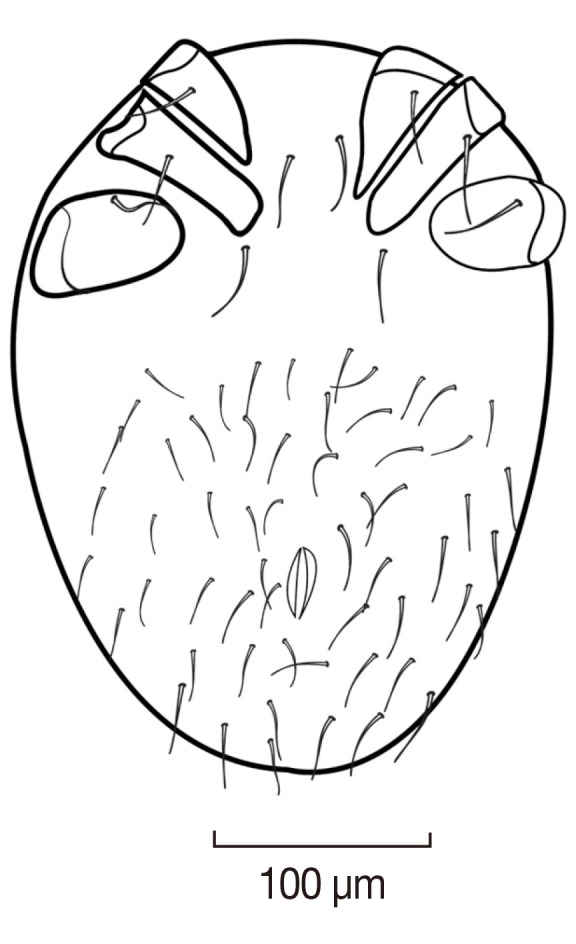
Fig. 3The legs of Gahrliepia cangshanensis n. sp. (larva). I, II, and III: distal segments of leg 1, leg 2, and leg 3. Cx1-Cx2-Cx3: the coxa 1, coxa 2, and coxa 3 of the legs.
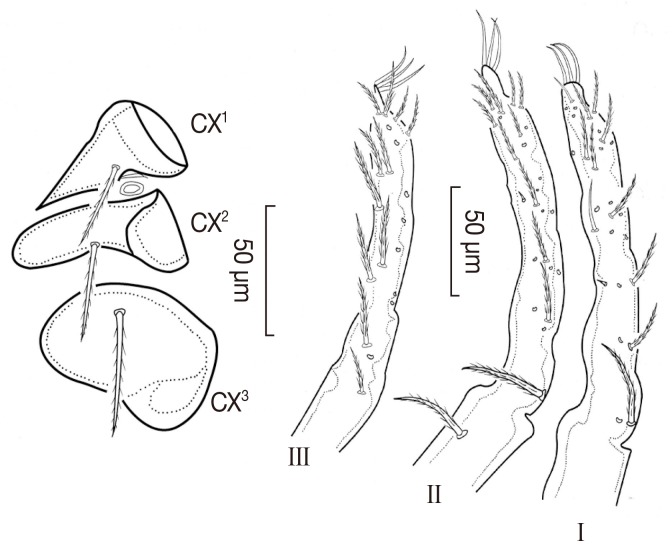
Fig. 4The gnathosoma (Gn) of Gahrliepia cangshanensis n. sp. (larva). D, dorsal view; V, ventral view.
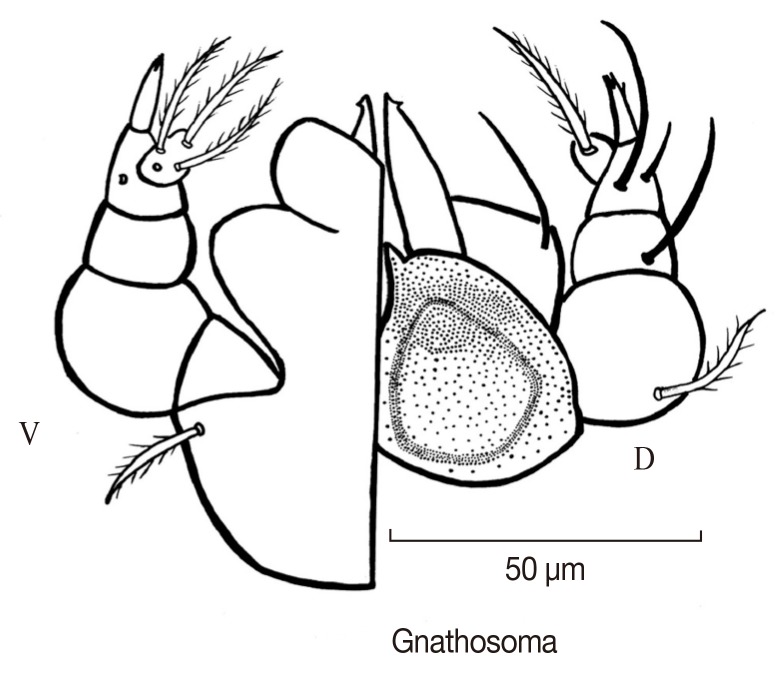
Fig. 5The scutum (dorsal shield) of Gahrliepia cangshanensis n. sp. (larva).
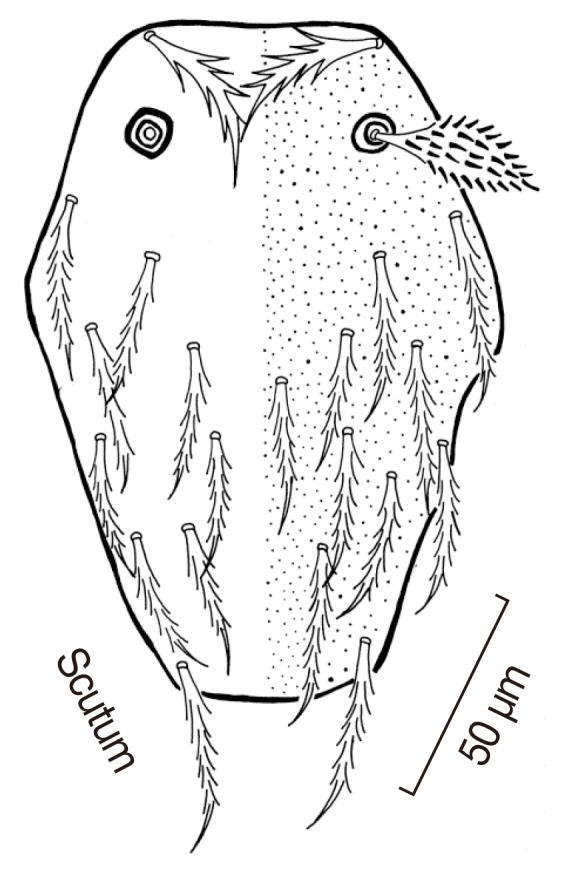
Table 1.List of small mammal species from the Cangshan Mountains in Yunnan Province of southwest China that were examined for ectoparasites between May and August 2010
Table 1.
|
Order |
Species name (total 29 species) |
|
Rodentia (14 species) |
Mus pahari Thomas, 1916; Rattus norvegicus (Berkenhout, 1769); Apodemus ilex Thomas, 1922; Apodemus chevrieri Milne-Edwards, 1868; Apodemus latronum Thomas, 1911; Niviventer excelsior (Thomas, 1911); Niviventer confucianus (Milne-Edwards, 1871); Niviventer fulvescens (Gray, 1847); Eothenomys custos (Thomas, 1912); Eothenomys miletus (Thomas, 1914); Eothenomys olitor (Thomas, 1911); Eothenomys eleusis (Thomas, 1911); Berylmys bowersi (Anderson, 1879); Dremomys pernyi (Milne-Edwards, 1867). |
|
Soricomorpha (14 species) |
Scaptonys fusicaudus (Milne-Edwards, 1872); Nasillus gracilis (Thomas, 1911); Anourosorex squamipes (Milne-Edwards, 1872); Blarinella guadraticauda (Milne-Edwards, 1872); Crocidura dracula (Thomas, 1912); Crocidura horsfield (Thomas, 1856); Crocidura attenuata (Milne-Edwards, 1872); Sorex excelsus (Allen, 1923); Sorex radulus (Thomas, 1922); Sorex bedfordiae (Thomas, 1911); Sorex cylindricauda (Milne-Edwards, 1871); Soriculus leucops (Horsfield, 1855); Soriculus nigrescens (Gray, 1842); Soriculus macrurus (Hodgson, 1863). |
|
Scandentia (1 species) |
Tupaia belangeri (Wangner, 1841). |
Table 2.The measurements (means) of 1 holotype and 4 paratypes (µm)
Table 2.
|
No. |
AW |
PW |
PPW |
SB |
ASB |
PSB |
SD |
AP |
AL |
PL |
PPL |
Sensilla |
|
1 |
53 |
90 |
53 |
52 |
26 |
132 |
158 |
42 |
37 |
49 |
41 |
3+32+15 |
|
2 |
52 |
85 |
55 |
53 |
33 |
145 |
178 |
43 |
13+ |
× |
× |
× |
|
3 |
54 |
90 |
55 |
53 |
25 |
139 |
164 |
40 |
39 |
50 |
46 |
× |
|
4 |
50 |
83 |
55 |
50 |
24 |
131 |
155 |
40 |
39 |
52 |
48 |
× |
|
5 |
52 |
96 |
71 |
52 |
23 |
132 |
155 |
41 |
42 |
51 |
38 |
× |