Abstract
This study was designed to investigate the incidence of ectoparasite infestation among stray dogs in Gwang-ju City, Republic of Korea. A total of 103 stray dogs collected in the Animal Shelter of Gwang-ju City from November 2003 to August 2005 were investigated in this study. Ectoparasites of one or more genera were detected in 45.6% (47 / 103) of the dogs examined for dermatologic lesions and/or skin scrapings (from 3-5 affected areas). Otodectes cynotis was found to be the most frequent parasite (22.%, 23 / 103), followed by Sarcoptes scabiei var canis (19.4%, 20 / 103), Ctenocephalides canis (6.8%, 7 / 103), Demodex canis (4.9%, 5 / 103), and Trichodectes canis (1.0%, 1 / 103). Monospecific infestation was found in 83.0% (39 / 47) of the affected dogs, whereas concurrent infestations with 2 or more ectoparasites per animal were found in 17.0% (8 / 47) of the affected dogs. Trichodectes canis is reported for the first time in the Republic of Korea. Dogs less than 1 yr old were more heavily infected than other age groups (66.7%), and small-sized dogs of less than 3 kg body weight were more heavily infected than larger dogs (41.7%).
-
Key words: Trichodectes canis, Otodectes cynotis, Sarcoptes scabiei var. canis, Ctenocephalides canis, Demodex canis, Stray dog, Ectoparasite, Animal shelter, Korea
INTRODUCTION
Ectoparasites are the common and pivotal cause of skin diseases in dogs. They can transmit various diseases and can cause hypersensitivity disorders in animals. They may also cause life-threatening anemia in young and / or debilitated animals [
1]. Some ectoparasites of pet animals, notably fleas, can infest humans and may lead to the development of dermatitis and transmit vector-borne diseases.
The most frequent canine ectoparasites reported in the Republic of Korea are
Demodex canis,
Sarcoptes scabiei var.
canis, and
Otodectes cynotis [
2,
3]. Canine demodiciosis caused by
Demodex canis could occur either in a localized or a generalized form. Sarcoptic mange is a highly contagious non-seasonal and pruritic skin condition caused by infestation with
S. scabiei var.
canis, a burrowing mite, which is transmitted by direct contact between dogs. Otoacariosis, caused by
O. cynotis, is characterized by irritation, rubbing, ear twitching, scratching, and head shaking. Because older animals may acquire immunity, puppies appear to be most susceptible to
O. cynotis [
4]. Human infestation with
O. cynotis has also been reported [
5]. In addition to occurring in Korea, the aforementioned ectoparasites have a worldwide distribution [
6-
9].
Various studies have found that
Ctenocephalides felis,
Ctenocephalides canis, and
Pulex irritans, are the 3 most common flea species on dogs. However, the prevalence of these species varies in different geographic areas;
C. felis being the most prevalent species in London [
10], Egypt [
11], and Denmark [
12], while
C. canis was the dominant species in dogs in rural parts of the United Kingdom [
13], Dublin [
14], and Australia [
15].
P. irritans was the prevalent species in dogs of the southern part of USA [
16], and this species was also commonly found in dogs in Hawaii [
17]. In the Republic of Korea,
C. canis was reported by Tipton et al. [
18]; however, the other species have not been reported previously.
The Gwang-ju Animal Shelter of Chonnam National University was established in 2001 and is the first humane shelter in the Republic of Korea. To the best of our knowledge, this is the first report examining the prevalence of various ectoparasites infesting stray dogs in the Republic of Korea. In the present investigation, ectoparasites were collected from 103 naturally infested dogs from the Gwang-ju Animal Shelter over a period of 10 months. The age, sex, weight, and breed of the dogs were recorded.
MATERIALS AND METHODS
Animals
Between November 2003 and August 2005, a total of 103 stray dogs captured within the boundary of Gwang-ju City were examined for the presence of ectoparasites. The sex, age (estimated by dental examination), body weight, breed, and the locality in Gwang-ju, where the dogs were found, were recorded for each dog.
Parasitological examination
Fleas were collected by combing the coat of the dog with a flea comb. The presence of lice was detected either by visual examination or by brushing the fur. Identification of fleas and lice was performed on the basis of the keys provided by Macy and Berntzen [
19] and Wall and Shearer [
20]. Identification of mites was performed on the basis of descriptions provided by Whitlock [
21] in addition to the keys provided by Macy and Berntzen and Wall and Shearer. Three to five samples were collected from the head, pinna, ear canal, thoracic-abdominal areas, elbow or paws of each animal by skin scraping. Areas of the skin with dermatologic lesions were moistened with mineral oil and scraped with a scalpel blade until capillary bleeding was visible. The scrapings were placed on glass slides with a drop of 10% KOH solution and were examined microscopically for the presence of mites. The presence of 1 mite at any developmental stage of dogs examined was considered to be a positive result.
RESULTS
Among the 103 stray dogs examined, 23 were found to be infested with
O. cynotis (22.3%), while
S. scabiei var.
canis,
D. canis,
C. canis, and
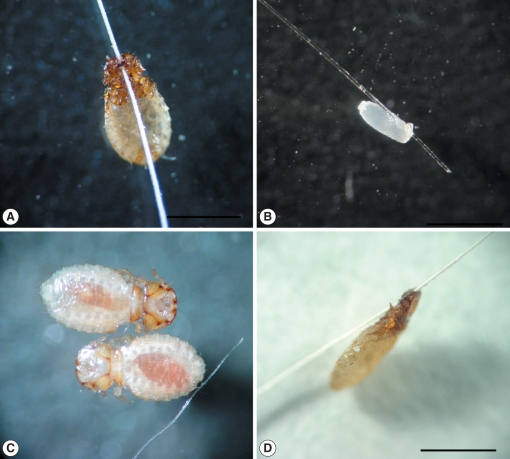
T. canis (
Table 1;
Fig. 1) were found on 20 (19.4%), 5 (4.9%), 7 (6.8%), and 1 (1.0%) dogs, respectively. Seven dogs (6.8%) were infested with both
S. scabiei var.
canis and
O. cynotis, while 1 dog harbored 3 different species,
C. canis,
S. scabiei var.
canis, and
O. cynotis. The majority of the dogs examined were mixed-breeds (48.5%), and 10 (20%) were infested with ectoparasites (
Table 2). Fifty-two out of 103 dogs (50.5%) were males, and 40 (38.8%) were females (
Table 3). Dogs less than 1 yr old were more commonly affected than older dogs (
Table 4). Small-sized dogs of less than 3 kg in weight were more frequently affected than larger body weight groups (41.7%,
Table 5). The highest number of affected dogs was found in Seo-gu area of the city (
Table 6), where 6 of 17 dogs were found to be infested with 1 or more ectoparasites.
DISCUSSION
The Gwang-ju Animal Shelter in the City of Gwang-ju is the first animal shelter established in the Republic of Korea. Between 2001 and 2004, a total of 1,857 stray dogs were cared for at the shelter; among which 890 dogs were adopted, 76 dogs returned to their homes, 352 dogs died, and 393 dogs were euthanized. Although several reports have documented ectoparasite infestations among dogs in this country [
2,
22-
24], this is the first investigation of various ectoparasites that infest stray dogs of the Republic of Korea.
In the Republic of Korea,
O. cynotis was reported by Chang et al. [
2] as the most frequent ectoparasite infesting pet dogs. In this study, we also found that ear mites (23 dogs, 22.3%) and sarcoptic mange (20 dogs, 19.4%) were the most common ectoparasites among stray dogs of Gwang-ju City. In several studies,
D. canis has been reported as the most frequent infestation [
6,
8,
9]. However, the current study found that the prevalence of
D. canis infestation was only 4.9% (5 / 47). This difference could not be easily explained, but may be attributed to epidemiological factors, such as weather, seasonal variations, geographical location, innate resistance, and particularly the age of the animals examined [
6]. Since
D. canis is considered to be a part of the normal fauna of the canine skin and is present in small numbers in most healthy dogs [
25], additional diagnostic procedures, such as trichography or skin biopsy may be required to obtain an accurate estimation of the mite infestation.
Sarcoptes scabiei var.
canis was found to be the second most abundant ectoparasite in this study (19.4%, 20 / 47). Chang et al. [
2] found that
S. scabiei var.
canis had a lower prevalence than
O. cynotis in the Republic of Korea, a finding which supported our results. Many dogs at the Shelter showed the typical signs of mange mite infestation, such as pruritis, papules, and alopecia. Therefore, it is speculated that more dogs might have been infested with
S. scabiei var.
canis than reported in this study.
In the present study, fleas and lice were found in 5.8% (7 / 47) and 0.97% (1 / 47) of the dogs examined. Studies from various parts of the world indicated that
C. felis,
C. canis, and
P. irritans are the most commonly occurring flea species in dogs and that dogs are regarded as the primary host for these 3 species. In the Republic of Korea,
C. canis was previously reported only once by Tipton et al. [
18]. However, the other species have not been previously reported. It was reported that
C. canis was the dominant species in Dublin [
14], rural England [
13], and Australia [
15]. However, Harman et al. [
26] reported that
C. canis was not identified among the dogs examined for fleas in Florida.
Infestation of dogs with lice, including
T. canis, has never been reported in the Republic of Korea. We found lice on only 1 dog, although we speculate that a higher infestation rate might be among stray dogs if more dogs and animal shelters were involved in the investigation. On the basis of the description of Wall and Shearer [
20], the species was identified as
T. canis, a biting louse.
Although utilization of an otoscope or cotton-tipped swab for the diagnosis of ear mite and examination of vellus hair for the sarcoptic mange might have increased the detection rates of those mites, only the skin scraping technique was used in this study. Adding several drops of mineral oil to the area to be scraped, the skin scraping technique to a depth that blood begins to ooze is considered to be a standard procedure for the diagnosis of mites [
27].
In previous studies, it was stated that dogs less than 1 yr old are more susceptible to ectoparasite infestations [
6,
28,
29], owing to their constant exposure to carrier mothers [
30]. Our results agree with these results in that 6 out of 9 dogs were affected by 1 or more ectoparasites. Small-sized dogs of less than 3 kg body weight were more affected than larger body weight groups. This finding may be related to age, because most of the affected animals of this group were less than 1 yr old.
In the present study, we found that the prevalence of ectoparasites was more frequent in male (26.9%, 14 / 52) than female (17.5%, 7 / 40) dogs. This contrasts to the reports by Nayak et al. [
6] and Rodriquez-Vivas et al. [
9], who suggested that both sexes are equally susceptible.
Among the 26 ectoparasite positive dogs, the highest involvement was recorded in Seo-gu (35.3%) 6 / 17, followed by Nam-gu, Buk-gu, Dong-gu, and Gwangsan-gu, in which the occurrence was 26.7% (4 / 15), 25.8% (8 / 31), 0% (0 / 10) and 0% (0 / 6), respectively. This result, however, does not appear to represent a true distribution profile of ectoparasite infestations of stray dogs in Gwang-ju due to the limited number of dogs investigated.
The zoonotic nature of some ectoparasites found in this study could be regarded as a public health alert. The canine sarcoptic mange (
S. scabiei var.
canis) and the ear mite (
O. cycotis) can infest humans and cause pruritic skin lesions [
5], although another report indicated that
O. cynotis does not cause pruritic dermatoses in man [
3].
T. canis is highly host specific, but it can act as an intermediate host for the tapeworm,
Dipylidium caninum [
20] that may affect humans, especially children. Fleas not only act as intermediate hosts of tapeworms but also directly infest human beings. To prevent the possibility of continued transmission of ectoparasites from pet animals, practicing veterinarians should advice pet owners to pay attention to and be aware of ectoparasites of zoonotic importance. This may prove to be important from both the veterinary and public health standpoints.
References
Fig. 1
Trichodectes canis isolated from a stray dog. (A) an adult louse grasping the hair; (B) an egg attached to the hair; (C) 2 adult females; (D) lateral view of an adult louse. Bar represents 1 mm.

Table 1.Prevalence of ectoparasites in stray dogs (n = 103) of Gwang-ju City, Republic of Korea
Table 1.
|
Ectoparasite |
No. of positive dogs |
Prevalence (%) |
|
Demodex canis
|
5 |
4.9 |
|
Sarcoptes scabiei var. canis
|
12 (20)a
|
11.6 (19.4)a
|
|
Otodectes cynotis
|
15 (23)a
|
14.6 (22.3)a
|
|
Trichodectes canis
|
1 |
1.0 |
|
Ctenocephalides canis
|
6 (7)a
|
5.8 (6.8)a
|
|
S. scabiei var. canis + O. cynotis
|
7 |
6.8 |
|
C. canis + S. scabiei var. canis + O. cynotis
|
1 |
1.0 |
|
Total |
47 |
45.6 |
Table 2.Incidence of ectoparasites in stray dogs by breed
Table 2.
|
Beed |
No. of dogs |
No. of positive dogs |
Detection rate (%) |
|
Mixed-breed |
50 |
10 |
20 |
|
Shih tzu |
9 |
1 |
11.1 |
|
Yorkshire terrier |
6 |
2 |
33.3 |
|
Cocker spaniel |
5 |
1 |
20 |
|
Chihuahua |
4 |
4 |
100 |
|
Schunauzer |
3 |
1 |
33.3 |
|
Poodle |
3 |
0 |
0 |
|
Jindo dog |
2 |
0 |
0 |
|
Beagle |
2 |
1 |
50 |
|
Maltese |
2 |
1 |
50 |
|
Alaskan malamute |
1 |
0 |
0 |
|
Pekingese |
1 |
0 |
0 |
|
Miniature pinscher |
1 |
0 |
0 |
|
No record |
14 |
5 |
35.7 |
|
Total |
103 |
26 |
25.2 |
Table 3.Occurrence of ectoparasites in stray dogs by sex
Table 3.
|
Sex |
No. of dogs |
No. of positive dogs |
Detection rate (%) |
|
Male |
52 |
14 |
26.9 |
|
Female |
40 |
7 |
17.5 |
|
No record |
11 |
5 |
45.5 |
|
Total |
103 |
26 |
25.2 |
Table 4.Occurrence of ectoparasites in stray dogs by age
Table 4.
|
Age |
No. of dogs |
No. of positive dogs |
Prevalence (%) |
|
≥ 4 yr |
5 |
1 |
20.0 |
|
1-3 yr |
22 |
1 |
4.5 |
|
< 1 yr |
9 |
6 |
66.7 |
|
No record |
67 |
19 |
28.4 |
|
Total |
103 |
27 |
26.2 |
Table 5.Occurrence of ectoparasites in stray dogs by body weight
Table 5.
|
Body weight |
No. of dogs |
No. of positive dogs |
Prevalence (%) |
|
≥ 3 kg |
24 |
10 |
41.7 |
|
3.1-5 kg |
16 |
3 |
18.8 |
|
5.1-10 kg |
6 |
1 |
16.7 |
|
> 10.1 kg |
5 |
0 |
0 |
|
No record |
52 |
12 |
23.1 |
|
Total |
103 |
26 |
25.2 |
Table 6.Distribution of ectoparasite infestations in stray dogs by region
Table 6.
|
Region surveyed |
No. of dogs |
No. of positive dogs |
Prevalence (%) |
|
Seo-gu |
17 |
6 |
35.3 |
|
Dong-gu |
10 |
0 |
0 |
|
Buk-gu |
31 |
8 |
25.8 |
|
Nam-gu |
15 |
4 |
26.7 |
|
Gwangsan-gu |
6 |
0 |
0 |
|
No record |
24 |
8 |
33.3 |
|
Total |
103 |
26 |
25.2 |