Abstract
The seasonal abundance of horse and deer flies (family Tabanidae) was analyzed using Mosquito Magnet® traps at 5 sites located near/in the demilitarized zone, northern Gyeonggi-do, Republic of Korea from late April to early October for 4 consecutive years (2010-2013). A total of 2,999 horse and deer flies (tabanids) belonging to 5 genera and 20 species were collected. Chrysops mlokosiewiczi (90.9%) was the most frequently collected, followed by Haematopota koryoensis (4.8%) and C. suavis (1.0%). The remaining 17 species comprised only of 3.3% of all species collected. C. mlokosiewiczi demonstrated bimodal peak populations during mid-June and early August, while H. koryoensis demonstrated a unimodal peak during mid-July. Overall numbers of tabanids collected were influenced by the previous year’s winter temperatures and precipitation. Population abundance was influenced by habitat with most of tabanids collected from habitats near forested areas, followed by rice paddies, and a beef farm.
-
Key words: Horse fly, deer fly, seasonal abundance, Tabanidae, mosquito magnet trap, Korea
INTRODUCTION
Adult horse and deer flies, or tabanids (Diptera: Tabanidae), blood feed on wild/domestic animals and humans. They are serious pests wherever they occur, resulting in economic losses in the dairy and beef industries due to reduced milk and meat production. Tabanids pose a threat to animal health and hygiene because of their ability to transmit numerous bloodborne pathogens by mechanical transmission (e.g., equine infectious anemia, bovine leukosis, vesicular stomatitis, hog cholera, bacteria of anthrax and tularemia, and trypanosomes that cause surra) [
1,
2]. They also act as biological or mechanical vectors of helminth and bacterial infections among humans (e.g., African eye worm and tularemia), which are life-threating/damaging without treatment [
3].
In the Republic of Korea (ROK), many systematic studies of the family Tabanidae have been recorded, but there are few observations on their seasonal activity. Kim et al. [
4] reported data on the seasonal abundance of female tabanids in Jeollabuk-do, and listed 20 species with
Tabanus pallidiventris and
Tabanus amaenus being the most frequently collected. Hyun and Shin [
5] investigated the seasonal population dynamics of tabanid flies in Jeongeup-si, Jeollabuk-do, using emergence and Manitoba or cow bait traps, and reported 17 species, of which
T. amaenus and
T. pallidiventris were the most frequently collected. A survey using both New Jersey light traps and Mosquito Magnet traps in the northern part of Gyeonggi-do resulted in high numbers of
Chrysops mlokosiewiczi (as
C. vanderwulpi) and Haematopota sinensis during late June [
6].
The purpose of this survey was to identify the seasonal and population distributions of members of the family Tabanidae collected at United States (US) and ROK Army military installations/training sites and nearby villages in/near the demilitarized zone (DMZ) in the ROK.
MATERIALS AND METHODS
Collection sites
As part of the mosquito-borne disease surveillance program of the 65th Medical Brigade and in collaboration with the Public Health Command Region-Pacific, Mosquito Magnet
® traps were set at 5 sites in/near the DMZ, northern Gyeonggido, ROK, from late April-early October for 4 successive years (2010-2013) (
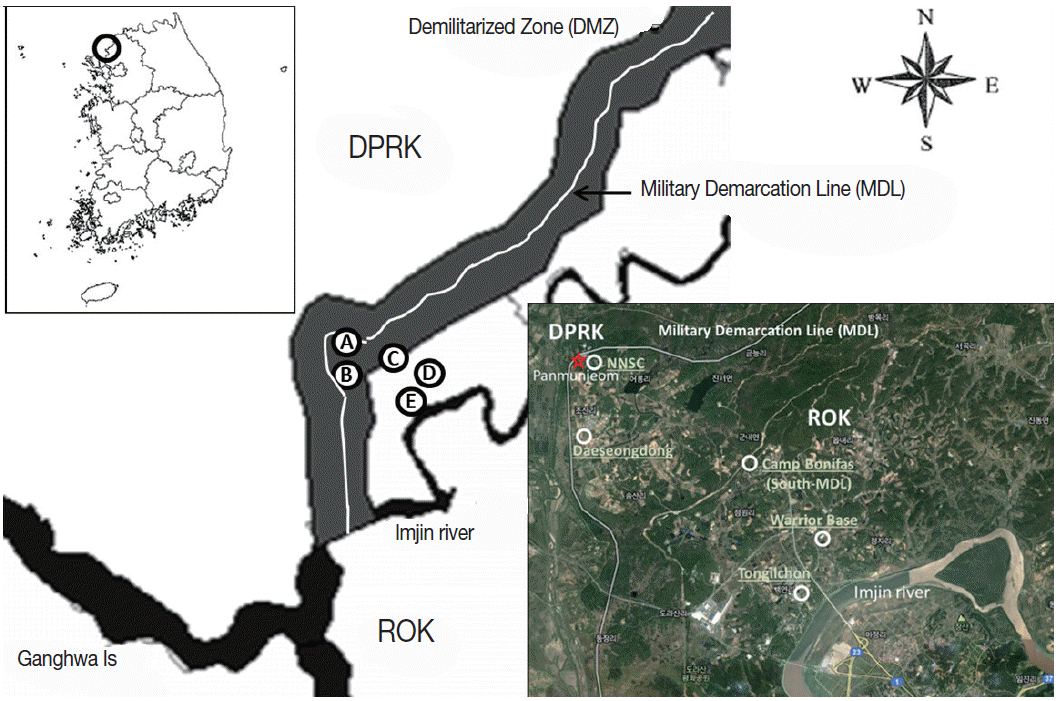
Fig. 1). Collection sites included the Neutral Nations Supervisory Commission (NNSC) camp (37° 57' 16.39" N, 26° 40' 50.03" E), Daeseong-dong (37° 56' 26.92" N, 126° 40' 37.42" E), Camp Bonifas [south boundary gate of the military demarcation line (S-MDL)] (37°56' 0.87" N, 126°43' 17.02" E) that separates North and South Korea, Warrior Base (US Army training site) (37° 55' 17.01" N, 126° 44' 30.22" E), and Tongilchon (beef farm) (37° 54' 32.18" N, 126° 44' 01.88" E) in northern Gyeonggi-do, ROK from April-October 2010-2013 (
Table 1). Both NNSC and Daeseong-dong are located inside the 2-km wide southern boundary of the DMZ, while Warrior Base and Tongilchon are located approximately 2-3 km southeast of the southern boundary of the DMZ and 1 km north of the Imjin River. The Mosquito Magnet traps at the NNSC camp were set <50 m from the DMZ MDL. Daeseong-dong is a village of approximately 200 residents that is under the protection of South Korea and is approximately 100-200 m from the MDL. Rice farming is the principal activity, while there is one enclosed (non-pastured) beef farm of <50 cattle. The trap was placed at the northern most edge of Daeseong-dong and approximately 100 m north of a beef farm and MDL. At Camp Bonifas, a Mosquito Magnet was set <20 m from the south boundary gate of the MDL only during 2013.
Mosquito Magnet
® traps (Pro Model, Woodstream Corp., Lititz, Pennsylvania, USA) use counter-flow technology and propane gas to produce heat and CO
2 as attractants to capture mosquitoes and other biting flies. Traps were operated continuously, with specimens collected bi-weekly from April-October during 2010-2013. Specimens were transported to the 5th Medical Detachment, US Army Garrison, Yongsan, Seoul, ROK, where mosquitoes and other biting flies were separated. Horse and deer flies were placed in 2 ml vials containing 70% ethanol and later identified morphologically using taxonomic keys [
7-
10]. The IBM SPSS Statistics version 21 was used for statistical analyses [
11].
RESULTS
A total of 2,999 specimens belonging to the Family Tabanidae, 2 subfamilies, Chrysopsinae (deer flies) and Tabaninae (horse flies), 5 genera, and 20 species were collected from 2010-2013 (
Table 2).
C. mlokosiewiczi (=
C. vanderwulpi) (90.93%) was the most frequently collected, followed by
Haematopota koryoensis (4.83%) and
Chrysops suavis (1.03%). The remaining 17 species comprised only 3.3% of all species collected. The annual mean numbers of tabanids collected/site during 2010 (35.0), 2011 (167.3), 2012 (372.8), and 2013 (153.8) from late-April to mid-October were variable. The mean numbers of tabanids collected during 2012 were 2.2, and 2.4 fold greater than the mean numbers collected during 2011 and 2013, respectively (
Table 2).
C. mlokosiewiczi accounted for 75.0-96.8% of all tabanids collected for each of the 5 survey sites (
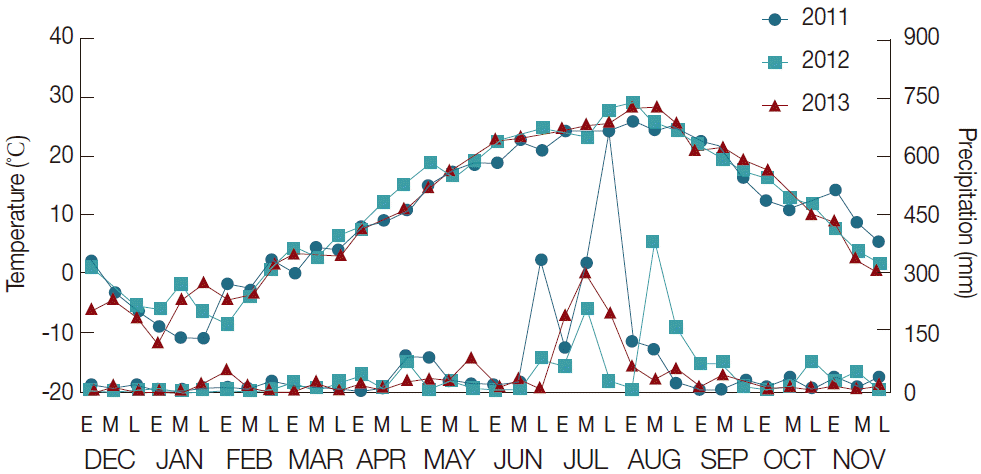
Table 3). Compared to the annual numbers collected at the same survey sites during 2010-2013, abundance (catches) was more influenced by the previous winter temperatures (December-February) when compared to the spring (March-May) or summer season (June-August) temperatures, with a tendency to be affected by low mean temperatures (
P=0.054) and precipitation (
P=0.071) (
Table 4;
Fig. 2). Populations of
C. mlokosiewiczi and
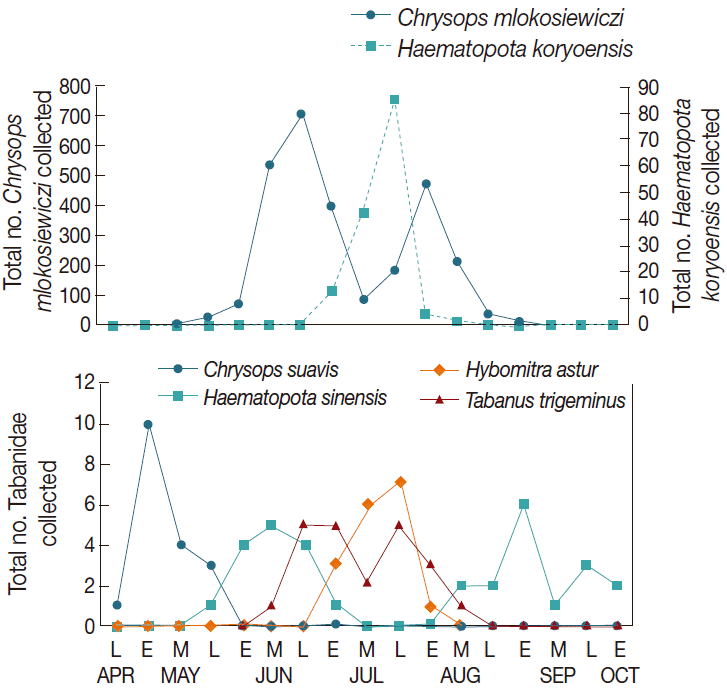
H. koryoensis peaked from mid-June to early August, while others (e.g.,
Chrysops japonicus,
Hybomitra astur,
Hybomitra bimaculata and
Hybomitra brevis) peaked during May (
Table 5;
Fig. 3).
Chrysops mlokosiewiczi populations demonstrated bimodal peaks with the first peak occurring in late June (25.7%) and the second peak in early August (17.3%), whereas
H. koryoensis populations represented a unimodal peak in late July (58.6%).
Atylotus horvathi populations peaked in early August (42.9%) and was the most frequently collected species during August.
The numbers of tabanids collected for the different sites were variable (
Table 3). Survey sites were divided into 3 groups by their property characteristics: NNSC and Camp Bonifas (adjacent to a low lying area and intermittent stream bordered by young mixed forests), Daeseong-dong and Warrior Base (bordered by rice paddies), and Tongilchon (adjacent to a cow shed and bordered by rice paddies and dry land agriculture on 2 sides and residences on the other 2 sides). Overall, the highest numbers (53.2%) of tabanids were collected from the NNSC camp, while the lowest numbers (0.7%) were collected at a beef farm in Tongilchon (
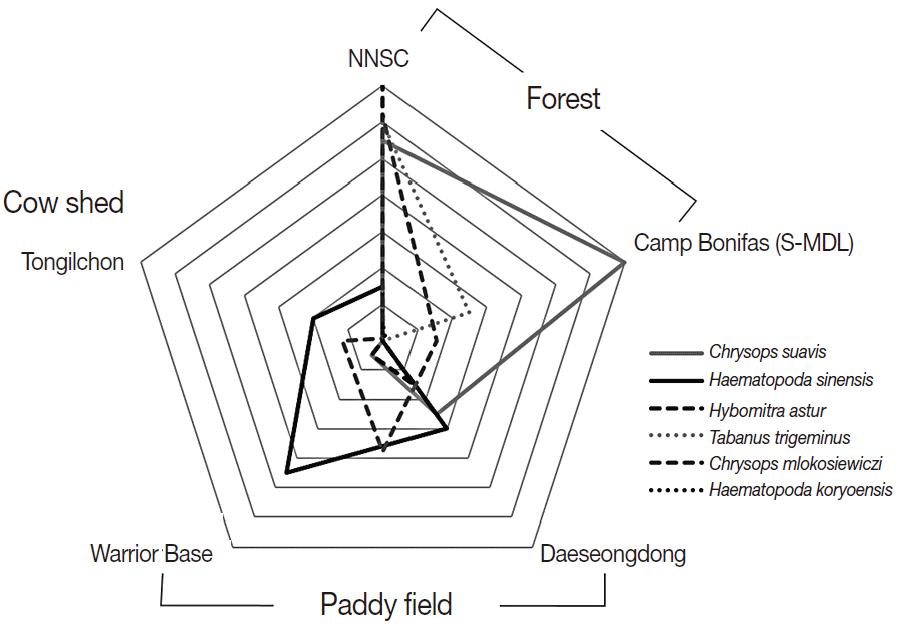
Table 3). Overall, tabanids were found to be the most abundant during all years for habitats consisting of low lying areas with intermittent streams bordered by forests (
Fig. 4).
DISCUSSION
Adult deer and horse flies oviposit on vegetation in damp environments, e.g., wetland agriculture, low lying areas that periodically flood, borders of intermittent streams, and forested areas, where the larvae emerge and feed on small insects. Mature larvae pupate in damp soil at the edge of water sources where they remain until adults emerge. Adult deer flies are medium sized flies that belong to the genus Chrysops, while horse flies are generally much larger. Females of both groups are vicious biters, cutting the dermis with “knife-like” mandibles that make a cross-shaped incision and then using other mouth parts to ingest the blood, while the males feed on pollen. The adults readily attach domestic livestock and wildlife, as well as humans, and are regarded as pests due to their bites. Horse and deer fly bites can be extremely painful, while their saliva can result in mild to severe allergic reactions that result in itching, discomfort, and other health issues. In addition, they are known to vector pathogenic bacteria, viruses, and helminths through mechanical transmission and pose disease threats to wildlife, domestic livestock, and local human and military populations that work or conduct operations in open sunlit areas where the adults are found.
Only 6 species,
C. mlokosiewiczi,
C. suavis,
H. koryoensis,
H. sinensis,
H. astur, and
T. trigeminus, were collected in sufficient numbers for analysis of seasonal abundance. In the southern part of Korea (Jeollabuk-do), Kim et al. [
4] collected 20 species of deer and horse flies belonging to 4 genera, with
T. griseinus (26.7%) and
T. amaenus (22.3%) as the most frequently collected. Hyun and Shin [
5] also found
T. amaenus (33.9%) and
T. griseinus (21.8%) as the most frequently collected species at Jeongeup-si, Jeollabuk-do. In a survey of tabanids of northern ROK, Suh et al. [
6] identified 14 species of tabanids belonging to 5 genera.
Chrysops mlokosiewiczi (57.3%) was the most frequently collected, followed by
H. sinensis (29.1%),
H. koryoensis (4.4%) and
T. mandarinus (2.3%). The most common tabanid species in northern ROK was
C. mlokosiewiczi, which accounted for 7.4% and 9.1% of the total collections for 2 survey sites in Jeollabuk-do [
4,
5]. Overall for years 2010-2013,
C. mlokosiewiczi accounted for 90.93% (range 87.1-96.82%) of all tabanids collected by Mosquito Magnets, compared to 57.3% in previous surveys using NJ light traps and Mosquito Magnet traps [
6]. Additional surveys and studies are required to determine reasons for the very high abundance of
C. mlokosiewiczi near the DMZ. Comparison of the annual numbers collected at the 4 survey sites during 2011-2013, abundance (catches) were more influenced by previous winter temperatures when compared to the spring or summer season temperatures, with a tendency to be affected by low mean temperatures (
P=0.054) and precipitation (
P=0.071). Krcmar [
12] reported that the seasonal meteorological variability significantly influenced the abundance of adult tabanids at low spring (May) temperatures. However, while the data is suggestive that low mean temperatures and precipitation during December-February result in fewer adults collected during the summer months, there was no significant difference between the mean numbers collected based on annual temperatures and precipitation variations from March to August.
In this study, populations of adult tabanids of some species (e.g.,
C. mlokosiewiczi and
H. koryoensis) peaked from mid-June to early August, while other species (e.g.,
C. japonicas,
H. astur,
H. bimaculata, and
H. brevis) demonstrated population peaks during May. Surveys in the southern part of the ROK (Jeollabuk-do) showed that populations of many of the species peaked from the end of June to early July [
4,
5], and early and mid-July [
6].
The surveyed areas were divided into 3 groups by their property characteristics: NNSC and Camp Bonifas (adjacent to a low lying and frequently flooded area and intermittent stream bordered by a forested area), Daeseong-dong and Warrior Base (bordered by rice paddies), and Tongilchon (adjacent to a cow shed). Kim et al. [
4] and Hyun and Shin [
5] reported that the association of hills and mountains resulted in increased numbers and diversity of tabanids collected. Although not all sites were collected over the 4-year period, the highest numbers of tabanids were collected from low lying areas often associated with water and intermittent streams that were bordered by forests, followed by sites surrounded by rice paddies, and lastly, the beef farm. The low numbers of tabanids collected at Tongilchon (beef farm) may in part be due to competition of beef cattle due to the close proximity (<5 m) from the Mosquito Magnet.
Haematopota koryoensis (97.2%) was more frequently collected in the forest areas, while the other Haematopota spp. were collected mostly from areas associated with rice paddies. Few
H. sinensis were collected, which are reported to be associated with mountain habitats [
4].
Chrysops japonicas (100%),
C. suavis (80.6%),
H. astur (77.8%) and
T. trigeminus (100%) were collected more frequently in forested areas, while
A. horvathi (100%) and
C. mlokosiewiczi (99.4%) were collected more frequently in both forest and rice paddy habitats. While Inaoka [
13] indicated that
C. suavis and
T. trigeminus were eurytopic or uniformly distributed over various habitats, all T. trigeminus and most
C. suavis (80.6%) were collected near forest habitats.
C. mlokosiewiczi was collected near forest habitats and rice paddies, unlike previous reports that indicated it was collected more frequently in pastures and open land habitats [
13].
In conclusion, C. mlokosiewiczi and H. koryoensis were the 2 most commonly collected tabanids collected from various habitats near and inside the southern boundary of the DMZ, with peak populations observed from mid-June to early August. Adult populations were more influenced by low winter temperatures and precipitation rather than high temperatures during throughout the adult stage. Habitat differences accounted for differences in relative abundance and diversity of tabanids collected. Tabanids are pestiferous and vicious biters, affecting wildlife and domestic animals and local and military populations during farming/military activities. In addition, they vector viruses, bacteria, and helminths that pose medical and veterinary threats.
Notes
-
We have no conflict of interest related with this work.
We thank the commander and Soldiers of the 5th Medical Detachment, 168th Multifunctional Medical Battalion, 65th Medical Brigade, for their assistance in conducting vector-borne disease surveillance. We also thank 1LT Adam Irby and 1LT Christopher Taylor, Physician Assistants, and their medical staff, United Nations Command Support Battalion, Camp Bonifas, for their assistance and coordination for mosquito and other biting fly collections at the NNSC camp, Camp Bonifas, and Daeseong-dong. We thank Mr. Chang-Hun Pak, Foreman of the Pest Control Section, Department of Public Works, Camp Casey, Installation Management Command-Korea, for assistance in conducting biting fly surveillance. Funding for this research was provided by the Armed Forces Health Surveillance Center, Global Emerging Infections Surveillance and Response System (AFHSC-GEIS), Silver Spring, Maryland, USA, and Public Health Command Region-Pacific, Camp Zama, Japan. The opinions expressed herein are those of the authors and are not to be construed as official or reflecting the views of the US Department of the Army, Department of Defense, or the US Government.
Fig. 1.Map of the northern part of Gyeonggi-do (
https://www.google.co.kr/maps) denoting collection sites of horse and deer flies at (A) NNSC (Neutral Nations Supervisory Commission camp adjacent to the Panmunjom); (B) Daeseong-dong (village of approximately 200 residents inside the DMZ), (C) Camp Bonifas [South boundary gate of the Military Demarcation Line (S-MDL) separating North and South Korea), (D) Warrior Base (US Army training sites approximately 2 km from the S-MDLsouthern boundary of the DMZ), and (E) Tongilchon (village of approximately 200 residents; trap set at a beef farm with approximately 50 cattle and 3 km from the S-MDL).
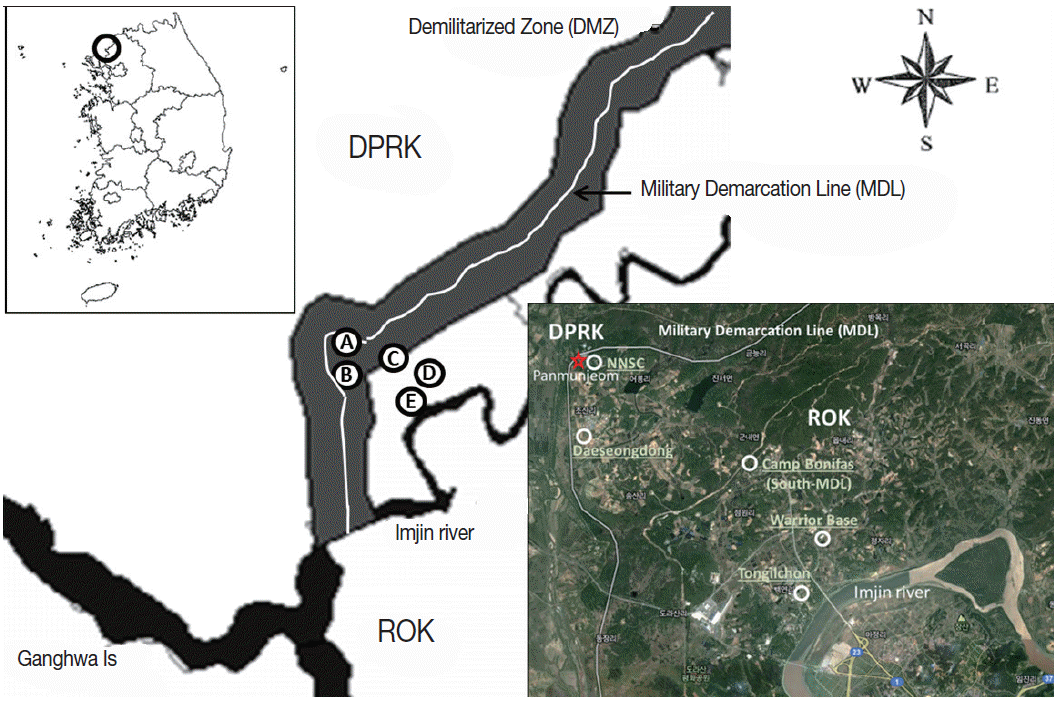
Fig. 2.Mean temperature and precipitation for January through December, Munsan, Paju-si, Gyeonggi-do, for years 2011-2013. Upper solid lines represent the mean temperatures for each of those years; Lower solid lines represent the precipitation for each of the years (see above legend). Mean rainfall and temperature were recorded at 10 day intervals for each month.
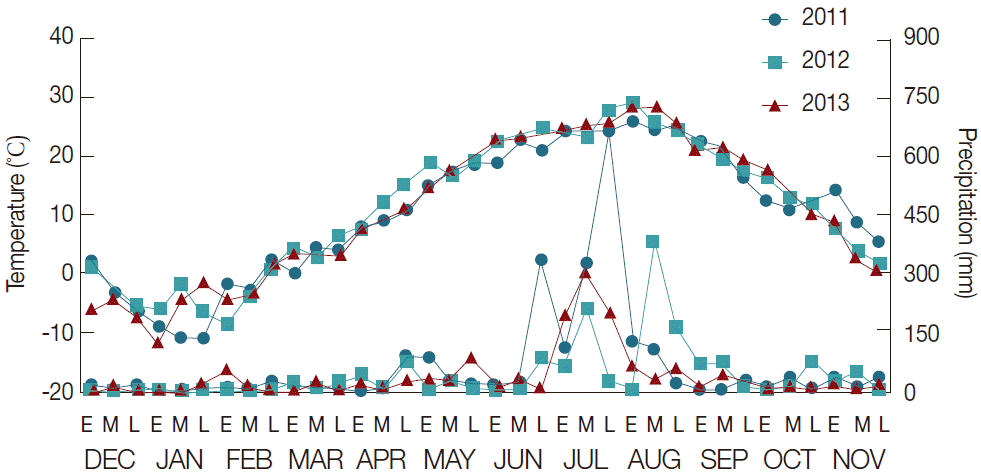
Fig. 3.Number of tabanids collected by Mosquito Magnets at 10 day intervals for each month at Camp Bonifas (ROK Army installation), Warrior Base (US Army training site), Neutral Nations Supervisory Commission camp (NNSC), Daeseong-dong (village inside the DMZ), and Tongilchon (beef farm near the DMZ) from April-October, 2010-2013.
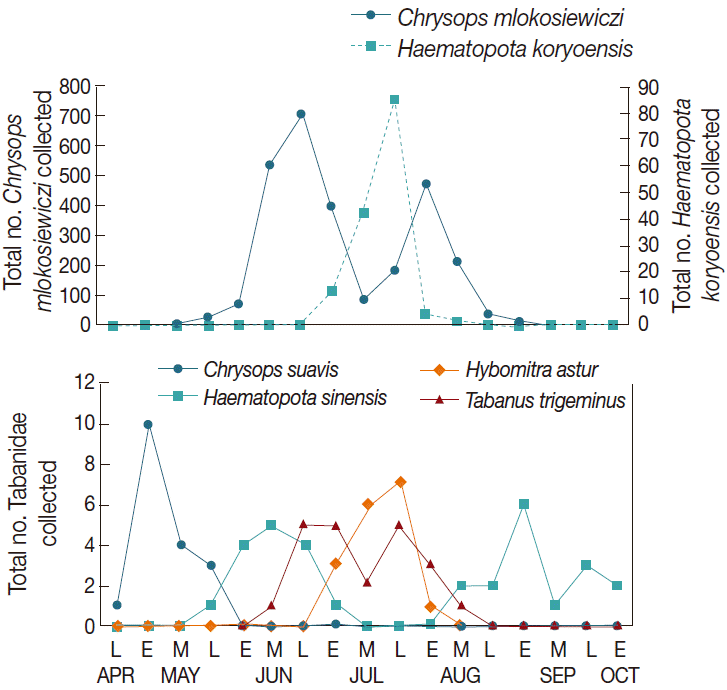
Fig. 4.Number of tabanids captured by Mosquito Magnet traps by collection site and general habitat characteristics.
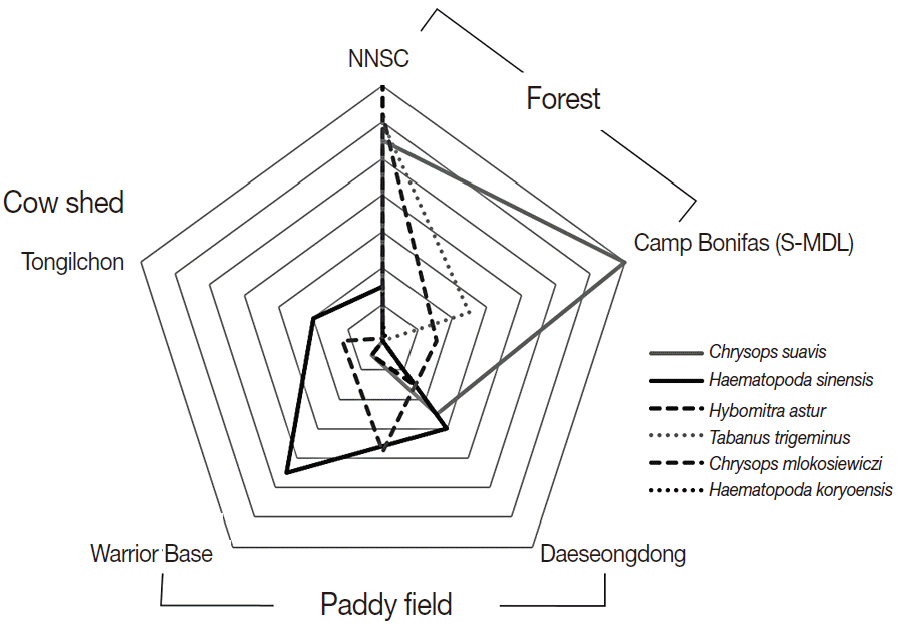
Table 1.Horse and deer fly collection sites and number of Mosquito Magnet traps established at Camp Bonifas, Warrior Base, Neutral Nations Supervisory Commission camp, Daeseong-dong, and Tongilchon in the ROK using Mosquito Magnet traps from late April-early October, 2010-2013
Table 1.
|
Year |
No. survey site |
Collection sites |
|
2010 |
2 |
Daeseong-dong, Warrior Base |
|
2011 |
4 |
Daeseong-dong, Warrior Base, NNSC, Tongilchon |
|
2012 |
4 |
Daeseong-dong, Warrior Base, NNSC, Tongilchon |
|
2013 |
5 |
Daeseong-dong, Warrior Base, NNSC, Tongilchon, Camp Bonifas |
Table 2.Annual number of horse and deer flies collected at Camp Bonifas (ROK Army installation), Warrior Base (US Army training site), Neutral Nations Supervisory Commission camp (NNSC), Daeseong-dong (village inside the DMZ), and Tongilchon (beef farm near the DMZ) in the ROK using Mosquito Magnet traps from late April-early October, 2010-2013
Table 2.
|
Species |
Year
|
Total |
% |
|
2010 |
2011 |
2012 |
2013 |
|
Chrysopsinae (Deer Flies) |
|
|
|
|
|
|
|
Atylotus horvathi
|
1 |
2 |
3 |
1 |
7 |
0.23 |
|
Chrysops basalis
|
0 |
0 |
0 |
1 |
1 |
0.03 |
|
Chrysops japonicus
|
0 |
0 |
2 |
7 |
9 |
0.3 |
|
Chrysops mlokosiewiczi
|
61 |
617 |
1,340 |
709 |
2,727 |
90.93 |
|
Chrysops suavis
|
1 |
2 |
10 |
18 |
31 |
1.03 |
|
Tabaninae (Horse Flies) |
|
|
|
|
|
|
|
Haematopota antennata
|
0 |
0 |
4 |
0 |
4 |
0.13 |
|
Haematopota koryoensis
|
0 |
24 |
98 |
23 |
145 |
4.83 |
|
Haematopota sinensis
|
7 |
9 |
4 |
2 |
22 |
0.73 |
|
Haematopota tamerlani
|
0 |
0 |
3 |
0 |
3 |
0.1 |
|
Hybomitra astur
|
0 |
0 |
18 |
0 |
18 |
0.6 |
|
Hybomitra bimaculata
|
0 |
0 |
0 |
1 |
1 |
0.03 |
|
Hybomitra brevis
|
0 |
0 |
2 |
0 |
2 |
0.07 |
|
Tabanus administrans
|
0 |
0 |
0 |
2 |
2 |
0.07 |
|
Tabanus budda
|
0 |
1 |
0 |
0 |
1 |
0.03 |
|
Tabanus griseinus
|
0 |
1 |
2 |
0 |
3 |
0.1 |
|
Tabanus kinoshitai
|
0 |
1 |
1 |
0 |
2 |
0.07 |
|
Tabanus loukashkini
|
0 |
1 |
0 |
0 |
1 |
0.03 |
|
Tabanus signatipennis
|
0 |
1 |
0 |
0 |
1 |
0.03 |
|
Tabanus taiwanus
|
0 |
1 |
1 |
0 |
2 |
0.07 |
|
Tabanus trigeminus
|
0 |
9 |
3 |
5 |
17 |
0.57 |
|
Total |
70 |
669 |
1491 |
769 |
2,999 |
100 |
Table 3.Number (%) of horse and deer flies collected at Camp Bonifas (ROK Army installation), Warrior Base (US Army training site), Neutral Nations Supervisory Commission camp (NNSC), Daeseong-dong, and Tongilchon (beef farm) in the ROK using Mosquito Magnet traps from late April-early October, 2010-2013
Table 3.
|
Species |
NNSCa
|
Cp Bonifasa
|
Daeseong-dongb
|
Warrior Baseb
|
Tongilchonc
|
Total |
|
Atylotus horvathi
|
4 (0.3) |
0 |
2 (0.3) |
1 (0.4) |
0 |
7 (0.2) |
|
Chrysops basalis
|
0 |
1 (0.3) |
0 |
0 |
0 |
1 (< 0.1) |
|
Chrysops japonicus
|
3 (0.2) |
6 (1.5) |
0 |
0 |
0 |
9 (0.3) |
|
Chrysops mlokosiewiczi
|
1,420 (88.9) |
339 (87.1) |
701 (96.8) |
252 (93.3) |
15 (75.0) |
2,727 (90.9) |
|
Chrysops suavis
|
11 (0.7) |
14 (3.6) |
5 (0.7) |
1 (0.4) |
0 |
31 (1.0) |
|
Haematopota antennata
|
0 |
0 |
3 (0.4) |
1 (0.4) |
0 |
4 (0.1) |
|
Haematopota koryoensis
|
120 (7.5) |
21 (5.4) |
1 (0.1) |
3 (1.1) |
0 |
145 (4.8) |
|
Haematopota sinensis
|
3 (0.2) |
0 |
6 (0.8) |
9 (3.3) |
4 (20.0) |
22 (0.7) |
|
Haematopota tamerlani
|
1 (< 0.1) |
0 |
0 |
1 (0.4) |
1 (5.0) |
3 (0.1) |
|
Hybomitra astur
|
14 (0.9) |
0 |
3 (0.4) |
1 (0.4) |
0 |
18 (0.6) |
|
Hybomitra bimaculata
|
0 |
1 (0.3) |
0 |
0 |
0 |
1 (< 0.1) |
|
Hybomitra brevis
|
2 (0.1) |
0 |
0 |
0 |
0 |
2 (< 0.1) |
|
Tabanus administrans
|
0 |
2 (0.5) |
0 |
0 |
0 |
2 (< 0.1) |
|
Tabanus budda
|
0 |
0 |
0 |
1 (0.4) |
0 |
1 (< 0.1) |
|
Tabanus griseinus
|
2 (0.1) |
0 |
1 (0.1) |
0 |
0 |
3 (0.1) |
|
Tabanus kinoshitai
|
1 (< 0.1) |
0 |
1 (0.1) |
0 |
0 |
2 (< 0.1) |
|
Tabanus loukashkini
|
1 (< 0.1) |
0 |
0 |
0 |
0 |
1 (< 0.1) |
|
Tabanus signatipennis
|
1 (< 0.1) |
0 |
0 |
0 |
0 |
1 (< 0.1) |
|
Tabanus taiwanus
|
1 (< 0.1) |
0 |
1 (0.1) |
0 |
0 |
2 (< 0.1) |
|
Tabanus trigeminus
|
12 (0.8) |
5 (1.3) |
0 |
0 |
0 |
17 (0.6) |
|
Totald
|
1,596 (53.2) |
389 (13.0) |
724 (24.1) |
270 (9.0) |
20 (0.7) |
2,999 |
Table 4.Multiple regression analysis between population density and temperature for horse and deer flies collected at a ROK Army installation (Camp Bonifas), US Army training site (Warrior Base), Neutral Nations Supervisory Commission camp (NNSC), village inside the DMZ (Daeseong-dong), and beef farm near the DMZ (Tongilchon) in the ROK using Mosquito Magnet traps from late April-early October, 2010-2013
Table 4.
|
Tem |
Variables |
Immature Development (Dec-Feb)
|
Adults (Jun-Aug)
|
|
Population density |
Avg. temperature |
Avg. high temperature |
Avg. low temperature |
Precipitation |
Population density |
Avg. temperature |
Avg. high temperature |
Avg. low temperature |
Precipitation |
|
Pearson Correlation |
Population density |
1.000 |
|
|
|
|
1.000 |
|
|
|
|
|
Avg. temperature |
0.986 |
1.000 |
|
|
|
-0.02 |
1.000 |
|
|
|
|
Avg. high temperature |
0.94 |
0.868 |
1.000 |
|
|
0.317 |
0.942 |
1.000 |
|
|
|
Avg. low temperature |
0.606 |
0.731 |
0.297 |
1.000 |
|
-0.394 |
0.927 |
0.747 |
1.000 |
|
|
Precipitation |
-0.975 |
-0.924 |
-0.992 |
-0.414 |
1.000 |
-0.227 |
-0.969 |
-0.996 |
-0.806 |
1.000 |
|
Significance (1-tailed) |
Population density |
. |
|
|
|
|
. |
|
|
|
|
|
Avg. temperature |
0.054 |
. |
|
|
|
0.494 |
. |
|
|
|
|
Avg. high temperature |
0.111 |
0.165 |
. |
|
|
0.397 |
0.109 |
. |
|
|
|
Avg. low temperature |
0.293 |
0.239 |
0.404 |
. |
|
0.371 |
0.123 |
0.231 |
. |
|
|
Precipitation |
0.071 |
0.125 |
0.04 |
0.364 |
. |
0.427 |
0.079 |
0.03 |
0.207 |
. |
Table 5.Seasonal prevalence of horse and deer flies collected at a ROK Army installation (Camp Bonifas), US Army training site (Warrior Base), Neutral Nations Supervisory Commission camp (NNSC), village inside the DMZ (Daeseong-dong), and beef farm near the DMZ (Tongilchon) in the ROK using Mosquito Magnet traps from late April-early October, 2010-2013
Table 5.
|
Species |
APR
|
MAY
|
JUN
|
JUL
|
AUG
|
SEP
|
OCT
|
Total |
|
L |
Ea
|
Ma
|
La
|
E |
M |
L |
E |
M |
L |
E |
M |
L |
E |
M |
L |
E |
|
Atylotus horvathi
|
0 |
0 |
0 |
0 |
0 |
0 |
0 |
0 |
0 |
0 |
3 |
2 |
1 |
1 |
0 |
0 |
0 |
7 |
|
Chrysops basalis
|
0 |
0 |
0 |
0 |
0 |
0 |
0 |
0 |
0 |
0 |
0 |
0 |
0 |
1 |
0 |
0 |
0 |
1 |
|
Chrysops japonicus
|
0 |
1 |
2 |
5 |
1 |
0 |
0 |
0 |
0 |
0 |
0 |
0 |
0 |
0 |
0 |
0 |
0 |
9 |
|
Chrysops mlokosiewiczi
|
0 |
0 |
0 |
23 |
69 |
538 |
702 |
397 |
86 |
184 |
471 |
216 |
34 |
5 |
0 |
2 |
0 |
2,727 |
|
Chrysops suavis
|
0 |
0 |
0 |
1 |
4 |
5 |
4 |
1 |
0 |
0 |
0 |
2 |
2 |
6 |
1 |
3 |
2 |
31 |
|
Haematopota antennata
|
0 |
0 |
0 |
0 |
0 |
0 |
0 |
0 |
1 |
2 |
1 |
0 |
0 |
0 |
0 |
0 |
0 |
4 |
|
Haematopota koryoensis
|
0 |
0 |
0 |
0 |
0 |
0 |
0 |
13 |
42 |
85 |
4 |
1 |
0 |
0 |
0 |
0 |
0 |
145 |
|
Haematopota sinensis
|
0 |
0 |
0 |
0 |
0 |
1 |
5 |
5 |
2 |
5 |
3 |
1 |
0 |
0 |
0 |
0 |
0 |
22 |
|
Haematopota tamerlani
|
0 |
0 |
0 |
3 |
0 |
0 |
0 |
0 |
0 |
0 |
0 |
0 |
0 |
0 |
0 |
0 |
0 |
3 |
|
Hybomitra astur
|
1 |
10 |
4 |
3 |
0 |
0 |
0 |
0 |
0 |
0 |
0 |
0 |
0 |
0 |
0 |
0 |
0 |
18 |
|
Hybomitra bimaculata
|
0 |
1 |
0 |
0 |
0 |
0 |
0 |
0 |
0 |
0 |
0 |
0 |
0 |
0 |
0 |
0 |
0 |
1 |
|
Hybomitra brevis
|
0 |
0 |
1 |
1 |
0 |
0 |
0 |
0 |
0 |
0 |
0 |
0 |
0 |
0 |
0 |
0 |
0 |
2 |
|
Tabanus administrans
|
0 |
0 |
0 |
0 |
0 |
1 |
0 |
1 |
0 |
0 |
0 |
0 |
0 |
0 |
0 |
0 |
0 |
2 |
|
Tabanus budda
|
0 |
0 |
0 |
0 |
0 |
0 |
0 |
0 |
0 |
0 |
1 |
0 |
0 |
0 |
0 |
0 |
0 |
1 |
|
Tabanus griseinus
|
0 |
0 |
0 |
0 |
0 |
0 |
1 |
0 |
2 |
0 |
0 |
0 |
0 |
0 |
0 |
0 |
0 |
3 |
|
Tabanus kinoshitai
|
0 |
0 |
0 |
1 |
0 |
1 |
0 |
0 |
0 |
0 |
0 |
0 |
0 |
0 |
0 |
0 |
0 |
2 |
|
Tabanus loukashkini
|
0 |
0 |
0 |
0 |
0 |
0 |
0 |
1 |
0 |
0 |
0 |
0 |
0 |
0 |
0 |
0 |
0 |
1 |
|
Tabanus signatipennis
|
0 |
0 |
0 |
0 |
0 |
0 |
0 |
1 |
0 |
0 |
0 |
0 |
0 |
0 |
0 |
0 |
0 |
1 |
|
Tabanus taiwanus
|
0 |
0 |
0 |
0 |
0 |
0 |
0 |
1 |
0 |
0 |
0 |
0 |
0 |
1 |
0 |
0 |
0 |
2 |
|
Tabanus trigeminus
|
0 |
0 |
0 |
0 |
0 |
0 |
0 |
3 |
6 |
7 |
1 |
0 |
0 |
0 |
0 |
0 |
0 |
17 |
|
Total |
1 |
12 |
7 |
37 |
74 |
546 |
712 |
423 |
139 |
283 |
484 |
222 |
37 |
14 |
1 |
5 |
2 |
2,999 |
References
- 1. Polyakov VA, Anisimovich V, Uzakov U, Veselkin G. Tabanidae. In Veterinary Entomology and Arachnology; Agropromizdat, Moscow. 1990. p. 14-19.
- 2. Foil LD. Tabanids as vector of disease agent. Parasitol Today 1989;5:88-96.
- 3. Krinsky WL. Animal disease agents transmitted by horse flies and deer flies (Diptera: Tabanidae). J Med Entomol 1976;13:225-275.
- 4. Kim CW, Kim JI, Shin TH. On the Tabanidae from Cheunra-Bukdo province in Korea. Bull Korean Ent Inst, Korea Univ 1973;5:55-62. (in Korean).
- 5. Hyun JS, Shin TH. 1975. Seasonal abundance of tabanid flies in Jeong-up based on the numbers captured in traps. Korean J Entomol 1975;5:17-21. (in Korean).
- 6. Suh SJ, Kim HC, Klein TA, Chong ST, Lee WJ, Kwon YJ. Tabanid flies (Diptera: Tabanidae) of the northern part of Gyeonggi province, Republic of Korea. Entomol Res 2005;35:195-198.
- 7. Mundoch WP, Takahasi H. The female Tabanidae of Japan, Korea and Manchuria. Ent Soc Washington 1969;6:110-118.
- 8. Suh SJ, Choi KS, Kwon YJ. Taxonomic revision of Tabanus mandarinus species group (Diptera: Tabanidae) from Korea. Korean J Entomol 2002a;32:113-118.
- 9. Suh SJ, Choi KS, Kwon YJ. Taxonomy of Tabanus immanis species group (Diptera: Tabanidae) in Korea. Insect Koreana 2002;19:277-282.
- 10. Suh SJ, Choi KS, Kwon YJ. Taxonomy of Tabanus cordiger species group (Diptera: Tabanidae) in Korea. Korean J Entomol 2003;33:1-3.
- 11. SPSS, IBM SPSS Statistics version 21. Chicago, Illinois USA. 2012.
- 12. Krcmar S. Seasonal abundance of horse flies (Diptera: Tabanidae) from two locations in eastern Croatia. J Vector Ecol 2005;30:316-321.
- 13. Inaoka T. 1975. Habitat preference of tabanid flies in Hokkaido based upon the collection of female adults. J Faculty Sci Hokkado Univ Ser VI. Zool 1975;20:77-92.