Abstract
In this study, we intended to describe an unrecorded species of heterophyid trematode recovered from the small intestine of a Korean raccoon dog, Nyctereutes procyonoides koreensis, in Korea. A total of 13 small flukes were collected from a deceased Korean raccoon dog which was found in Chuncheon-si, Gangwon-do, Korea in May 2017. The trematode body were covered with many small spines, rectangular, broader than long, 807–1,103 μm long and 1,270–1,550 μm wide. Oral sucker in the anterior end slightly smaller than acetabulum. Pharynx muscular and well developed. Esophagus relatively long and sigmoid. Acetabulum small and located at median in anterior 2/5 portion. Ceca bifurcated at the anterior of genital pore and acetabulum and terminated at testis level. Testes larger, deeply lobed and located at the near of posterior end of body. Ovary small, triangular and located at the slight left of median and the anterior of left testis. Vitelline follicles dendritic and extend from the middle level of esophagus to the posterior portion of body. Eggs embryonated, operculated, small and 33–35×15–16 μm in size. Based on the morphological characteristics, the small heterophyid flukes recovered from the small intestines of Korean raccoon dog, N. procyonoides koreensis, were identified as Euryhelmis squamula (Digenea: Heterophyidae). Accordingly, this species of heterophyid flukes is to be a new trematode fauna in Korea by this study.
-
Key words: Euryhelmis squamula, Nyctereutes procyonoides koreensis, Korean raccoon dog, Korea
Trematode members in the genus
Euryhelmis (Digenea: Heterophyidae) are small, rectangular or pyriform intestinal parasites of frog- and salamander eating mammals [
1,
2]. About 8 species, i.e.,
E. squamula,
E. monorchis,
E. pacificus,
E. costaricensis,
E. pyriformis,
E. zelleri,
E. cotti, and
E. asiaticus, have been reported in this genus [
3–
9] (
Table 1). Most of them including
E. squamula were reported from mustelid mammalian hosts, i.e.,
Mustela putorius,
M. vison,
M. frenata costaricensis, and
Martes flavigula. Adult worms of
E. pacificus were also found in the intestines of muskrat,
Ondatra zibethicus, and marsh shrew,
Sorex bendirii palmeri [
4], and
E. pyriformis adults were detected from striped skunk, Mephitis methitis [
6].
E. zelleri [
7] and
E. cotti [
8] were reported from experimental animals such as mink, white rats, albino mice, hamster, and chicks.
Available literatures on the trematode fauna from carnivora are not so many in Korea. Sohn and Chai [
10] reported more than 11 species of heterophyid flukes, i.e.,
Metagonimus spp.,
Heterophyes nocens,
Pygidiopsis summa,
Heterophyopsis continua,
Stictodora fuscata,
Stictodora lari,
Acanthotrema felis,
Stellantchasmus falcatus,
Centrocestus armatus,
Procerovum varium,
Cryptocotyle sp., in the small intestines of 438 feral cats from a wholesale house of animals in Busan Metropolitan City, Korea. They also reported 11 other species of trematodes, such as
Clonorchis sinensis,
Paragonimus westermani,
Eurytrema pancreaticum,
Pharyngostomum cordatum,
Echinostoma revolutum,
Echinostoma hortense (=
Isthmiophora hortensis),
Echinochasmus japonicus,
Stephanoprora sp.,
Plagiorchis muris,
Neodiplostomum sp., and diplostomulum (mesocercaria of
Diplostomum sp.). Shin et al. [
11] detected 4 species of heterophyid flukes, i.e.,
H. nocens,
P. summa,
S. fuscata,
A. felis, and
Gymnophalloides seoi in the small intestines of 4 feral cats from Aphaedo (Island), Shinan-gun, Jeollanam-do, Korea. They also found
P. summa and unidentified echinostomes in the small intestines of a raccoon dog. Chai et al. [
12] morphologically described 13 trematode species i.e.,
S. falcatus,
S. fuscata,
S. lari,
C. armatus,
P. varium,
Cryptocotyle concava,
E. hortense,
E. revolutum,
E. japonicus,
Stephanoprora sp.,
Neodiplostomum seoulense,
P. muris, and
Eurytrema pancreaticum, as the cat fluke fauna in Korea. Shin et al. [
13] detected more than 10 species of heterophyid fluke, i.e.,
Metagonimus spp.,
P. summa,
H. nocens,
S. falcatus,
H. continua,
A. felis,
C. armatus,
P. varium,
C. concava, and
S. lari, together with 5 species of echinostomes and
Plagiorchis spp. in the small intestines of 400 stray cats from riverside areas of 5 major rivers in Korea. Recently, Choe et al. [
14] reported 2
Isthmiophora species recovered from 4 species of wild carnivores, i.e.,
Nyctereutes procyonoides,
Mustela sibirica,
Meles lucurus, and
M. flavigula with morphological descriptions. So many species of trematodes including heterophyid flukes have been reported from carnivora in Korea. However, there is no reports on the
Euryhelmis species in Korea. Herein, we describe a new trematode fauna,
E. squamula, of which heterophyid flukes recovered from a Korean raccoon dog,
N. procyonoides koreensis, in Korea.
In May 2017, a deceased Korean raccoon dog was found in Chuncheon, Korea, and transferred to the Gangwon Wildlife Medical Rescue Center at Kangwon National University. The raccoon dog was autopsied, and 13 flukes were harvested from the contents of the small intestine, which is washed with saline, under the stereo microscope. Unfortunately, we tried to stain the flukes with Semichon’s aceto-carmine, but the body of flukes were so thin, that it contracted during the dyeing process, thus, we could not obtain a properly stained specimens. However, fortunately the internal organs of the flukes could be confirmed from the non-stained flukes. The morphology was documented by photographing the flukes before fixation, and measured and drawn with tracing paper. All measurement (n=10) unit are in micrometer.
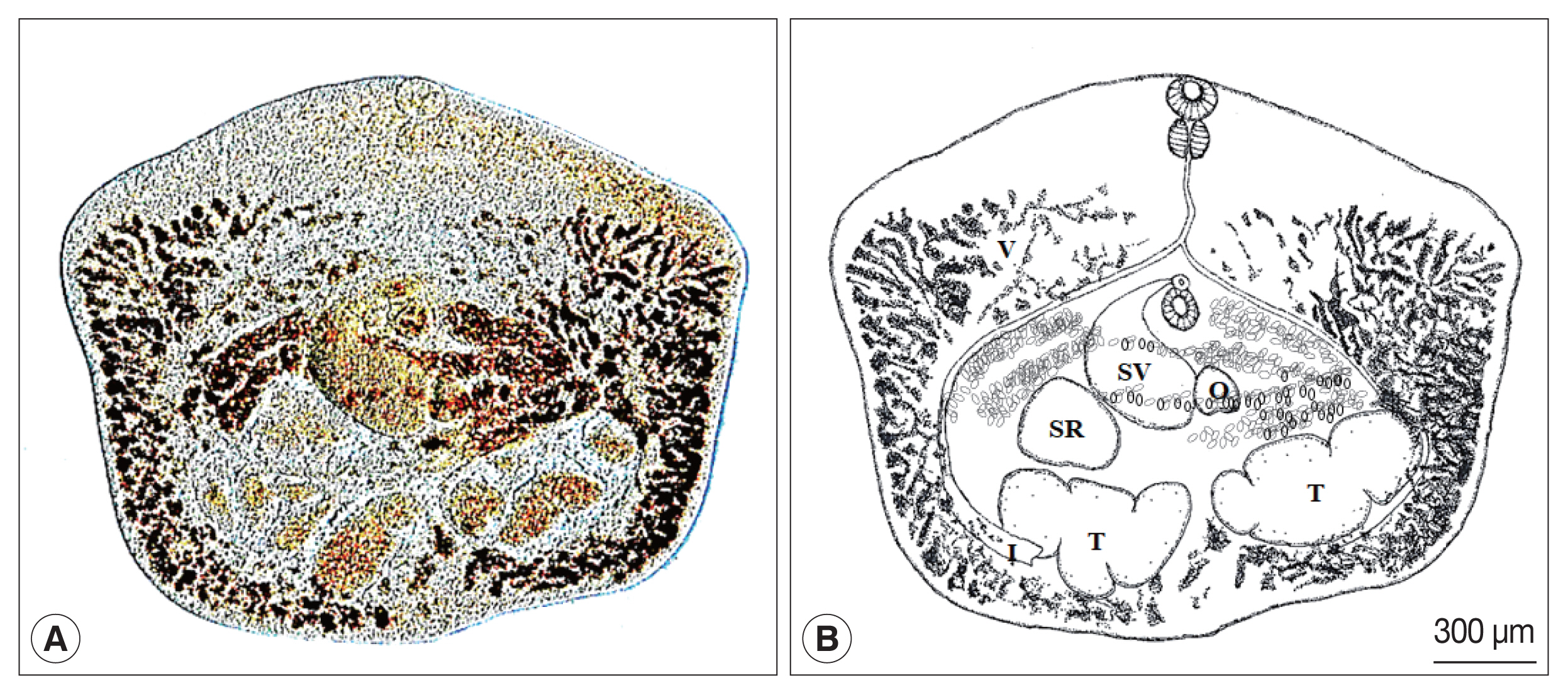
The morphological characters of heterophyid flukes in this study were as follow (
Fig. 1). Body covered with many minute spines, rectangular, broader than length, 807–1,103 (1,053)×1,270–1,550 (1,460) μm. Oral sucker 91–143×100–141 μm, lying at the anterior end of the body. Pharynx nearly spherical, 79–95 (91)×85–106 (98.5) μm, and esophagus well-developed, sigmoid and long. Esophagus bifurcates at the anterior to acetabulum, and ceca follow the contour of the body to the posterior. Acetabulum 103–124 (118)×127–150 (140) μm, lying in the middle of the body. Genital atrium opens immediately anterior to acetabulum and is overhung by genital papillae. Testes symmetric or slightly diagonal, globular and lie on either side of the median at the posterior of the body. Testes 511–582 (557)×268–300 (294) μm and 468–547 (515)×254–300 (287) μm and deeply lobed. Ovary 125–141 (139)×97–124 (117) μm, heart-shaped or triangular in shape and lies slightly to the left side, anterior to left testis. Seminal receptacle 502–582 (552)×197–229 (217) μm, heart or club-shaped and lies between the right testis and seminal vesicle. Seminal vesicle 380–424 (413)×311–371 (352) μm, club-shaped, bends medially beneath the right edge of acetabulum, and opens via a short ejaculatory duct into genital pore. Genital pore and atrium located medially in front of acetabulum and covered by gonotyle. Uterus consists of 3 or 4 loops at the right side of the body and opens into genital atrium. Vitelline follicles dendritic and extend from the intestinal bifurcation to the posterior part of the body, following the ceca, but do not exceed the extra-cecal margin. Eggs 33–35 (34.5)×15–16 (15.6) μm, polar thickening and operculated.
The several species of carnivora act as definitive host of the genus
Euryhelmis [
1–
9]. Although many heterophyid flukes from carnivora had been reported and described in Korea [
10–
21], there is no literature of
E. squamula and their host in Korea. In this study,
E. squamula was recorded for the first time as the natural infection in a raccoon dog from Korea.
In 1819, Rudolphi [
22] incompletely described
Distomum squamula, which later became the genus Eurysoma (Dujardin, 1845), and finally,
Euryhelmis (Heterophyidae) in 1925 by Poche [
23]. The Heterophyidae subfamily, Euryhelminthinae, is composed of wide-bodied trematodes. Baer [
24] fully described
E. squamula (type species) in 1931, and the taxonomic location of
E. squamula was confirmed by Callot’s, publishing the adult measurements in 1946 [
25].
Yamaguti [
26] reported that the most identifiable features of the subfamily Euryhelminae are a wider body, short esophagus, almost symmetrical testes, and vitelline follicles located in the extra-cecal margin, lateral to the pharynx and testes. Further exploration of the species from genus
Euryhelmis showed that the morphology, taxonomy, and occurrence of these trematodes were variable [
27], but the superfamily Euryhelminae: Heterophyidae could be identified based on the following characteristics: a longitudinally or transversally elongated flat body, a variable esophagus length, the acetabulum is located a small distance in front of the middle of the body, the genital pore is immediately in front of the acetabulum and covered by a gonotyl (varying in size and structure), 1 or 2 testes are located at the posterior of the body, the ovary and seminal receptacles are transversally elongated and lie in front of the right testes, the vitelline follicles are in the lateral margins and reach behind the testes at the body’s posterior end to the intestine bifurcation level, or to the level of the pharynx and oral sucker at the body’s anterior end, the uterus is short with several convolutions between the gonotyl and transversal vitelline channels, and there is a Y-shaped excretory vesicle. The characteristic keys of
Euryhelmis are the body rectangular or pyriform, testis lobed, vitelline follicles in both fore- and hind-body, natural definitive host raccoon and mink [
1]. In this study, the wider body is rectangular, testis deeply lobed, vitelline follicles in both fore- and hind-body. The genital pore opening in front of the acetabulum is an important characteristic note of Heterophyidae [
1], and this is same as this study.
The
E. squamula morphological characteristics are as follows: the body is small, leaf-like, and broader than long, the excretory vesicle is Y- or T-shaped, there is 1 transitory testis or 2 spherical or lobate testes that are large and persist throughout adult life, the uterus relatively short and consists of 3 loops, principally situated at the left side of the body between the acetabulum and excretory vesicle, the vitelline follicles are numerous, primarily lateral, and extend from the posterior region of the body to the intestinal bifurcation, the genital atrium is immediately in front of the acetabulum, the intestinal crura extends to the posterior extremity of the body, the eggs are operculated, with or without slight polar thickening, and the adults are found in the intestine of mustelids [
3]. The morphological appearance of heterophyid flukes shown in this study was well consistent with the morphological characteristics of
E. squamula: the body is small, leaf-like, and broader than long. The uterus relatively short and consists of 3 loops, and the vitelline follicles numerous, primarily lateral, and extend from the posterior region of the body to the intestinal bifurcation. The intestinal crura extends to the posterior extremity of the body. The uterus consists of 3 or 4 loops at the right side of the body.
The comparison of morphometric features of the genus
Euryhelmis species is compared in
Table 1. The body shape of
E. monochis,
E. zelleri,
E. squamula, and this fluke are broader than long, which differs from
E. asiaticus,
E. costaricensis,
E. cotti,
E. pacificus,
E. pyriformis that are pyriform or elongate.
E. monochis,
E. squamula, and this fluke have the characteristic rectangular shape.
E. mornochis,
E. zelleri and
E. cotti are smaller than
E. squamula, and this fluke that identified from this study. Length and width of the
E. squamula are 0.6–1 mm and 1.4–1.9 mm, respectively. In this study, the specimen’s body length and width are 807–1,103 μm and 1,270–1,550 μm, respectively.
E. asiaticus,
E. costaricensis,
E. monochis,
E. squamula and this fluke differ from
E. pacificus,
E. pyriformis, and
E. zelleri, that the acetabulum is larger than the oral sucker.
E. squamula resembles
E. costaricensis in morphology (the acetabulum is larger than the oral sucker), but the
E. costaricensis acetabulum is located anterior to the body length midpoint, and the
E. squamula acetabulum is located at the body length midpoint. Similarly,
E. asiaticus has a slender and straight esophagus and an acetabulum is larger than the oral sucker, but to find the relationships among
E. costaricensis,
E. squamula, and
E. asiaticus require further investigations [
27].
E. monochis and
E. pyriformis differ from the other species by having 2 non-transitory testes.
E. squamula and
E. monorchis are also morphologically similar [
4], but differ in the testes.
E. monorchis has 1 transitory testis, and
E. squamula has 2 persistent testes. Also,
E. asiaticus has a slender and straight esophagus, but most of species, including
E. squamula and this fluke, have sigmoid esophagus. The seminal vesicle and seminal receptacule of this this fluke are larger than other species. The fluke of this study is slightly larger than
E. squamula of Grabda-Kazubska [
7] in most of the measurements, but similar to
E. squamula.
In this study, the flukes are small, leaf-like, broader than long, and rectangular in shape. Although, we could not obtain a properly stained specimen, the microscopic finding of non-stained heterophyid fluke revealed the features of internal organ. The acetabulum was smaller than the oral sucker, and the sigmoid esophagus bifurcates anterior to the acetabulum. The testes deeply lobed, and the vitelline follicles numerous, primarily lateral, and extend from the posterior region of the body to the intestinal bifurcation. The genital atrium is immediately located in front of the acetabulum, and the intestinal crura extend to the posterior extremity of the body. The results herein reveal that the fluke of this study is E. squamula.
E. squamula is a trematode parasite with a complex lifecycle, which require at least 3 hosts to complete it. The first intermediate host of
E. squamula is a tiny, operculate snail,
Bythinella hemphilli Pilsbry (Family Hydrobiidae), which develops lophocercous cercariae in the rediae after infection [
28]. The second intermediate hosts are frogs and toads, such as
Ascaphus truei,
Rana aurora,
Rana cascadae,
Rana esculenta L.,
Rana pipiens,
Rana temporaria, and
Triturus cristatus Laurenti, as evidenced by
E. squamula encysted metacercariae on the skin [
28–
30]. The final hosts of
Euryhelmis are raccoons, weasels, badgers, and minks [
24,
29–
40]. Moreover, globally,
M. vison,
M. putorius,
Procyon lotor,
Mustela frenata,
Martes melampus,
Martes nivalis,
Martes americana,
Martes sibirica,
Meles anakuma,
O. zibethicus, and
S. bendirii palmeri are distributed. In Europe,
E. squamula was reported from
M. nivalis,
M. putorius,
M. frenata and
Vulpes vulpes. In North America,
E. squamula was reported from
M. vision,
M. americana,
P. lotor,
O. zibethicus, and
S. bendirii palmeri [
29–
39], and in Asia from
M. melampus and
M. anakuma [
40]. In this study, the adult worms of
E. squamula were found in the intestine of
N. procyonoides koreensis and now,
N. procyonoides koreensis is new definitive host of
E. squamula.
A limited point, i.e., no stained specimens were obtained, but our photographs of unstained heterophyid flukes taken before the fixation are closely identical with the characteristic morphologies of E. squamula.
In conclusion, based on the morphological comparison of 8 Euryhelmis species, the small heterophyid flukes recovered from the intestine of Korean raccoon dog, N. procyonoides koreensis, were identified as E. squamula in this study, and E. squamula is to be a new trematode fauna in Korea. Accordingly, we report for the first time that the Korean raccoon dog, N. procyonoides koreensis, serves as the definitive host of E. squamula, and E. squamula is distributed in Korea. However, there is no information on the first and second intermediate hosts of E. squamula in Korea. Further studies on what kind of animals act as the first and second intermediate hosts of E. squamula should be continued in Korea.
Notes
-
The authors declare that there are no conflicts of interest.
ACKNOWLEDGMENT
This research was supported by Basic Science Research Program through the National Research Foundation of Korea (NRF) funded by the Ministry of Education (Grant No. 2017 RIDIAIB06031728).
Fig. 1Adult Euryhelmis squamula from the small intestine of Korean raccoon dog. (A) Unstained fluke. (B) Schematic drawing of the (A) specimen. Note the sigmoid esophagus, heart club-shaped ovary, deeply-lobed testes, intestinal crura that extend to the posterior extremity of the body, and dendritic vitelline follicles that do not exceed the extra-cecal margin. I, intestine; O, ovary; SR, seminal receptacle; SV, seminal vesicle; T, testis; V, vitellaria.
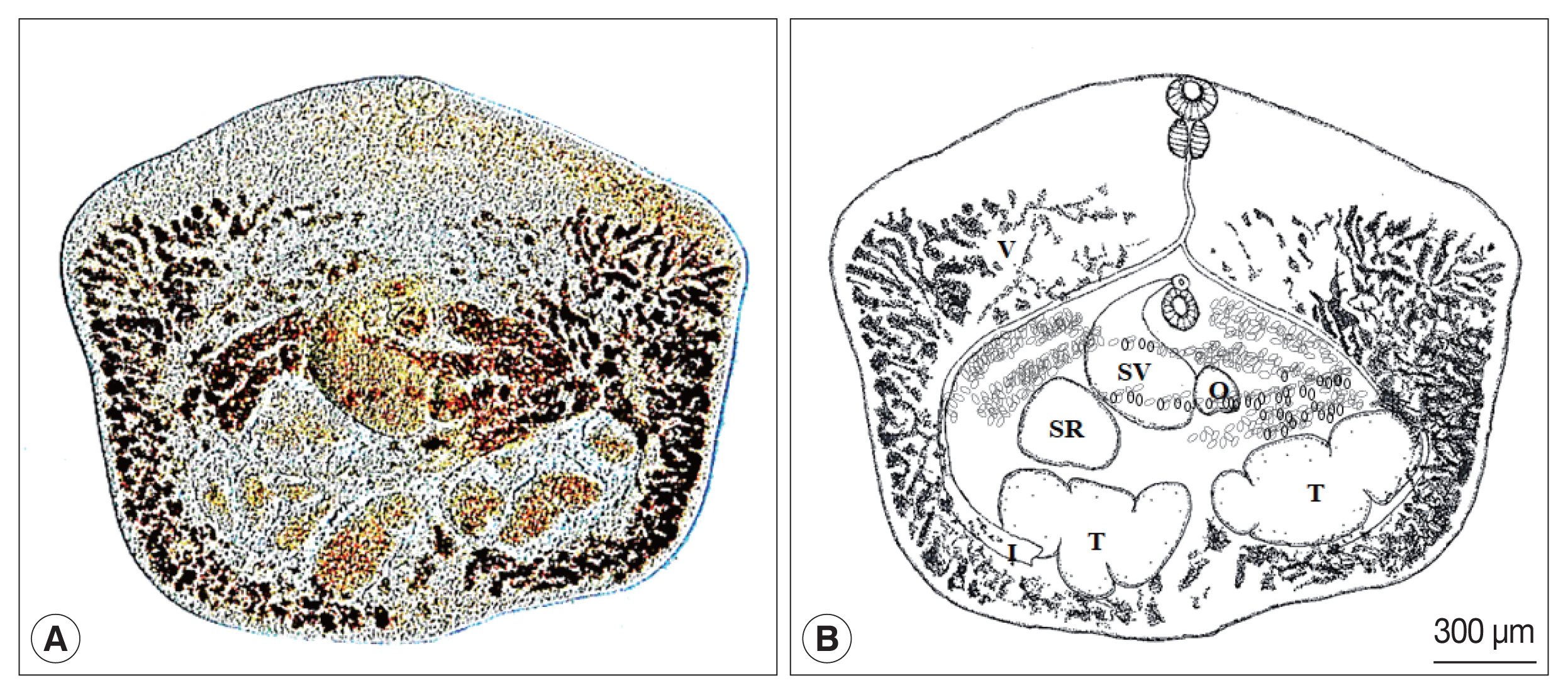
Table 1Comparison of morphometric features of species in the genus Euryhelmis
Table 1
|
|
|
|
|
|
|
|
|
Unit: μm |
|
|
E. monorchis [3] |
E. pacificus [4] |
E. costaricensis [5] |
E. pyriformis [6] |
E. zelleri [7] |
E. cotti [8] |
E. asiaticus [9] |
E. squamula [7] |
Present study |
|
Body length width |
390–460 |
660–1,040 |
1,074–1,281 |
2,250 |
347–495 |
270–550 |
920–1,117 |
723–1,050 |
807–1,103 |
|
520–690 |
340–680 |
716–854 |
570 |
915–1,504 |
150–290 |
630–900 |
1,080–1,380 |
1,270–1,550 |
|
|
Shape of body |
Much broader than long |
Pyriform or elongate |
Quadrangular |
Pyriform or elongate |
Much broader than long |
Pyriform or elongate |
Mostly pyriform |
Broader than long |
Broader than long |
|
|
Spine on body |
Spinose overall |
Spinose overall |
Spinose |
Spinose anterior absent posterior |
|
Spinose overall |
Spinose |
Spinose |
Spinose |
|
|
Oral sucker |
32–48×67.2 |
35–87×49–90 |
73–80×53–82 |
100 |
45–68×59–87 |
32.5–42.5×37.5–55.0 |
51–68×63–74 |
73–111×90–128 |
91–143×100–141 |
|
|
Pharynx |
32–40×32–43 |
35–59 |
64×48 |
50–70 |
34–45×34–48 |
25–30 |
31–43×29–40 |
45–60×55–69 |
79–95×85–106 |
|
|
Esophagus |
(Sigmoid) |
|
115–161×11–13 (Sigmoid) |
600 |
(Sigmoid) |
62.5–140 |
110–180 (Slander & straight) |
(Sigmoid) |
(Sigmoid) |
|
|
Gonotyl |
|
14×50 |
52×73 |
230 |
14–20×24–38 |
|
34×57 |
38–52×76–97 |
|
|
|
Acetabulum |
40–64×62–76 |
35–65 |
96–101×96–10 |
90 |
38–52×35–52 |
25–29 |
68–80×86–103 |
97–139×97–125 |
103–124×127–150 |
|
|
Anterior (left) testis |
Absent |
100–160×180–320 |
193×277 |
|
55–120×41–90 |
76–152.5×55–80 |
190–260×250–400 |
|
511–582×268–300 |
|
|
Posterior (right) testis |
|
140–180×150–260 |
184×230 |
Absent |
55–114×48–100 |
76–152.5×55–80 |
170–230×260–420 |
369–480×184–310 |
511–582×268–300 |
|
|
Seminal vesicle |
Absent |
|
207×80 |
|
|
|
230–410 |
295–443×221–361 |
380–424×311–371 |
|
|
Seminal receptacule |
|
60–160×70–320 |
184×298 |
150 |
59–111×25–52 |
|
60–100×200–300 |
258–428×76–192 |
502–582×197–229 |
|
|
Ovary |
|
70–140×100–250 |
29×230 |
|
45–93×25–52 |
37.5–67.5×40–50 |
40–120×160–290 |
177–265×97–177 |
125–141×97–124 |
|
|
Shape of ovary |
Dextral, elliptical or lobate |
Club-shaped |
Strongly elongated |
Triangular |
Oval |
Oval to triangular |
Club-shaped |
Club-shaped |
Heart-shaped or triangular |
|
|
Ova |
25–30×12–14 |
20–34×10–17 |
29×16 |
28–34×18–23 |
|
30–37×16–22.5 |
2,813 |
28–33×12–15 |
33–35×15–16 |
References
- 1. Schell SC. Handbook of Trematodes of North America North of Mexico. Idaho, USA. University Press of Idaho; 1985. p. 237-242.
- 2. Bray RA, Gibson DI, Jones A. Keys to the Trematode. 3:London, UK. CAB International and Natural History Museum; 2008. p 824.
- 3. Ameel DJ. The morphology and life cycle of Euryhelmis monorchis n. sp. (Trematoda) from the mink. J Parasitol 1938;24:219-224. https://doi.org/10.2307/3272291
- 4. Senger CM, Macy RW. Helminths of northwest mammals. Part III. The description of Euryhelmis pacificus n. sp., and notes on its life cycle. J Parasitol 1952;38:481-486. https://doi.org/10.2307/3273929
- 5. Brenes RR, Arroyo G, Jiménez-Quirós O. Helmintos de la República de Costa Rica RR. Helmintos de la República de Costa Rica XVIII. Una nueva especie de Euryhelmis (Trematoda: Heterophyidae), parásito de Mustela frenata costaricensis. Re Biol Trop 1960;8:247-251. (in Spanish). https://revistas.ucr.ac.cr/index.php/rbt/article/view/30303
- 6. Webster GA, Wolfgang RW. Alaria canadensis sp. nov. and Euryhelmis pyriformis sp. nov. from the skunk, Mephitis mephitis in Quebec. Can J Zool 1956;34:595-601. https://doi.org/10.1139/z56-062
- 7. Grabda-Kazubska B. Euryhelmis zelleri sp. n. and Euryhelmis squamula (Rudolphi, 1819) (Trematoda, Heterophyidae), metacercariae from Rana temporaria L., from the Babia Gora National Park, Poland. Acta Parasitol Pol 1980;26:115-128.
- 8. Simon MJ. Euryhelmis cotti N. Sp. (Trematoda: Heterophyidae) with observations on its life cycle. Master’s thesis. Portland State University; 1972. Available from: http//pdxscholar.library.pdx.edu/open_access_cetds
- 9. Chin TH. A new trematode, Euryhelmis asiaticus, of the yellow-throated marten from Kweiyang. Acta Zootaxonomica Sinica 1965;2:30-32. (in Chinese).
- 10. Sohn WM, Chai JY. Infection status with helminthes in feral cats purchased from a market in Busan, Republic of Korea. Korean J Parasitol 2005;43:93-100. https://doi.org/10.3347/kjp.2005.43.3.93
- 11. Shin EH, Park JH, Guk SM, Kim JL, Chai JY. Intestinal helminth infections in feral cats and a raccoon dog on Aphaedo Island, Shinan-gun, with a special note on Gymnophalloides seoi infection in cats. Korean J Parasitol 2009;47:189-191. https://doi.org/10.3347/kjp.2009.47.2.189
- 12. Chai JY, Bahk YY, Sohn WM. Trematodes recovered in the small intestine of stray cats in the Republic of Korea. Korean J Parasitol 2013;51:99-106. https://doi.org/10.3347/kjp.2013.51.1.99
- 13. Shin SS, Oh DS, Ahn KS, Cho SH, Lee WJ, Na BK, Sohn WM. Zoonotic intestinal trematodes in stray cats (Felis catus) from riverside areas of the Republic of Korea. Korean J Parasitol 2015;53:209-213. https://doi.org/10.3347/kjp.2015.53.2.209
- 14. Choe S, Na KJ, Kim Y, Jeong DH, Yang JJ, Eom KS. Infections of two Isthmiophora species (Digenea: Echinostomatidae) in wild mammals from Republic of Korea with their morphological descriptions. Korean J Parasitol 2019;57:647-656. https://doi.org/10.3347/kjp.2019.57.6.647
- 15. Kang HJ. Studies on the parasitic helminths of the cats in western province of Kyung Sang Nam-do. Res Bull Chinju Agric Coll 1967;6:91-96. (in Korean).
- 16. Lee HS. A survey on helminth parasites of cats in Gyeongbuk Area II. Trematodes. Korean J Vet Res 1979;19:57-61. (in Korean). https://www.koreascience.or.kr/article/JAKO197924457072402.page
- 17. Eom KS, Son SY, Lee JS, Rim HJ. Heterophyid trematodes (Heterophyopsis continua, Pygidiopsis summa and Heterophyes heterophyes nocens) from domestic cats in Korea. Korean J Parasitol 1985;23:197-202. https://doi.org/10.3347/kjp.1985.23.2.197
- 18. Huh S, Sohn WM, Chai JY. Intestinal parasites of cats purchased in Seoul. Korean J Parasitol 1993;31:371-373. https://doi.org/10.3347/kjp.1993.31.4.371
- 19. Yang HJ, Park TW, Cheon SJ, Yoon YB, Kim NJ, Park BK, Kim CS. Internal parasites of cats in Iri and its vicinity. Korean J Vet Serv 1995;18:33-40. (in Korean).
- 20. Sohn WM, Na BK. Soboliphyme baturini (Nematoda: Soboliphymatidae) recovered from stomach of Asian badger, Meles leucurus, in Geochang-gun, Gyeongsangnam-do, Korea. Korean J Parasitol 2019;57:521-524. https://doi.org/10.3347/kjp.2019.57.5.521
- 21. Kim JH, Lee K, Sohn WM, Kim HY, Lee YR, Choi EJ, So B, Jung JY. Necrotizing enteritis caused by Pharyngostomum cordatum infection in a stray cat. Korean J Parasitol 2019;57:17-20. https://doi.org/10.3347/kjp.2019.57.1.17
- 22. Rudolphi CA. Entozoorum synopsis: Cui Acccedunt Mantissa Duplex Et Indices Locupletissimi. Berolini. Sumtibus A. Rücker; 1819. Available from: https://www.biodiversitylibrary.org/page/9698015
- 23. Poche F. Das system der Platodaria. Arch Naturgesch 1926;91:1-458. (in German).
- 24. Baer JG. Quelques helminthes rares ou peu connus du Putois. Rev Suisse Zool 1931;38:313-334. (in French).
- 25. Callot J. Matériaux pour servir à la faune des distomes de France. Ann Parasitol 1946;21:199-201. (in French).
- 26. Yamaguti S. Synopsis of Digenetic Trematodes of Vertebrates. I and II:Tokyo, Japan. Keigaku Publishing Co; 1971. p 1074.
- 27. Jancev J. On the morphology, taxonomy and distribution of Euryhelmis squamula (Rudolphi, 1819) (Trematoda: Heterophiidae) in some Mustelidae in Bulgaria. Khelmintologiya 1987;23:50-58. https://pascal-francis.inist.fr/vibad/index.php?action=getRecordDetail&idt=7551096
- 28. Anderson GA, Pratt I. Cercaria and first intermediate host of Euryhelmis squamula. J Parasitol 1965;51:13-15. https://doi.org/10.2307/3275636
- 29. McIntosh A. The occurrence of Euryhelmis squamula (Rudolphi, 1819) in the United States. J Parasitol 1936;22:536.
- 30. Zeller E. Ueber das enkystierte Vorkommen von Distomum squamula Rud. in braunen Grasfrosh. Z Wissensch Zool 1867;17:215-220.
- 31. Cole RA, Shoop WL. Helminths of the raccoon (Procyon lotor) in Western Kentucky. J Parasitol 1987;73:762-768. https://doi.org/10.2307/3282410
- 32. Torres J, Feliu C, Miquel J, Casanova JC, García-Perea R. Gisbert J. Helmintofauna de Mustela putorius Linnaeus, 1758 (Carnivora: Mustelidae) en la península Ibérica. Boll Soco Hist Nat Balears 1996;39:155-165. https://www.raco.cat/index.php/BolletiSHNBalears/article/view/169277
- 33. Sato H, Inaba T, Ihama Y, Kamiya H. Parasitological survey on wild carnivora in north-western Tohoku, Japan. J Vet Med Sci 1999;61:1023-1026. https://doi.org/10.1292/jvms.61.1023
- 34. Sato H, Ihama Y, Inaba T, Yagisawa M, Kamiya H. Helminth fauna of carnivores distributed in north-western Tohoku, Japan, with special reference to Mesocestoides paucitesticulus and Brachylaima tokudai. J Vet Med Sci 1999;61:1339-1342. https://doi.org/10.1292/jvms.61.1339
- 35. Torres J, Miquel J, Motje M. Helminth parasites of the Eurasian badger (Meles meles L.) in Spain: a biogeographic approach. Parasitol Res 2001;87:259-263. https://doi.org/10.1007/s004360000316
- 36. Millán J, Sevilla I, Gerrikagoitia X, García-Pérez AL, Barral M. Helminth parasites of the Eurasian badger (Meles meles L.) in the Basque country (Spain). Eur J Wildl Res 2004;50:37-40. https://doi.org/10.1007/s10344-003-0032-x
- 37. Torres J, Miquel J, Fournier P, Fournier-Chambrillon C, Liberge M, Fons R, Feliu C. Helminth communities of the autochthonous mustelids Mustela lutreola and M. putorius and the introduced Mustela vison in south-western France. J Helminthol 2008;82:349-355. https://doi.org/10.1017/S0022149X08046920
- 38. Parker MV. Euryhelmis squamula (Rudolphi), 1819 reported from a raccoon. J Parasitol 1950;36:89.
- 39. Senger CM, Neiland KA. Helminth parasites of some fur-bearers of Oregon. J Parasitol 1955;41:637-638. http://www.jstor.org/stable/3274151
- 40. Yagisawa M. Studies on zoonotic helminths from mammals in Northern Honshu, Japan. Hirosaki Med J 1978;30:239-284. (in Japanese).


 , Eui Ju Hong2,†