Abstract
Parasite infection rates estimated by examining ancient coprolites can provide insights into parasitism in Joseon society. Using newly discovered Joseon period cases is essential to regularly update the parasite infection rates and reinforce the reliability of our previous estimations. In the present study, we investigated parasite infections in Joseon coprolites newly isolated from the cities of Euijeongbu, Gumi, and Wonju. We then updated the overall parasite infection rates of Joseon period samples (n=30) as follows: 86.7% (26/30) for Trichuris trichiura, 56.7% (17/30) for Ascaris lumbricoides, 30.0% (9/30) for Clonorchis sinensis, and 30.0% (9/30) for Paragonimus westermani. The parasite infection rates in the Joseon society, estimated through coprolite examination, were very similar to those determined previously despite the addition of new cases to the existing data pool.
-
Key words: Paleoparasitology, mummy, national survey statistics, Joseon, Korea
Studying ancient parasite eggs remaining in archaeological samples (e.g., coprolites) can reveal the infection pattern of specific parasites throughout history. Over the past decade, we performed parasitological investigations using feces (coprolite) samples from the mummies of the Joseon period. A series of such studies led to the identification of various parasite species [
1]. These data provided an essential basis for estimating the parasite infection rate during the Joseon period. In brief, we compared the data obtained from parasitological studies on Joseon mummies (
n=24) and those obtained from the South Korean national survey of 1971 [
1]. The estimated parasite infection rates in Joseon mummies were 58.3% for
Ascaris lumbricoides, 83.3% for
Trichuris trichiura, 25% for
Clonorchis sinensis, and 33.3% for
Paragonimus westermani [
1]. On the other hand, in the 1971 study, the infection prevalence was 54.9, 65.4, 4.6, and 0.09% for
A. lumbricoides, T. trichiura, C. sinensis, and
P. westermani, respectively. Thus, archaeoparasitological studies enable the estimation of changing patterns of parasitic infection rates in Korean people throughout history [
1,
2].
Our work on Joseon period samples has great academic significance. Therefore, this kind of research needs to be pursued, especially because only 24 cases have been investigated so far. In this regard, we should thoroughly examine more coprolite samples from newly discovered Korean mummies. By updating the data with new Joseon period cases, we can more accurately estimate the parasite infection rate in premodern Korean society.
Recently, we examined parasites in the coprolites from 4 Joseon period individuals recovered during archaeological excavations in the cities of Euijeongbu (Gyeonggi-do), Gumi (Gyeongsangbuk-do), and Wonju (Gangwon-do) (
Fig. 1). The archaeological information related to each case is summarized in
Table 1.
Microscopic analyses were performed on coprolites or pelvic bone sediments collected from fully or half-mummified Joseon period human remains. Specimens (0.5–4 g) were rehydrated in trisodium phosphate solution (0.5%) [
3,
4]. They were filtered through a mesh, precipitated, and dissolved in a trisodium phosphate solution (0.5%, 20 ml). The solution was dropped on slides for observations under a BH-2 light microscope (Olympus, Tokyo, Japan). A total of 200 μl was examined for each sample. The size of parasite eggs was measured for each species. The newly obtained data were then compared with those reported previously in the national survey from 1972 to 2019 [
5,
6].
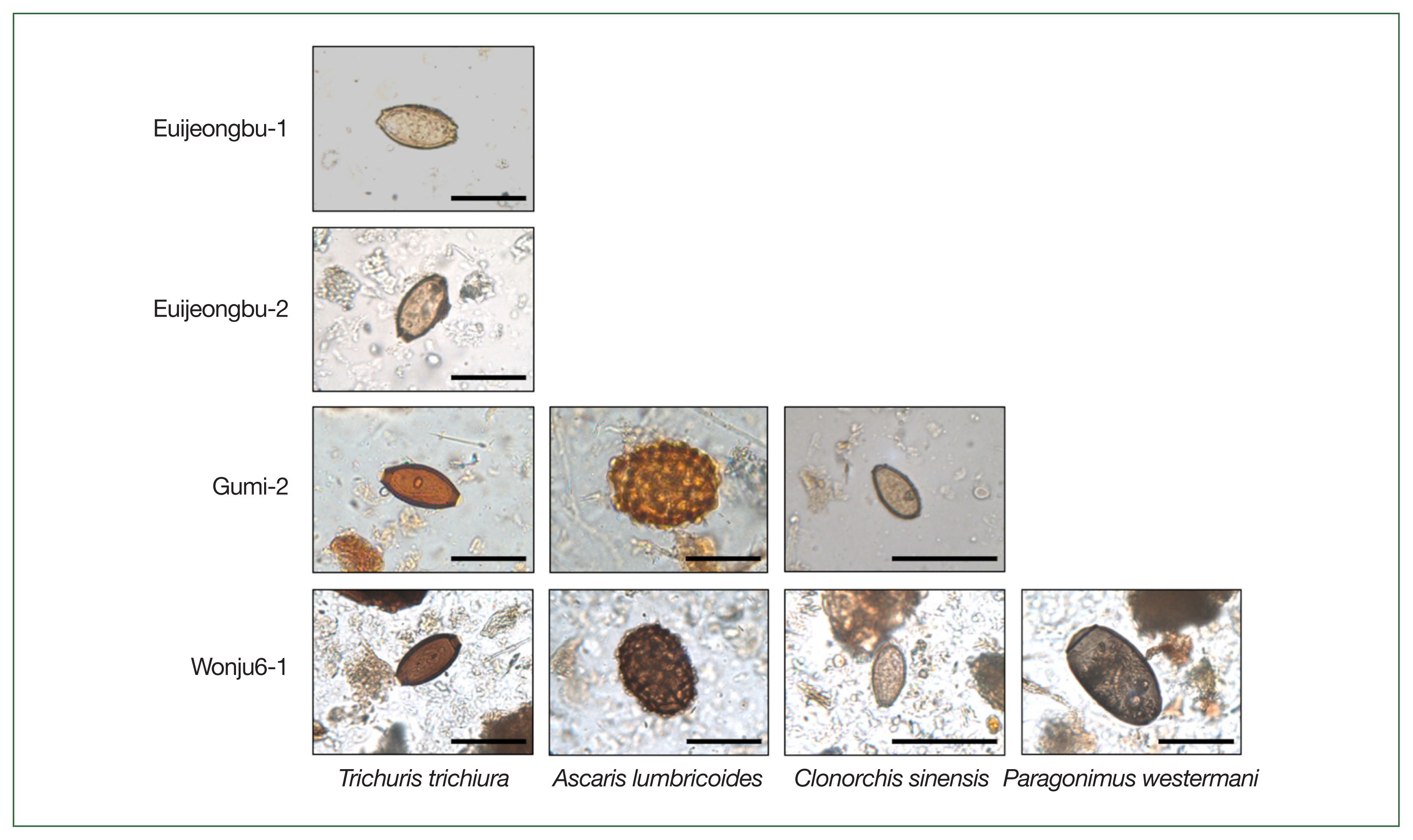
Microscopic analyses revealed that mummy coprolites comprised the following variety of ancient parasite eggs:
T. trichiura in Euijengbu-1 and -2;
T. trichiura, A. lumbricoides, and
C. sinensis in Gumi-2; and
T. trichiura, A. lumbricoides, C. sinensis, and
P. westermani in Wonju6-1 (
Fig. 2). Average egg sizes are presented in
Table 1.
Table 2 shows the present and previous data of parasitological examinations (total case number=30). The overall positive infection rates of soil-transmitted helminths during the Joseon period were 86.7% (26/30) for
T. trichiura and 56.7% (17/30) for
A. lumbricoides. Regarding trematodes,
C. sinensis and
P. westermani infection rates were estimated to be 30.0% (9/30) and 30.0% (9/30), respectively. Compared with the Joseon period results (
n=24) reported by Seo et al. [
1], the estimated overall infection rate obtained in the present study is slightly different, albeit the difference is not significant.
Since limited information is available on parasite infection patterns in the Joseon period society, studies on Korean mummies are invaluable to parasitologists. Over the last few years, parasitological data on Joseon period mummy coprolites have been reported [
2]. The results of the present study provide additional information to re-estimate the parasite infection rate in the Joseon society. Moreover, only a slight difference was observed between the present data and the last estimate of the Joseon period infection rate reported by Seo et al. [
1]. Thus, we confirmed the changing pattern of parasite infection prevalence throughout the Joseon period to 21st century in Korea reported by Seo et al. [
1]. Briefly, the infection prevalence of the trematodes
C. sinensis and
P. westermani was lower than that of the nematodes
A. lumbricoides and
T. trichiura. The trematode infection rates obtained from the data of the 1971 study and those obtained from the Joseon period are very different (26.7 and 4.6% for
C. sinensis, respectively, and 33.3% and 0.09% for
P. westermani, respectively). In contrast, the nematode infection rates in the Joseon period (83.3% for
T. trichiura and 60.0% for
A. lumbricoides) remained almost the same until 1971 (65.4% for
T. trichiura and 54.9% for
A. lumbricoides) but were greatly decreased (0.2% for
T. trichiura and 0.3% for
A. lumbricoides) in 1992. Various hypotheses have been proposed to explain these historical changes in the rate of parasitic infection [
7]; however, none explains it completely so far. Further research and discussion are needed to accurately comprehend this subject.
Analyzing parasite infection during the Joseon period and comparing it with the 20th century national survey data provide remarkable insights into historical parasitism in premodern Korean society that could not be obtained using conventional research. In this regard, periodical updates with newly discovered cases provide supplementary information that further reinforces the reliability of our data on Joseon parasite infection. The present study analyzed newly discovered mummy coprolites and confirmed the human parasite infection rates in the Joseon society estimated previously by examining mummy coprolites.
Notes
-
Author contributions
Conceptualization: Oh CS, Shin DH
Data curation: Oh CS, Shin DH, Seo M
Formal analysis: Oh CS
Investigation: Min S, Oh KT, Seol J, Song MK
Methodology: Chai JY, Seo M
Validation: Chai JY, Seo M
Visualization: Oh CS
Writing – original draft: Oh CS, Shin DH, Seo M
Writing – review & editing: Oh CS, Shin DH, Seo M
-
All authors declare no conflict of interest.
Acknowledgments
This work was supported by the National Research Foundation of Korea (NRF) grant funded by the Korea government (NRF-2022R1C1C1013540). This study was conducted after obtaining a review exemption from the Institutional Review Board of Eulji University (IRB No. EU22-40).
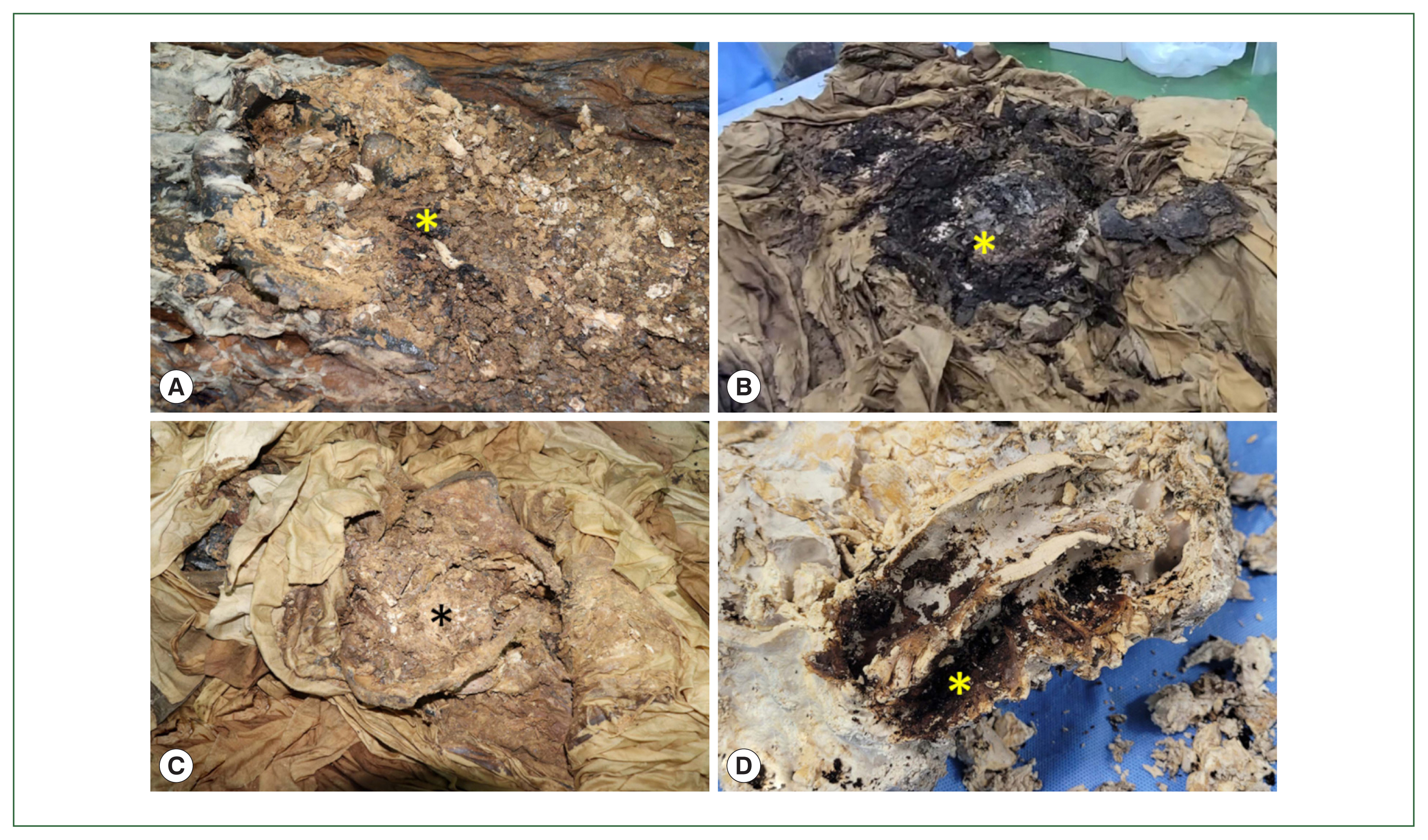
Fig. 1Organic materials precipitated on the pelvic or abdominal regions of the 4 human remains examined in the present study. (A) Wonju6-1, (B) Euijeongbu-1, (C) Euijeongbu-2, and (D) Gumi-2 cases. *Indicate the sampling location for the archaeoparasitological analysis.
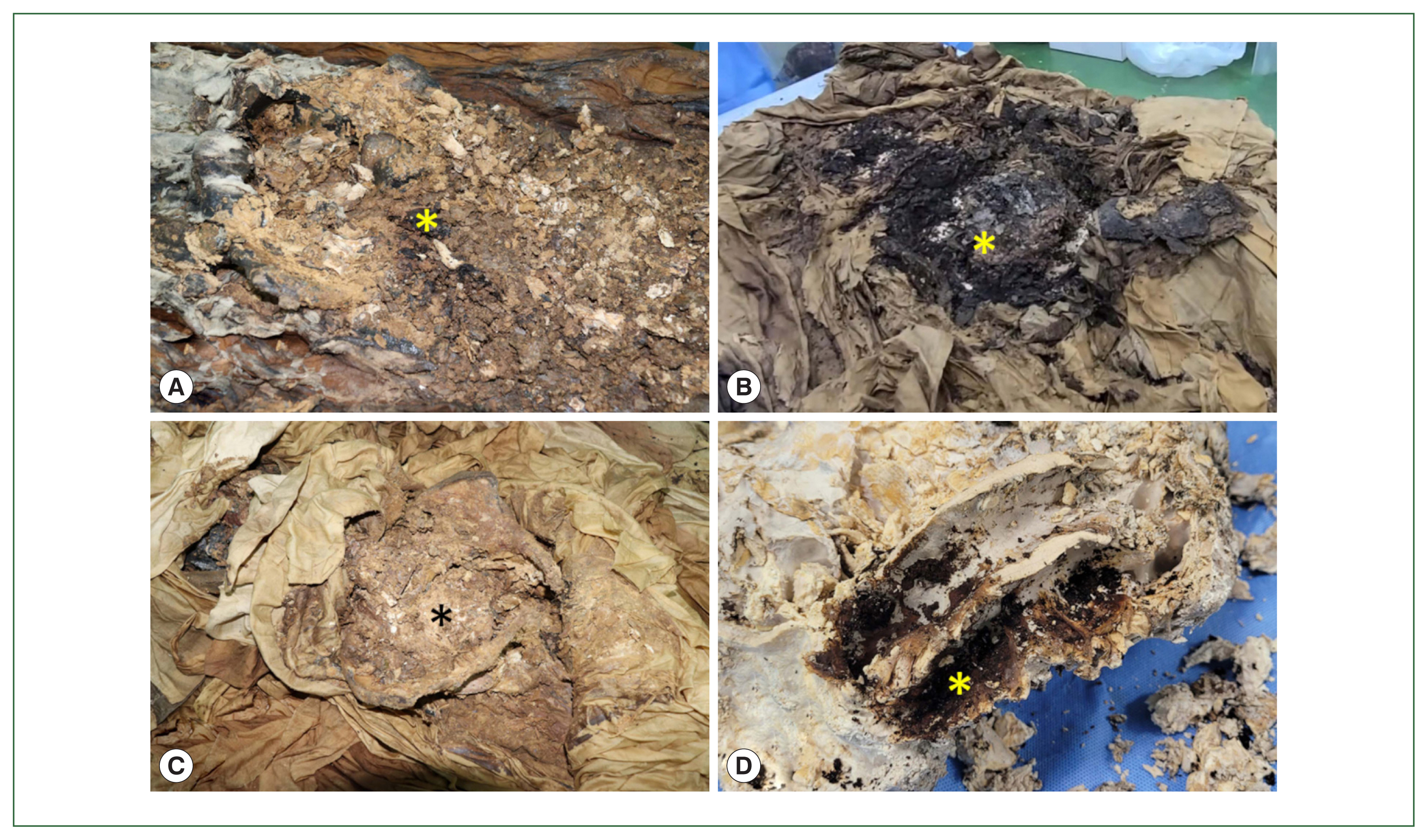
Fig. 2Parasite eggs found in the feces of 4 mummified human remains (Euijeongbu-1, Euijeongbu-2, Gumi-2, and Wonju6-1). Scale bars, 50 μm.
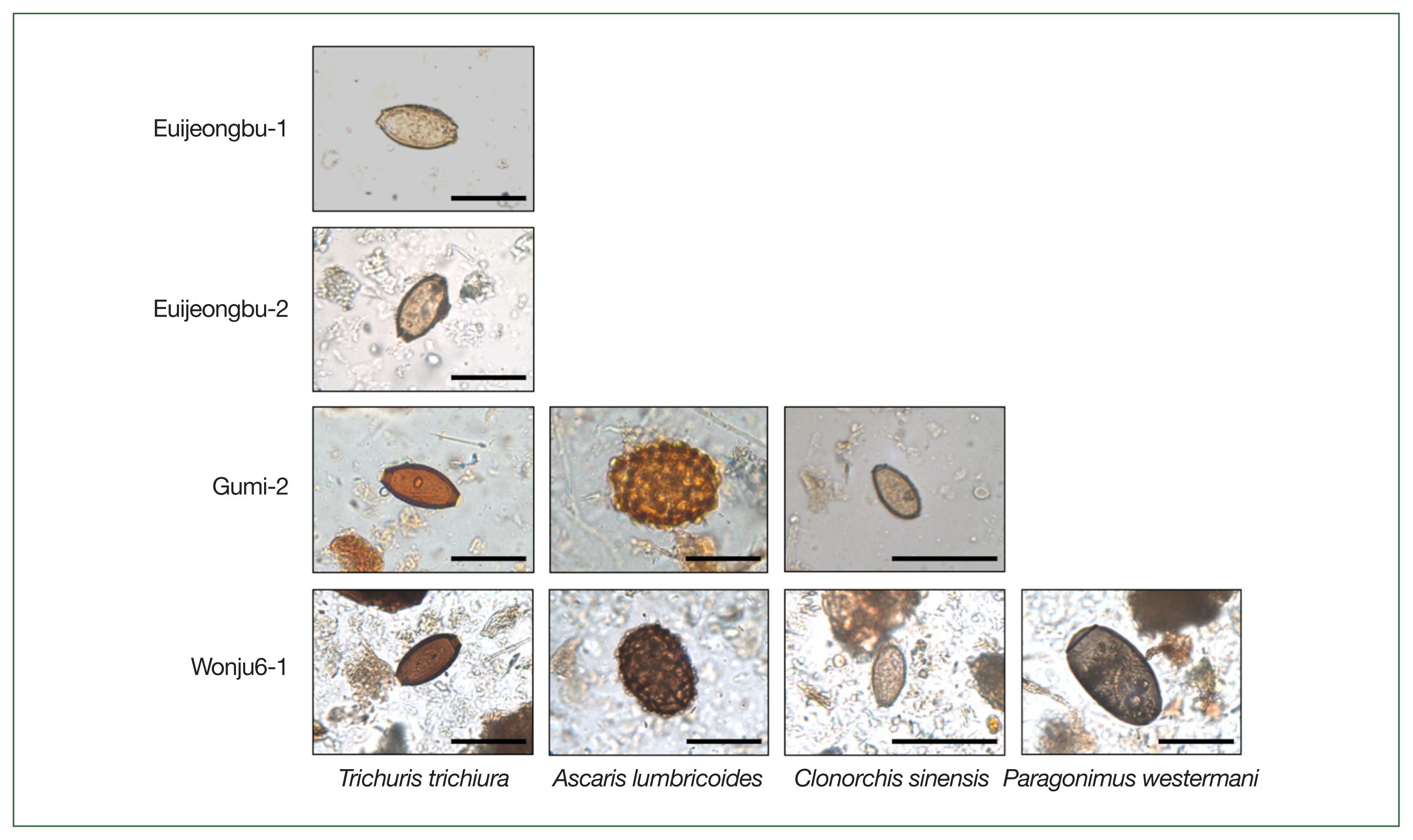
Table 1The information on Joseon period human remains examined in this study and archaeoparasitological data
Table 1
|
Cases |
Year of excavation |
Estimated date |
Affiliations of archaeologists |
Parasite eggs identified |
Average dimensions (μm) |
EPGa
|
|
Wonju6-1 |
2020 |
16–17Cb
|
Nuri Institute for Archaeology |
T. trichiura
|
54.4×25.1 |
666.7 |
|
|
|
|
A. lumbricoides
|
69.5×53.5 |
1,040.0 |
|
|
|
|
C. sinensis
|
27.5×15.0 |
146.7 |
|
|
|
|
P. westermani
|
84.8×46.1 |
266.7 |
|
|
Uijeongbu-1 |
2021 |
18Cc
|
Sudo Institute of Cultural Heritage |
T. trichiura
|
49.2×24.2 |
339.0 |
|
Uijeongbu-2 |
2021 |
18Cc
|
Sudo Institute of Cultural Heritage |
T. trichiura
|
48.9×24.7 |
1,872.3 |
|
Gumi-2 |
2022 |
17Cc
|
Sejong Research Institute of Cultural Heritage |
T. trichiura
|
57.5×25.0 |
1,666.7 |
|
|
|
|
A. lumbricoides
|
73.5×60.5 |
10,833.3 |
|
|
|
|
C. sinensis
|
29.1×15.0 |
30,833.3 |
Table 2Archaeoparasitological results of Korean mummies
a
Table 2
|
No. |
Cases |
Archaeological Remarks |
Location discovered |
Estimated date |
Ascaris lumbricoides
|
Trichuris trichiura
|
Clonorchis sinensis
|
Paragonimus westermani
|
|
1 |
Yongin |
Female |
Yongin, Gyeonggi-do |
15–16C |
+ |
+
|
|
+ |
|
2 |
Jinju |
Male |
Jinju, Gyeongsangnam-do |
15–16C |
+ |
+
|
|
+ |
|
3 |
Sapgyo |
A male mummy found at the coastal country of Yellow Sea |
Yesan, Chungcheongnam-do |
16C |
|
+
|
+ |
|
|
4 |
Hadong-2 |
Female |
Hadong, Gyeongsangnam-do |
16–17C |
|
|
|
+ |
|
5 |
Hadong-1 |
A female mummy from the coastal grave |
Hadong, Gyeongsangnam-do |
17C |
|
|
+ |
|
|
6 |
Sacheon |
Female |
Sacheon, Gyeongsangnam-do |
1620–1630 |
|
|
|
|
|
7 |
Gangneung |
A male mummy of Gangneung Choi clan |
Gangneung, Gangwon-do |
1622 |
|
+
|
|
|
|
8 |
Dangjin |
Female |
Dangjin, Chungcheongnam-do |
1633 |
+ |
|
|
+ |
|
9 |
Mungyeong |
A middle-aged female (1560s CE); Not married |
Mungyeong, Gyeongsangbuk-do |
1647 |
|
+
|
+ |
|
|
10 |
Waegwan |
Male |
Chilgok, Gyeongsangbuk-do |
1624–1685 |
|
+
|
+ |
|
|
11 |
PJ SM |
Female |
Paju, Gyeonggi-do |
1699 |
+ |
+
|
|
|
|
12 |
Seocheon |
Female |
Yongin, Gyeonggi-do |
17C |
+ |
+
|
|
|
|
13 |
Yangju |
A child mummy |
Yangju, Gyeonggi-do |
17C |
+ |
+
|
+ |
|
|
14 |
SN 1–2 |
The tombs from the cemetery of Seoul people during Joseon Dynasty period; Urban people |
Sinnae, Seoul |
1605–1733 |
|
+
|
|
|
|
15 |
SN3-7-1 |
|
Sinnae, Seoul |
16–17C |
|
+
|
|
|
|
16 |
SN2-19-1 |
|
Sinnae, Seoul |
1765±10 |
+ |
+
|
|
|
|
17 |
SN2-19-2 |
|
Sinnae, Seoul |
1755±10 |
+ |
+
|
|
|
|
18 |
GJ1-2 |
Wife and husband buried together at the same grave (GJ1-2 is a husband) |
Gongju, Chungcheongnam-do |
17–18C |
+ |
+
|
|
+ |
|
19 |
Hwasung |
Rich jungin class individual |
Hwasung, Gyeonggi-do |
18C |
+ |
+
|
|
+ |
|
20 |
Andong |
Economically poor yangban; A low-ranking official (chambong) |
Andong, Gyeongsangbuk-do |
16C |
|
+
|
+ |
|
|
21 |
YG2-4 |
A housewife from a family of official |
Yonggwang, Jeollanam-do |
15–16C |
+ |
+
|
|
+ |
|
22 |
YG2-6 |
Similar to YG2-4. |
Yonggwang, Jeollanam-do |
15–16C |
+ |
+
|
|
+ |
|
23 |
Danlsung |
A housewife from yangban family |
Dalsung, Daegu |
16–17C |
+ |
+
|
|
|
|
24 |
Junggye |
Socioeconomic status looks very high; Urban people |
Junggye, Seoul |
16–17C |
+ |
+
|
|
|
|
25 |
Goryeong |
A widow named Gwak; a freed female emancipated from slavery |
Goryeong, Gyeongsangbuk-do |
17C |
|
+
|
+ |
|
|
26 |
Gwangmyeong |
Female |
Gwangmyeong, Gyeonggi-do |
17C |
+ |
+
|
|
|
|
27 |
Wonju6-1 |
Female |
Wonju, Gangwon-do |
16–17C |
+ |
+
|
+ |
+ |
|
28 |
Uijeongbu-1 |
Male; Married Eunuch; Official in Joseon Dynasty government |
Uijeongbu, Gyeonggi-do |
18C |
|
+
|
|
|
|
29 |
Uijeongbu-2 |
The wife of Uijeongbu-1 |
Uijeongbu, Gyeonggi-do |
18C |
|
+
|
|
|
|
30 |
Gumi-2 |
Male |
Gumi, Gyeongsangnam-do |
17C |
+ |
+
|
+ |
|
References
- 1. Seo M, Oh CS, Hong JH, Chai JY, Cha SC, et al. Estimation of parasite infection prevalence of Joseon people by paleoparasitological data updates from the ancient feces of pre-modern Korean mummies. Anthropol Sci 2017;125(1):9-14.
- 2. Seo M, Hong JH, Reinhard K, Shin DH. Archaeoparasitology of Korean mummies. In: Shin DH, Bianucci R, editors. The Handbook of Mummy Studies. Springer; Singapore. 2021. https://doi.org/10.1007/978-981-15-1614-6_14-2
- 3. Han ET, Guk SM, Kim JL, Jeong HJ, Kim SN, Chai JY. Detection of parasite eggs from archaeological excavations in the Republic of Korea. Mem Inst Oswaldo Cruz 2003;98(Suppl 1):123-126. https://doi.org/10.1590/s0074-02762003000900018
- 4. Reinhard K, Urban O. Diagnosing ancient diphyllobothriasis from Chinchorro mummies. Mem Inst Oswaldo Cruz 2003;98(Suppl 1):191-193. https://doi.org/10.1590/s0074-02762003000900028
- 5. Korea Association of Health Promotion. Prevalence of Intestinal Parasitic Infections in Korea: the 8th Report. Korea Association of Health Promotion; Seoul, Korea. 2012.
- 6. Shin H, Lee M, Bahk S, Lee Y, Ju J, Lee H. The current status of the elimination project on intestinal parasitic diseases in 2019. Public Health Weekly Report 2020;13(29):2146-2148.
- 7. Zhan X, Yeh HY, Shin DH, Chai JY, Seo M, Mitchell PD. Differential change in the prevalence of the Ascaris, Trichuris and Clonorchis infection among past East Asian Populations. Korean J Parasitol 2019;57(6):601-605. https://doi.org/10.3347/kjp.2019.57.6.601
- 8. Oh CS, Lee H, Kim J, Hong JH, Cha SC, et al. Two helminthic cases of human mummy remains from Joseon-period graves in Korea. Korean J Parasitol 2021;59(2):149-152. https://doi.org/10.3347/kjp.2021.59.2.149
Citations
Citations to this article as recorded by

- A parasitological study on the possible toilet ruins of the Japanese colonial period in Korea
Jieun Kim, Min Seo, Hisashi Fujita, Jong Yil Chai, Jin Woo Park, Jun Won Jang, In Soo Jang, Dong Hoon Shin
Parasites, Hosts and Diseases.2023; 61(2): 198. CrossRef - Paleoparasitology research on ancient helminth eggs and larvae in the Republic of Korea
Jong-Yil Chai, Min Seo, Dong Hoon Shin
Parasites, Hosts and Diseases.2023; 61(4): 345. CrossRef


 , Jong-Yil Chai2