Abstract
One coastal village in Haenam-gun and two in Yeongam-gun, Jeollanam-do were surveyed for intestinal parasite infections by fecal examination. The egg positive rates of Gymnophalloides seoi were high, 24.1% (14/58) in Haenam-gun and 9.3% (11/118) in Yeongam-gun. The egg positive rates of heterophyids, including Heterophyes nocens, and of Clonorchis sinensis were 10.3% and 6.9% in Haenam-gun, and 14.4% and 8.5% in Yeongam-gun, respectively. After praziquantel treatment and purgation, a total of 37,761 fluke specimens were recovered from 17 patients; 11 in Haenam-gun and 6 in Yeongam-gun. Gymnophalloides seoi was the most commonly recovered species, with 37,489 specimens in total (2,205 per person). Other recovered flukes included Heterophyes nocens, Stictodora fuscata, Heterophyopsis continua, Pygidiopsis summa, and undetermined species. These results indicate that the areas surveyed are new endemic foci of G. seoi.
-
Key words: Gymnophalloides seoi, heterophyid, Heterophyes nocens, Clonorchis sinensis, prevalence, worm burden
INTRODUCTION
Gymnophalloides seoi Lee, Chai, and Hong, 1993 (Digenea: Gymnophallidae) was described as a new human intestinal trematode, after the recovery of adult flukes from a female patient suffering from acute pancreatitis (
Lee et al., 1993;
Chai et al., 2003). Natural oysters,
Crassostrea gigas, were proven to be the source of human infections with
G. seoi (
Lee et al., 1995). After the discovery of this first human case, the patient's home village, which was located on a southwestern offshore island (Aphaedo, Shinan-gun, Jeollanam-do) was surveyed for
G. seoi infection. The first study conducted in this area revealed a 49.0% egg positive rate for
G. seoi (
Lee et al., 1994), and it was later confirmed that re-infection cycle persists in this village (
Chai et al., 2000).
Epidemiological surveys were undertaken in several other localities. Two islands, Munyodo and Sunyudo, Kunsan-shi, Jeollabuk-do (
Lee et al., 1999), and 2 coastal villages in Muan-gun, Jeollanam-do and in Puan-gun, Jeollabuk-do, were found to be low-grade endemic areas of
G. seoi infection (
Chai et al., 1998a). Subsequently, a total of 24 small villages on western and southern coastal islands were documented as new endemic areas (
Chai et al., 2001). However, further study is needed to figure out more precisely the distribution and endemicity of
G. seoi infection in the Republic of Korea. Thus, the present study was undertaken to determine the prevalence and intensity of
G. seoi infection in coastal areas of Haenam-gun and Yeongam-gun, Jeollanam-do.
MATERIALS AND METHODS
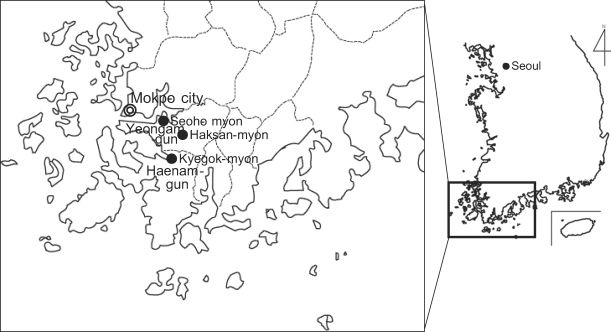
The village of Kyegok-myon, Haenam-gun (hereafter Haenam-gun), and the villages of Haksan-myon and Seoho-myon, Yeongam-gun, Jeollanam-do (hereafter Yeongam-gun) were subjected to an epidemiological survey for
G. seoi infection from August to November, 2003 (
Fig. 1). These villages are removed from the sea and estuaries, and hence, natural oysters and other kinds of bivalves are unavailable locally. The majority of villagers are engaged in agriculture. Fecal samples were collected from 58 inhabitants of Haenam-gun and from 118 in Yeongam-gun, and examined using the cellophane thick smear and formalin-ether sedimentation techniques, followed by modified acid-fast staining to detect
Cryptosporidium
oocysts.
After fecal examination, 11 (Haenam-gun) and 6 (Yeongam-gun) G. seoi or heterophyid egg positive cases were treated with a single oral dose of 10 mg/kg praziquantel, and purged with 30 g magnesium sulfate. One hour later, whole diarrheic stools were individually collected and washed several times with tap water. The sediments obtained were fixed with 1% formalin, and transferred to our laboratory. Flukes were collected using a stereomicroscope, flattened gently under a cover slip pressure, fixed with 10% neutral buffered formalin, and stained with Semichon's acetocarmine for species identification. The statistical significances of positive rate differences between males and females and age groups were analyzed using the Student's t-test.
RESULTS
Overall helminth egg/protozoan oocyst positive rates were 37.9% in Haenam-gun and 28.0% in Yeongam-gun (
Table 1); an overall total of 31.3% of all surveyed. Six villagers (10.3%) in Haenam-gun and 11 (9.3%) in Yeongam-gun were found to be infected with more than 2 types of parasite (
Table 1). The egg positive rates of intestinal trematodes, namely
G. seoi,
Heterophyes nocens, and other species of heterophyids, were high in both surveyed areas. The egg positive rates of
G. seoi were 24.1% in Haenam-gun and 9.3% in Yeongam-gun, and the combined rates of
H. nocens and other heterophyids were 10.3% and 14.4%, respectively (
Table 1).
When fecal examination results were analyzed by age group, the highest overall parasite positive rate was observed in those 21-40 years old (60.0%), followed by those 41-60 (37.0%) and 61-80 years old (27.4%). The positive rates of men (35.9%; 28/78) and women (27.6%; 27/98) were not significantly different (
P > 0.05). With regard to
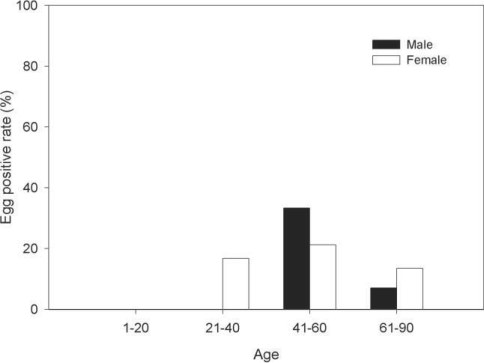
G. seoi infection, the highest egg positive rate was observed in those 41-60 years old (25.9%), followed by those 61-80 (10.5%) and 21-40 years old (10.0%) (
Fig. 2).
Gymnophalloides seoi egg positive rates were not significantly different (
P > 0.05) between men (12.8%; 10/78) and women (15.3%;
15/98).
Seventeen egg positive cases of
G. seoi or heterophyid flukes in the surveyed areas cooperated in the collection of adult flukes after treatment with praziquantel and MgSO
4 purgation. Informed consent on the worm collection was obtained from each person. The adult specimens of
G. seoi (37,489 in total number; 2,205 per person),
Heterophyes nocens (248; 27.6),
Stictodora fuscata (10; 5.0),
Heterophyopsis continua (7; 7.0),
Pygidiopsis summa (3; 1.5), and an undetermined species (4; 2.0) were recovered in diarrheic stools (
Table 2). In Haenam-gun, a total of 34,044 (range 28-17,231; av. 3,404 per person) adult
G. seoi specimens were collected from 10 of 11 treated cases, and in Yeongam-gun, a total of 3,445 (range 2-1,503; av. 689) adult
G. seoi were collected from 5 of 6 treated cases (
Table 2). Mixed infections with 2-4 kinds of heterophyids were detected in 6 (Haenam-gun) and 5 (Yeongam-gun) cases.
DISCUSSION
This study shows that the 3 coastal villages (1 in Haenam-gun and 2 in Yeongam-gun, Jeollanam-do) are endemic areas of
G. seoi infection, which is particularly interesting because these villages are far (more than 50 km) from the sea and estuaries. The villagers from all 3 villages reported that they obtained raw oysters, the source of
G. seoi infection (
Lee et al., 1995), from a local market named Dokchun-jang (located in southern Yeongam-gun). It was said that these oysters are usually brought from Muan-gun (Jeollanam-do), Tongyeong-gun (Kyongsangnam-do), and Jindo-gun (Jeollanam-do). Thus, we purchased oysters from this market and examined them for
G. seoi metacercarial infection, and found that only oysters from Muan-gun were infected with
G. seoi metacercariae (data not shown). Based on this finding, it is believed that oysters brought from Muan-gun and other localities are the source of
G. seoi infection among the villagers.
The prevalences of
G. seoi in villagers from Haenam-gun and Yeongam-gun were lower than those reported from other endemic areas of Shinan-gun, i.e., off-shore islands in the western sea, including Aphaedo (49.0-72.0%) (
Lee et al., 1994;
Chai et al., 2000), and Amtaedo (25.3%) and Cheungdo (25.0%) (
Chai et al., 2001). However, the observed prevalences in Haenam-gun and Yeongam-gun were higher than those in Muan-gun (3.7%) (
Chai et al., 1997), Puan-gun (9.1%) (
Chai et al., 1998a), and on several offshore islands in the western and southern seas (lower than 10.0%) (
Chai et al., 2001).
The individual worm burdens of
G. seoi among villagers were lower than those in Aphaedo, Shinan-gun (
Lee et al., 1994;
Chai et al., 2000), but higher than those in Muan-gun (
Chai et al., 1997) and Puan-gun (
Chai et al., 1998a). However, 5 of 10 treated cases in Haenam-gun were found to have more than 1,000 adult flukes. Such heavy infections of
G. seoi must have been caused by frequent and repeated raw oyster consumption. All infected individuals stated that they had eaten raw oysters purchased from the Dokchun-jang local market.
It is difficult to precisely determine the geographical distribution of
G. seoi. Endemic areas have been reported only from western and southern coastal areas of the Republic of Korea (
Chai et al., 2003). It is has been suggested that the distribution of
G. seoi may be related with the distribution of natural oysters, which are known to be distributed from the southern to the western coastal areas (
Shim et al., 1998). Countrywide surveys have been performed to determine the distribution of
G. seoi infected oysters (
Lee et al., 1996). High prevalences of
G. seoi metacercariae were discovered in oysters produced from Shinan-gun, whereas low-grade prevalences were detected in oysters in nearby areas such as Puan-gun, Jeollabuk-do (
Lee et al., 1996).
The oystercatcher
Haematopus ostralegus has also been reported to be a natural definitive host of
G. seoi (
Ryang et al., 2000). These are migratory birds and are temporary visitors or overwintering species in the Republic of Korea (
David and David, 1995). Therefore, the distribution of
G. seoi may be more extensive than has been previously considered. In particular,
G. seoi probably also exist in other countries, such as China, Japan, and the eastern coast of Russia (
Ryang et al., 2000).
In addition to
G. seoi, other intestinal flukes, including
H. nocens,
H. continua,
P. summa, and
S. fuscata, were harvested. These flukes are contracted by consuming raw brackish water fishes, such as mullets, gobies, and perches (
Chai and Lee, 2002). Human
H. nocens,
H. continua,
P. summa, and
S. fuscata infections have been repeatedly reported in different localities; Shinan-gun (
Chai et al., 1994) and Muan-gun, Jeollanam-do (
Chai et al., 1997), Puan-gun, Jeollabuk-do (
Chai et al., 1998a), and Sachon-gun, Kyongsangnam-do (
Chai et al., 1998a). A case of
S. fuscata infection was described from a young man, who regularly ate raw mullets and gobies (
Chai et al., 1988b). Thirteen additional human cases of
S. fuscata were subsequently found in a seaside village in the southwestern coastal area (
Chai and Lee, 2002). In the present study, 2 more cases of
S. fuscata infections were confirmed among villagers of Yeongam-gun, Jeollanam-do.
Notes
-
This work was supported by the BK21 Human Life Sciences Projects of the Ministry of Education, Republic of Korea.
References
Fig. 1Map showing the Republic of Korea (right panel) and 3 surveyed villages in Haenam-gun (1 village) and Yeongam-gun (2 villages), Jeollanam-do (left panel). All these villages are located far (more than 50 km) from the estuaries where oysters are naturally available.
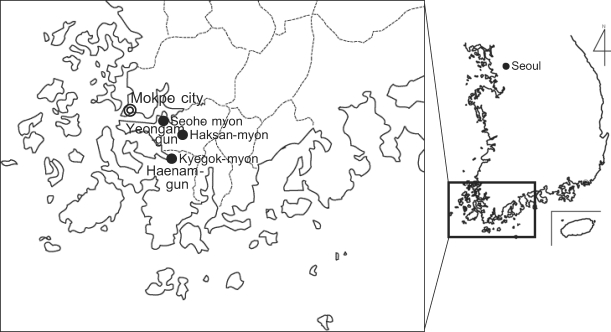
Fig. 2Age-prevalence of Gymnophalloides seoi infection among the inhabitants of the 3 surveyed villages (total). The 41-60 year old male age group showed highest prevalence.
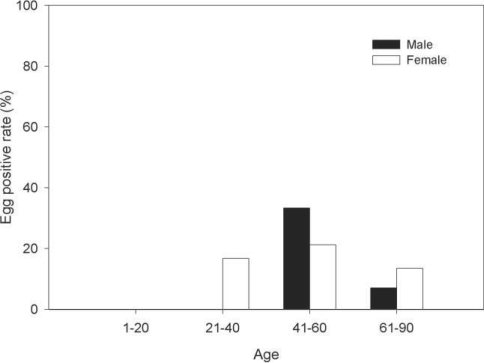
Table 1.Prevalence of helminth eggs and Cryptosporidium oocysts in the feces of inhabitants of 3 villages in Jeollanam-do (2003)
Table 1.
|
Parasite |
No. positive (%)
|
|
Haenam-gun |
Yeongam-gun |
|
No. examined |
58 |
118 |
|
No. overall egg and oocyst |
|
|
|
positive casesa)
|
22 (37.9) |
33 (28.0) |
|
Gymnophalloides seoi
|
14 (24.1) |
11 (9.3) |
|
heterophyids |
6 (10.3) |
17 (14.4) |
|
Clonorchis sinensis
|
4 (6.9) |
10 (8.5) |
|
Cryptosporidium parvum
|
2 (3.5) |
5 (4.2) |
Table 2.Number of Gymnophalloides seoi and heterophyid fluke specimens recovered from egg positive cases after praziquantel treatment and purgation
Table 2.
|
Parasites |
Haenam-gun
|
Yeongam-gun
|
Total
|
|
No. of villagers |
No. worms collected |
No. of villagers |
No. worms collected |
No. of villagers |
No. worms collected |
|
Gymnophalloides seoi
|
10 |
34,044 |
5 |
3,445 |
15 |
37,489 |
|
Heterophyes nocens
|
4 |
35 |
5 |
213 |
9 |
248 |
|
Stictodora fuscata
|
0 |
0 |
2 |
10 |
2 |
10 |
|
Heterophyopsis continua
|
1 |
7 |
0 |
0 |
1 |
7 |
|
Pygidiopsis summa
|
1 |
2 |
1 |
1 |
2 |
3 |
|
Unidentified trematode |
1 |
1 |
1 |
3 |
2 |
4 |