Abstract
The infection status of mullets Mugil cephalus (n = 139) and gobies (n = 35) Acanthogobius flavimanus with metacercariae of Heterophyes nocens and Pygidiopsis summa was examined in 11 western, southern, and eastern coastal areas of the Republic of Korea, using a digestion technique. Heterophyid metacercariae were highly prevalent in mullets from western and southern coastal areas; Shinan-gun (100% for H. nocens and 100% for P. summa), Muan-gun (93% and 100%), Buan-gun (42% and 75%), Seocheon-gun (73% and 53%), Ganghwa-gun (47% and 100%), Sacheon-shi (47% and 77%), and Gangjin-gun (50% and 70%, respectively). Only 1 (10%) of 10 mullets from an eastern coastal area, i.e., Donghae-shi, was positive for P. summa metacercariae. Metacercarial densities were the highest in the trunk of mullets for H. nocens and the gill for P. summa. Gobies from Muan-gun were positive for H. nocens (40%) and P. summa metacercariae (40%), and gobies from Seocheon-gun revealed H. nocens metacercariae (20%). The metacercarial density was remarkably higher in mullets than in gobies. The results revealed that H. nocens and P. summa metacercariae are prevalent in mullets and gobies from coastal areas of the Republic of Korea, and the prevalence and intensity of infection vary according to geographical locality.
-
Key words: Heterophyes nocens, Pygidiopsis summa, metacercaria, mullet, goby
INTRODUCTION
Heterophyes nocens and
Pygidiopsis summa are minute intestinal trematodes of the family Heterophyidae Odhner, 1914 (= heterophyids) infecting avian and mammalian hosts. Human infections with these heterophyids in the Republic of Korea were first reported from inhabitants residing in Okku-gun, Jeollabuk-do who habitually consumed raw flesh of mullets (
Seo et al., 1981a). Subsequently, their endemicities were recorded in western coastal areas, including Shinan-gun, Muan-gun, and Buan-gun (
Chai et al., 1997,
1998,
2000;
Chai and Lee, 2002). In many coastal islands, wide distribution of human
H. nocens and
P. summa infections was also reported (
Chai et al., 2004).
The main source of human infection with heterophyids, i.e.,
H. nocens and
P. summa, is brackish water fish, including mullets
Mugil cephalus and gobies
Acanthogobius flavimanus (
Chun, 1963;
Seo et al., 1980,
1981b). More than 20 years ago, high prevalence of these heterophyid metacercariae was reported in mullets and gobies collected from several southwestern coastal areas of the Republic of Korea (
Seo et al., 1981b). However, further information on geographical distribution of fish intermediate hosts, and prevalences and metacercarial densities of
H. nocens and
P. summa in fish, has not been available.
Metacercarial infections in fish could affect the prevalence of definitive hosts in local areas (
Seo et al., 1982;
Song et al., 1985;
Chai and Lee, 2002). Therefore, studies on metacercarial infections in brackish water fish could give useful information on the present status as well as strategies for prevention of human infections. The present study was performed to determine the current status of geographical distribution of
H. nocens and
P. summa infections based on detection of metacercariae in mullets and gobies in western, southern, and eastern coastal areas of the Republic of Korea.
MATERIALS AND METHODS
Surveyed areas
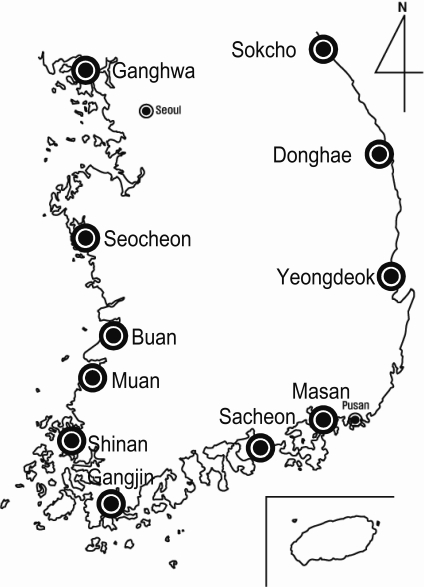
A total of 11 coastal areas, i.e., 5 western coastal areas (Shinan-gun, Muan-gun, Buan-gun, Seocheon-gun, and Ganghwa-gun), 3 southern coastal areas (Masan-shi, Sacheon-shi, and Gangjin-gun), and 3 eastern coastal areas (Sokcho-shi, Donghae-shi, and Yeongdeok-gun), were selected according to geographical locations (
Fig. 1) and sea water flows.
A total of 139 mullets were caught from 11 localities during the period from April 2002 to June 2003, and examined for H. nocens and P. summa metacercariae. Their body size and weight were in the range, 12-48 cm and 13-1,050 g, respectively. A total of 35 gobies were collected from 3 western coastal areas.
To determine the infection rate and metacercarial density, the fish body was divided into head, gill, trunk, fin and tail, and visceral organs. Each body part was digested in 0.6% pepsin-HCl solution and filtered through a mesh (pore size: 1 mm in diam.) to remove large tissue debris. The precipitates were examined for metacercariae using a stereomicroscope. The metacercariae were identified according to the size and shape of metacercarial cysts, and characteristic features of internal structures. The metacercarial cysts of H. nocens were round or slightly ellipsoid, measuring 0.16-0.20 by 0.13-0.19 mm. Their excretory bladder was round and bluish brown or dark pinkish. The metacercarial cysts of P. summa were globular, round to elliptical, and measured 0.19-0.29 by 0.16-0.29 mm. Their excretory bladder was an X- or I-shaped and dark brown in color. These metacercariae were finally identified obtaining adult flukes a week after experimental infection to 8-week-old Sprague-Dawley (SD) rats.
RESULTS
Metacercariae in mullets
Of 139 mullets examined, metacercariae of
H. nocens were found in 70 mullets (50%) and those of
P. summa were detected in 88 mullets (63%) (
Table 1). The mullets infected with
H. nocens metacercariae were found in 7 areas; chiefly western and southern coastal areas (
Table 1). All mullets from Shinan-gun were found infected with
H. nocens metacercariae. Metacercariae of
H. nocens were positive in mullets from Muan-gun (positive rate: 93%), Seocheon-gun (73%), Gangjin-gun (50%), Sacheon-shi (47%), Ganghwa-gun (47%), and Buan-gun (42%). No
H. nocens metacercariae were found in mullets from eastern coastal areas, i.e., Sokcho-shi, Donghae-shi, and Yeongdeok-gun. The metacercariae of
P. summa were found in mullets from Shinan-gun (100%), Muan-gun (100%), Ganghwa-gun (100%), Sacheon-shi (77%), Buan-gun (75%), Gangjin-gun (70%), Seocheon-gun (53%), and Donghae-shi (10%) (
Table 1). The infection rate of heterophyid metacercariae in mullets from western (
H. nocens 35% and
P. summa 54%) and southern coastal areas (74% and 87%, respectively) were higher than those from eastern coastal areas (0% and 4%, respectively).
A total of 8,132
H. nocens metacercariae were collected from 70 infected mullets, and the average number of metacercariae per mullet was 116 (
Table 1). As to
P. summa, a total of 12,831 metacercariae were collected from 88 infected mullets, with the average number of metacercariae per mullet of 146 (
Table 1). The metacercarial density was the highest in mullets from Shinan-gun (av. no. of
H. nocens metacercariae per infected mullet was 271, and av. no. of
P. summa metacercariae was 483), followed by mullets from Seocheon-gun (134 and 30), Buan-gun (103 and 24), and Sacheon-shi (51 and 71, respectively) (
Table 1). The highest number of metacercariae infected in a fish was 2,314 for
H. nocens, and 3,106 for
P. summa in mullets from Shinan-gun (
Table 1).
With regard to the metacercarial distribution in body portions of fish, the density of
H. nocens metacercariae was the highest in the trunk (muscle) (71%), followed by the gill (21%) and head (7%) of mullets (
Table 2). The majority of
P. summa metacercariae were detected in the gill (76%), trunk (12%), and intestine (10%) of mullets (
Table 3). The distribution of metacercariae in the fish body was not different according to locality of mullets collected (
Tables 2,
3).
Gobies from Muan-gun were found infected with metacercariae of
H. nocens (40.0%) and
P. summa (40.0%) (
Table 4). However, gobies from Seocheon-gun were infected only with
H. nocens metacercariae (20.0%). Low metacercarial densities were observed in gobies from Muan-gun (av. 2 and 2 for
H. nocens and
P. summa metacercariae, respectively) and Seocheon-gun (av. 2 for
H. nocens metacercariae). No gobies from Ganghwa-gun were found infected with metacercariae of
H. nocens or
P. summa. In gobies from Muan-gun,
H. nocens metacercariae were found in the head, gill, and trunk, and in gobies from Seocheon-gun, they were found in the head and trunk (
Table 5). Metacercariae of
P. summa were found in the head and gill of gobies from Muan-gun (
Table 5).
The adult fluke grown in SD rats for a week after infection with 2 types of metacercariae were identified as H. nocens and P. summa, respectively (data not shown). No other species of flukes were found in the small intestines of experimental animals.
DISCUSSION
In the present study, wide variations in the prevalence of H. nocens and P. summa metacercariae were observed in mullets and gobies according to geographical locality, where the fish were caught. Mullets from western coastal areas were more highly infected with metacercariae of H. nocens and P. summa than mullets from southern and eastern coastal areas. Metacercarial densities in mullets also varied according to locality, i.e., low in Ganghwa-gun (4 per fish) and high in Shinan-gun (271) for H. nocens, and low in Gangjin-gun (2) and high in Shinan-gun (483) for P. summa. Moreover, individual mullet caught from the same area also revealed remarkable differences in the metacercarial density, for example, in Shinan-gun, the density ranged from 10 to 2,314 metacercariae for H. nocens and from 4 to 3,106 metacercariae for P. summa (n = 20 mullets).
The exact survey areas were different between the present study and several previous studies (
Seo et al., 1980,
1981b;
Sohn et al., 1989,
1994). However, the results of the present study were somewhat different from those of the previous studies. In the study progressed in 1980, all mullets caught from Ganghwa-gun were found free from infections with metacercariae of
H. nocens and
P. summa (
Seo et al., 1981b). However, in the present study,
H. nocens metacercariae were found in 7 (47%) of 15 mullets from Ganghwa-gun, and all (100%) mullets from Gangwha-gun were infected with
P. summa metacercariae. In the present study, mullets from Seocheon-gun were highly infected with metacercariae of
H. nocens (73%) and
P. summa (53%), however, in a previous study, no metacercariae of these species were found in 5 mullets from an area nearby the present surveyed area (
Seo et al., 1981b). These results may represent significant changes in the ecology of these heterophyid flukes in western coastal areas of the Republic of Korea.
Moreover, the highest metacercarial density (av. 271 metacercariae for
H. nocens, and av. 483 metacercariae for
P. summa) and high infection rates (both 100%) were observed in mullets from an island of Shinan-gun, a western coastal area, which is not far from 5 km from Mokpo-shi. These results agree to a previous study (
Seo et al., 1981b), in which all mullets caught from Mokpo-shi were found infected with metacercariae of
H. nocens and
P. summa. However, metacercarial densities in that survey (
H. nocens: 52,
P. summa: 23 metacercariae per mullet) were much lower than those observed in the present study.
Similarly, in southern coastal areas, the status of metacercarial infection in fish also seems to be variable according to the time of surveys. For example, Seo et al. (
1980) reported low infection rates (
H. nocens: 0%,
P. summa: 7%) and low metacercarial densities in 14 mullets caught from Sacheon-shi. However, remarkable increases in the infection rates (100% for both species) and metacercarial densities were reported in another study in a nearby area, Samcheonpo-shi (
Sohn et al., 1989). However, in the present study, out of 17 mullets, only 8 (47%) were infected with
H. nocens metacercariae and 13 (77%) were with
P. summa metacercariae. It is suggested that the ecology, in terms of endemicity, of
H. nocens and
P. summa around Sacheon-shi may have fluctuated during the 2 decades between the 1980s and the 2000s.
In eastern coastal areas, the infection rate and density of heterophyid metacercariae in mullets were very low both in the present study and in a previous study (
Seo et al., 1981b). For example, in Yeongdeok-gun, it was reported that 1 of 3 mullets examined was infected with
H. nocens metacercariae (
Seo et al., 1981b). However, in the present study, no metacercariae of
H. nocens and
P. summa were detected in 10 mullets from Yeongdeok-gun and 5 mullets from Sokcho-shi. Only 1 of 10 mullets from Donghae-shi was infected with
P. summa metacercariae.
In the present study, the majority of
H. nocens metacercariae were found in the trunk, gill, and head of mullets, and the majority of
P. summa metacercariae were found in the gill, trunk, and intestine. These results are similar to those of previous studies. Seo et al. (
1981b) reported metacercariae of
H. nocens and
P. summa in the muscle (90.9% and 0.7%, respectively) and gill (9.1% and 99.3%) of mullets. Sohn et al. (
1989) found
P. summa metacercariae in the head of mullets, including the gill (87.4%) and viscera (12.6%), and
H. nocens metacercariae in the muscle (82.2%) and head (17.8%) of mullets caught from Haenam-gun. However, metacercarial distribution of
H. nocens in a previous study in Sacheon-shi was quite different from that in the present study;
H. nocens metacercariae were found in the head (83.6%), muscle (16.2%), and viscera (0.2%) of mullets (
Sohn et al., 1994). The reasons and factors for this difference should be elucidated.
Only a few reports have been available on the infection of gobies with heterophyid metacercariae in the Republic of Korea. Infections with
H. nocens metacercariae in gobies from Mokpo-shi, Yeochun-gun, and Haenam-gun were reported previously (
Seo et al., 1981b;
Sohn et al., 1994) and infections with
P. summa metacercariae were studied in gobies from Mokpo-shi (
Seo et al., 1981b). In the present study, it has been first shown that gobies from Muan-gun were infected with
H. nocens and
P. summa metacercariae, and that gobies from Seocheon-gun were infected with
H. nocens metacercariae. With regard to
H. nocens metacercariae, metacercarial distribution in the body of gobies varied by different reports. In the present study,
H. nocens metacercariae were detected in the gill as well as the head and trunk (muscle) of gobies. However, Sohn et al. (
1994) reported that
H. nocens metacercariae were distributed only in the muscle (67.7%) and head (32.3%) of gobies.
It is concluded that H. nocens and P. summa metacercariae are highly prevalent in mullets and gobies caught from western and southern coastal areas of the Republic of Korea. The prevalence and metacercarial density varied according to locality where mullets and gobies were caught. Attention to prevent human H. nocens and P. summa infections is required in the coastal areas of the Republic of Korea.
Notes
-
This study was supported by a grant from The Korea Association of Health Promotion (2002-2003).
References
Fig. 1The surveyed areas (5 western, 3 southern, and 3 eastern coasts) of the Republic of Korea to detect Heterophyes nocens and Pygidiopsis summa metacercarial infections in mullets and gobies.
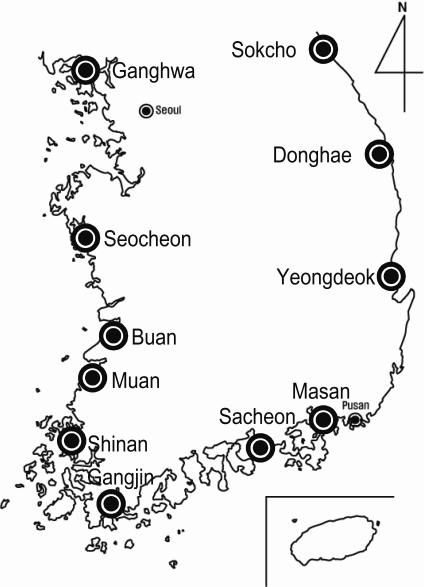
Table 1.Status of metacercarial infections in mullets caught along the western, southern, and eastern coastal areas of the Republic of Korea
Table 1.
|
Area |
No. of fish examined |
No. (%) of fish positive
|
Range (mean) of metacercarial densitya)
|
|
H. nocens
|
P. summa
|
H. nocens
|
P. summa
|
|
Shinan-gun |
20 |
20 (100) |
20 (100) |
10-2,314 (271) |
4-3,106 (483) |
|
Muan-gun |
15 |
14 (93) |
15 (100) |
1-30 (13) |
2-273 (59) |
|
Buan-gun |
12 |
5 (42) |
9 (75) |
1-305 (103) |
1-89 (24) |
|
Seocheon-gun |
15 |
11 (73) |
8 (53) |
1-702 (134) |
1-125 (30) |
|
Ganghwa-gun |
15 |
7 (47) |
15 (100) |
1-14 (4) |
3-188 (59) |
|
Masan-city |
10 |
0 (0) |
0 (0) |
0 |
0 |
|
Sacheon-city |
17 |
8 (47) |
13 (77) |
1-357 (51) |
1-301 (71) |
|
Gangjin-gun |
10 |
5 (50) |
7 (70) |
3-71 (21) |
1-7 (2) |
|
Sokcho-city |
5 |
0 (0) |
0 (0) |
0 |
0 |
|
Donghae-city |
10 |
0 (0) |
1 (10) |
0 |
8 (8) |
|
Yeongdeok-gun |
10 |
0 (0) |
0 (0) |
0 |
0 |
|
Total |
139 |
70 (50) |
88 (63) |
8,132b) (116) |
12,831b) (146) |
Table 2.Distribution of H. nocens metacercariae in body parts of mullets caught from coastal areas
Table 2.
|
Area surveyed |
No. of H. nocens metacercariae from body parts of mullets
|
|
Head |
Gill |
Trunk |
Intestine |
Tail & fin |
Total |
|
Shinan-gun (n = 20)a)
|
508 |
1,040 |
3,860 |
10 |
2 |
5,420 |
|
Muan-gun (n = 14) |
14 |
28 |
84 |
56 |
0 |
182 |
|
Buan-gun (n = 5) |
0 |
35 |
480 |
0 |
0 |
515 |
|
Seocheon-gun (n = 11) |
33 |
220 |
1,188 |
33 |
0 |
1,474 |
|
Ganghwa-gun (n = 7) |
0 |
28 |
0 |
0 |
0 |
28 |
|
Sacheon-city (n = 8) |
0 |
344 |
32 |
32 |
0 |
408 |
|
Gangjin-gun (n = 5) |
4 |
0 |
100 |
0 |
0 |
104 |
|
Total (n = 70) |
559 |
1,695 |
5,744 |
131 |
2 |
8,132 |
|
% |
(7) |
(21) |
(71) |
(2) |
(0.02) |
|
Table 3.Distribution of P. summa metacercariae in body parts of mullets caught from coastal areas
Table 3.
|
Area surveyed |
No. of P. summa metacercariae from body parts of mullets
|
|
Head |
Gill |
Trunk |
Intestine |
Tail & fin |
Total |
|
Shinan-gun (n = 20)a)
|
140 |
7,042 |
1,398 |
1,080 |
0 |
9,660 |
|
Muan-gun (n = 15) |
3 |
627 |
120 |
135 |
0 |
885 |
|
Buan-gun (n = 9) |
0 |
207 |
9 |
0 |
0 |
216 |
|
Seocheon-gun (n = 8) |
8 |
120 |
32 |
64 |
16 |
240 |
|
Ganghwa-gun (n = 15) |
0 |
879 |
0 |
6 |
0 |
885 |
|
Sacheon-city (n = 13) |
0 |
884 |
0 |
39 |
0 |
923 |
|
Gangjin-gun (n = 7) |
2 |
8 |
1 |
3 |
0 |
14 |
|
Donghae-city (n = 1) |
0 |
8 |
0 |
0 |
0 |
8 |
|
Total (n = 88) |
153 |
9,775 |
1,560 |
1,327 |
16 |
12,831 |
|
% |
(1) |
(76) |
(12) |
(10) |
(0.1) |
|
Table 4.Status of metacercarial infections in gobies caught along the western coastal areas of the Republic of Korea
Table 4.
|
Area |
No. of fish exam. |
No. (%) of fish positive
|
Range (mean) of metacercarial densitya)
|
|
H. nocens
|
P. summa
|
H. nocens
|
P. summa
|
|
Muan-gun |
15 |
6 (40) |
6 (40) |
1-4 (2) |
1-6 (2) |
|
Seocheon-gun |
15 |
3 (20) |
0 (0) |
1-2 (2) |
0 (0) |
|
Ganghwa-gun |
5 |
0 (0) |
0 (0) |
0 (0) |
0 (0) |
|
Total |
35 |
9 (26) |
6 (17) |
1-4 (2) |
1-6 (2) |
Table 5.Metacercarial distribution of H. nocers and P. summa in body parts of gobies caught from western coastal areas
Table 5.
|
Fluke species |
No. of metacercariae from body parts of gobies
|
|
Head |
Gill |
Trunk |
Intestine |
Tail & fin |
Total |
|
H. nocens metacercariae |
|
|
|
|
|
|
|
Muan-gun (n = 6)a)
|
5 |
5 |
1 |
0 |
0 |
11 |
|
Seocheon-gun (n = 3) |
2 |
0 |
3 |
0 |
0 |
5 |
|
Subtotal |
7 |
5 |
4 |
0 |
0 |
16 |
|
P. summa metacercariae |
|
|
|
|
|
|
|
Muan-gun (n = 6) |
8 |
4 |
0 |
0 |
0 |
12 |