Abstract
Profilins are ubiquitous pan-allergens responsible for cross-reactivity between pollens and plant foods. While we previously demonstrated that recombinant Acanthamoeba profilin (rAc-PF) drives allergic airway inflammation via Th2/Th17 pathways in murine models, its clinical relevance in human allergic disease remains unclear. This study investigated rAc-PF as a novel inhalant allergen and its immunological impact on patients with allergic airway diseases. A total of 176 patients with allergic airway diseases underwent skin prick tests with rAc-PF and a standard panel of 55 common aeroallergens. Acanthamoeba-specific and rAc-PF–specific serum IgE levels were quantified using ELISA. To elucidate immune mechanisms, peripheral blood mononuclear cells from atopic asthma patients were stimulated with rAc-PF, and Th2/Th17 cytokine production was analyzed. Thirteen patients (7.4%) showed positive skin prick tests reactions to rAc-PF. This sensitization was significantly associated with tree, grass, and weed pollens, indicating a pan-allergen characteristic due to high cross-reactivity. Notably, one patient sensitized to rAc-PF reacted to no other common inhalants, suggesting rAc-PF as a unique causative agent. Patients exhibited significantly elevated levels of serum Acanthamoeba-specific and rAc-PF–specific IgE compared to healthy controls. Furthermore, rAc-PF stimulation of peripheral blood mononuclear cells from asthmatic patients induced robust production of IL-4, IL-5, IL-13, and IL-17A in humans. rAc-PF is identified as a novel allergen capable of inducing IgE-mediated sensitization and mixed Th2/Th17 responses. The strong association with pollen sensitization supports its role as an environmental pan-allergen. Therefore, rAc-PF should be considered a clinically relevant diagnostic target, especially in patients with polysensitization or unidentified triggers.
-
Key words: Acanthamoeba, profilins, allergens, respiratory hypersensitivity, immunoglobulin E
Introduction
Asthma is a heterogeneous chronic airway disease characterized by variable airflow obstruction, airway hyperresponsiveness, and persistent airway inflammation [
1,
2]. IgE-mediated sensitization to environmental allergens represents a major immunologic feature of allergic asthma, and cumulative IgE responses to inhalant allergens are strongly associated with disease expression and treatment outcomes [
3]. Exposure to airborne allergens such as pollens, house dust mites, molds, and animal dander plays a critical role in triggering and perpetuating airway inflammation, and is strongly influenced by environmental and climatic conditions [
4]. Allergen-driven Th2 inflammation contributes to the development and progression of asthma through IL-4/IL-13–mediated IgE class switching, eosinophilic recruitment, and mast-cell activation [
5]. More recently, Th17 cells and IL-17–associated pathways have emerged as additional contributors to airway inflammation, particularly in more severe phenotypes [
6]. Together, these findings underscore the central role of environmental allergen exposure and IgE sensitization in the immunopathogenesis of asthma.
Despite extensive characterization of major aeroallergens, growing evidence suggests that additional, previously unrecognized allergens may contribute to airway disease in certain populations [
4-
7]. Environmental risk factors, including allergens, pollutants, and pathogenic microbes, have the potential to disrupt airway epithelial barrier functions and promote sensitization, thereby amplifying susceptibility to allergic airway inflammation [
8,
9]. Moreover, the presence of sensitization patterns that cannot be fully explained by known aeroallergens suggests that unidentified or overlooked allergens may also play a role in allergic disease development.
Profilins are a ubiquitous family of proteins, approximately 12–16 kDa in size, found in eukaryotic cells and play a role in actin polymerization control [
10]. Profilin was first identified as an allergen in birch pollen in 1991 [
11]. Both natural and recombinant forms were shown to react with IgE from birch pollen-allergic patients in immunoblot assays. Subsequently, profilin was identified as an allergen in grass (
Phleum pratensis) and weed (
Artemisia vulgaris) pollens [
12]. Allergenic profilins have since been detected in various pollen types, latex, and plant-derived foods. They are recognized as panallergens due to their highly similar tertiary structures, which leads to significant cross-reactivity even among plant species that are taxonomically distant [
13].
Acanthamoeba profilin, comprising 125 amino acids, exists in 2 isoforms (profilin-I and profilin-II) and exhibits partial sequence homology with vertebrate profilin [
14]. Although previous studies utilizing various protein mapping analyses have identified significant differences between the sequences of profilin-I and profilin-II, both profilins interact with monoclonal antibodies and inhibit actin polymerization similarly. We have confirmed that allergic airway disease can be induced through repeated exposure to
Acanthamoeba induces allergic airway disease in a murine model; importantly, recombinant Acanthamoeba profilin (rAc-PF) alone can elicit similar airway inflammatory responses, supporting its role as a principal allergenic determinant [
9,
15]. Additionally, our findings suggest that rAc-PF has the potential to induce airway inflammatory disease by enhancing Th2 immune responses and airway hyper-responsiveness via toll-like receptor 2 (TLR2) [
16]. However, there is currently no allergenicity data for humans regarding rAc-PF. In this study, we evaluated the sensitization rate to rAc-PF using skin prick test (SPT) in patients with allergic rhinitis and asthma to investigate its potential role as an inhalant allergen. We also investigated the interaction of rAc-PF allergens with IgE in these patients and measured cytokine production levels following rAc-PF stimulation in the patients' peripheral blood mononuclear cells (PBMCs).
Methods
Ethics statement
The ethics committee of Pusan National University Hospital approved the experimental protocols (IRB 2012-029-098), and this study adhered to the Helsinki Declaration.
Subjects and skin prick test
To investigate the sensitivity of rAc-PF in patients with respiratory allergic diseases, we recruited subjects from January 2021 to December 2022. A total of 176 patients who underwent SPT for symptoms of asthma and allergic rhinitis during the study period were included in this study (
Table 1). The SPT was conducted using a panel of 55 common aeroallergens (Allergopharma),
Acanthamoeba protein [
15], and rAc-PF [
14] according to adapted methods from Oryszczyn et al. [
17]. The SPT reactions to 55 common aeroallergens were graded by the ratio of the allergen wheal diameter to the histamine wheal diameter, and were considered positive when the ratio was ≥1. Atopy was defined as a positive skin test response to at least 1 allergen.
Fifteen minutes after administering the SPT, the average diameter of the wheals formed by histamine and rAc-PF was measured. A skin response to rAc-PF was deemed positive if the wheal diameter measured at least 2 mm.
Acanthamoeba-specific or rAc-PF–specific serum IgE level
To determine the relationship between airway diseases and Acanthamoeba-specific or rAc-PF–specific antibodies, we detected the levels of rAc-PF–specific IgE in patient serum. The rAc-PF was produced and purified as previously described [Song, 2018 #1]. rAc-PF–specific IgE was measured by ELISA in 8 patients among 13 patients with a positive skin test result to rAc-PF. Normal controls consisted of non-atopic individuals with no history of allergic diseases, negative SPT results to common aeroallergens, and an age range comparable to the patient group. The ELISA cut-off value was determined as the mean +2 SD of the normal controls. Ninety-six-well immune plates (Nunc) were coated with Acanthamoeba antigens or rAc-PF protein (final concentration, 1 μg/ml). Microplates were coated with Acanthamoeba antigen or rAc-PF (1 μg/ml). Following coating, the ELISA was performed using an in-house protocol, while subsequent steps, including blocking, incubation, and detection, were carried out according to the manufacturer’s instructions for the ELISA reagents (eBioscience). The biospecimens used for this study were provided by the Biobank of Pusan National University Hospital, a member of the Korea Biobank Network.
PBMC isolation, stimulation, and evaluation of cytokine production
PBMCs were isolated from blood samples using SepMate-50 (STEMCELL Technologies). The isolated PBMCs (1×10⁶ cells/ml) were cultured either untreated or stimulated with phytohemagglutinin or rAc-PF. After 72 hours of culture, the supernatant was harvested for cytokine analysis. The levels of IL-4, IL-5, IL-13, and IL-17A in the PBMC culture supernatants were measured using ELISA kits (eBioscience), according to the manufacturer’s recommended protocols.
Statistical analysis
The statistical analysis was conducted using Prism 6 (GraphPad Prism) and IBM SPSS Statistics version 30.0 (IBM Corp.). The Phi coefficient was utilized to estimate the correlation between rAc-PF and other common allergens. Mean±SD was calculated, and significant differences were determined using Student's t-test or one-way analysis of variance with Dunnett's multiple comparison post hoc test comparing all groups to controls.
Results
Clinical characteristics of the study population
A total of 176 subjects were analyzed (
Table 1). The mean age was 45.5±16.4 years, and 67.0% were female. Sensitization to at least 1 aeroallergen was observed in 58.5% of the subjects. The most common diagnoses included asthma, allergic rhinitis, non-allergic rhinitis, eosinophilic bronchitis, and chronic rhinosinusitis. Among all subjects, the most common sensitizing allergens were house dust mites, with 38.1% showing positive responses. Sensitization to animals and insects was observed in 5.5%, mold in 1.9%, pollens in 7.5%, and other allergens in 3.7%. Positive responses to rAc-PF were observed in 13 out of 176 patients (7.4%). These patients included 5 with allergic rhinitis, 7 with atopic asthma accompanied by allergic rhinitis, and 1 with non-atopic asthma.
Among rAc-PF–positive subjects, sensitization profiles were heterogeneous (
Table 2). House dust mites were the most frequently detected co-sensitizing allergens. Both monosensitization and polysensitization patterns were observed, involving combinations of indoor and outdoor aeroallergens. Some subjects demonstrated sensitization restricted to indoor allergens, whereas others exhibited additional sensitization to seasonal pollens or mixed indoor–outdoor allergen profiles. Notably, one subject with rAc-PF positivity showed no sensitization to any of the tested inhalant allergens.
Positive reactions to rAc-PF were observed in 13 out of 176 patients (7.4%) including 5 with allergic rhinitis, 7 with atopic asthma accompanied by allergic rhinitis, and 1 with non‑atopic asthma. The results of SPT with common inhalant allergens in patients positive to rAc-PF are summarized in
Table 2. Sensitization patterns demonstrated marked heterogeneity among rAc-PF–positive patients. House dust mites were the most frequently identified allergens, with
Dermatophagoides pteronyssinus and
D. farinae detected in 42.6% and 48.3% of patients, respectively. Three patients exhibited sensitization exclusively to indoor allergens, such as house dust mites, storage mites, cockroach or animal dander. Furthermore, one patient showed negative results to all common inhalant allergens, indicating absence of sensitization to commercially tested inhalant allergens despite rAc-PF positivity, suggesting
Acanthamoeba as a unique or primary sensitizer in this patient. Another 3 patients showed sensitization only to seasonal pollens, with positive reactions to tree, grass, or weed pollens. In contrast, 6 patients showed cosensitization to both indoor allergens such as house dust mites, cockroach, animal dander, or molds and outdoor allergens including tree, grass, and weed pollens.
To investigate the relationship between rAc-PF and common inhalant allergens, the chi-square test was used to determine the correlation between rAc-PF and other allergens. Although the highest number of positive reactions was observed for
D. pteronyssinus and
D. farinae, no significant correlation was found between rAc-PF positivity and these allergens. However, rAc-PF positivity was significantly associated with several pollen-derived allergens. Notably, positive reactions to poplar (
r=0.34,
P<0.001), willow tree (
r=0.36,
P<0.001), plane tree (
r=0.25,
P<0.001), ash tree (
r=0.28,
P<0.001), orchard grass (
r=0.38,
P<0.001), and meadow grass (
r=0.30,
P<0.001) were observed (
Table 3).
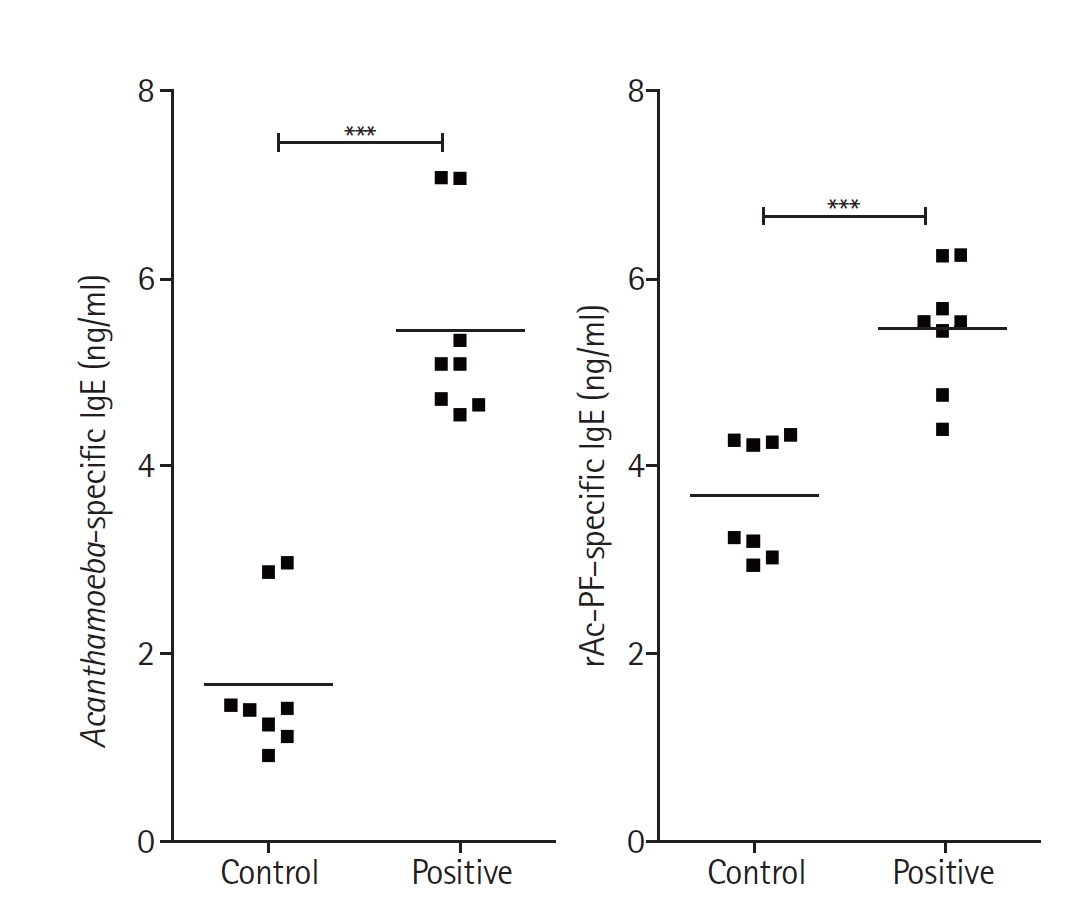
The mean levels of
Acanthamoeba-specific or rAc-PF–specific IgE titers in patient sera were significantly higher than those in normal controls (
Fig. 1). Compared to the control group, the mean
Acanthamoeba-specific IgE levels in the patient group showed a greater than 3.2-fold increase, while the titer of rAc-PF–specific IgE exhibited an increase exceeding 1.5-fold. (
P<0.001) Additionally, these patients were found to have a higher positive reaction to pollen in the SPT results compared to other patients.
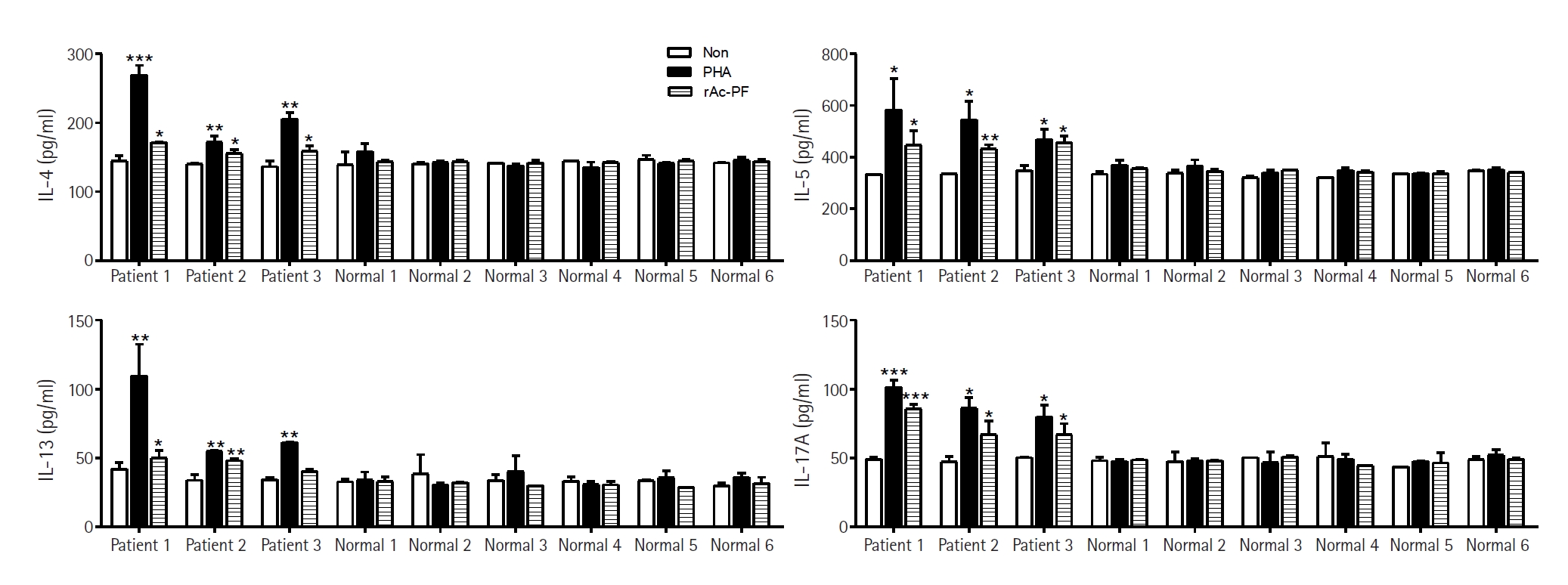
The control group used PBMCs from individuals who tested negative in the SPT to common aeroallergens. The cytokine production analysis of PBMCs showed that the levels of Th2 and Th17-related genes IL-4, IL-5, IL-13, and IL-17A were higher in the positive group compared to the control group (
Fig. 2). Although the cytokine levels in the rAc-PF treated group were minimal compared to the phytohemagglutinin (nonspecific stimuli) treated group, they were significantly (
P<0.05) increased compared to the control group. These findings indicate that rAc-PF affects cytokine production in PBMCs from patients with airway disease.
Discussion
Previous studies have demonstrated that
Acanthamoeba-derived profilin acts as an allergen capable of inducing airway inflammation through the activation of Th2 and Th17 pathways, primarily mediated by TLR2 signaling in mouse models [
14,
18]. Consistent with these findings, the present study confirmed that 13 of 176 patients with airway diseases exhibited positive skin prick reactions to rAc-PF, accompanied by significantly higher levels of rAc-PF–specific IgE compared with healthy nonatopic controls. These results provide further evidence supporting the relevance of rAc-PF as an allergen in humans.
In this study, sensitization patterns among rAc-PF positive patients were heterogeneous. Although house dust mites were the most frequently detected allergens among rAc-PF–positive patients, no significant correlation was found between rAc-PF reactivity and mite sensitization. Instead, significant associations were identified with several pollen derived allergens including poplar, willow, plane tree, ash tree, orchard grass, and meadow grass. These findings indicate that rAc-PF-specific IgE may be influenced by sensitization to pollen allergens rather than indoor allergens.
The distribution of sensitization patterns provided additional insights into the potential mechanisms underlying rAc-PF reactivity Patients restricted. Patients restricted to seasonal pollen sensitization likely represent cases in which rAc-PF recognition results from IgE cross-reactivity, as many tree and grass pollens share homologous allergenic epitopes with profilin-like proteins. The broad polysensitization to tree, grass, and weed pollens observed in these individuals supports this interpretation. Several recent studies have documented that under specific circumstances, profilin serves as an indicator of severity and acts as an allergen capable of inducing respiratory allergic symptoms [
19-
21]. Considering the statistical correlation between Ac-PF and pollen, our findings suggest that rAc-PF functions as an environmental allergen. Furthermore, it is postulated that individuals with respiratory allergy who spend extended periods outdoors are more likely to come into contact with external allergens compared to those who do not, or to individuals without allergies, thereby exhibiting reactivity to specific allergens. In contrast, patients sensitized exclusively to indoor allergens such as house dust mites, storage mites, cockroach, or animal dander and those without sensitization to any common inhalant allergens represent a distinct phenotype. In these individuals, rAc-PF positivity is less likely to be explained by cross-reactivity. Instead, their responses show the possibility of primary sensitization to
Acanthamoeba-derived antigens. These findings suggest that rAc-PF may function not only as a cross-reactive profilin but also as a primary allergen in a subset of patients with airway disease.
In our prior mouse model study, exposure to rAc-PF induced airway inflammatory phenotypes, including airway hyperresponsiveness, peribronchial immune cell infiltration, histological alterations, and increased production of pro-inflammatory cytokines [
14]. We also demonstrated that TLR2 contribute the production of dendritic cell-derived Th2/17 cell-polarizing cytokines in response to rAc-PF stimulation [
18]. Consistent with these findings, the present study reveals that rAc-PF elicits comparable immune responses in human PBMCs. rAc-PF stimulation significantly increased the production of Th2-related cytokines (IL-4, IL-5, and IL-13) and the Th17-related cytokine (IL-17A) in PBMCs obtained from patients with atopic asthma supporting its role in promoting type 2 and type 17 inflammatory pathways. Taken together, these findings demonstrate that rAc-PF induces prominent type 2 and type 17 inflammatory responses in human immune cells, supporting its relevance to the immunopathogenesis of human allergic airway disease.
Previous studies have demonstrated that patients with allergic diseases exhibit allergen-specific Th2-mediated responses, and that clinical resolution is often associated with a shift toward a Th1 response [
22,
23]. Th2 cytokines play pivotal roles in allergic inflammation, including the propagation of the Th2 phenotype, IgE isotype switching, eosinophil recruitment, and mast cell maturation and activation [
24]. Recent investigations have revealed that the Th1/Th2 paradigm in allergy extends to other T cell effector subsets, particularly Th17 cells, which are characterized by IL-17 production [
25]. In humans, IL-17 expression is elevated in moderate-to-severe asthma [
26]. Th17 responses contribute to neutrophilic airway inflammation through IL-17-mediated induction of IL-8, a key chemokine for neutrophil recruitment by airway epithelial cells and smooth muscle [
27,
28]. Moreover, IL-17 stimulates the expression of granulocyte-colony-stimulating factor in bronchial epithelial cells, promoting neutrophil development and granulopoiesis [
25].
This study has several limitations. First, the number of rAc-PF–positive patients was relatively small, and the limited sample size, particularly in the PBMC experiments, may have reduced the statistical power for subgroup analyses. Second, because cross-inhibition assays and molecular epitope-mapping studies were not performed, we were unable to conclusively differentiate cross-reactivity from primary sensitization. Further structural and epitope-mapping studies are required to elucidate the shared molecular features between Acanthamoeba-derived profilin and pollen profilins, which may explain the observed cross-reactivity. Third, the absence of environmental and exposure data limited our ability to assess exposure-dependent patterns of sensitization. Fourth, the cross-sectional study design precludes any inference regarding the temporal sequence of sensitization or causal relationships. Finally, as our analyses were confined to in vitro PBMC responses, the in vivo functional relevance of rAc-PF in humans warrants further investigation.
In this study, we observed that a subset of patients with airway disease showed significant reactivity to rAc-PF in SPT and specific IgE assays. We also demonstrated that rAc-PF induces Th2 and Th17 cytokine production from PBMCs of patients with respiratory diseases. Although cross-reactivity with pollen profilins likely contributes to rAc-PF–specific IgE binding in many patients, evidence of primary sensitization in a subset of individuals highlights the need for further characterization of shared and unique epitopes between Acanthamoeba-derived and pollen-derived profilin. Overall, these findings support the identification of rAc-PF as a previously unrecognized environmental and pathogen-derived allergen with potential clinical significance in respiratory allergic disease.
Notes
-
Author contributions
Conceptualization: Yu HS. Data curation: Park MK. Formal analysis: Park MK. Funding acquisition: Park HK. Investigation: Park MK. Methodology: Park MK. Project administration: Park HK, Yu HS. Supervision: Yu HS. Validation: Park MK, Park HK. Visualization: Park MK, Park HK. Writing – original draft: Park MK. Writing – review & editing: Park HK, Yu HS.
-
Conflict of interest
Hak Sun Yu serves as an editor of Parasites, Hosts and Diseases but had no involvement in the decision to publish this article. No other potential conflicts of interest relevant to this study were reported.
Fig. 1.Serum levels of Acanthamoeba-specific and recombinant Acanthamoeba profilin (rAc-PF)–specific IgE in patients with airway disease and normal controls. Serum samples from 8 patients with positive skin prick tests responses to rAc-PF and 8 non-atopic normal controls were analyzed. Microplates were coated with Acanthamoeba extract or rAc-PF (1 μg/ml), and IgE levels were measured using ELISA. Serum samples were diluted 1:2 in PBS. IgE levels are presented as ng/ml. Data are expressed as mean±SD (***P<0.001).
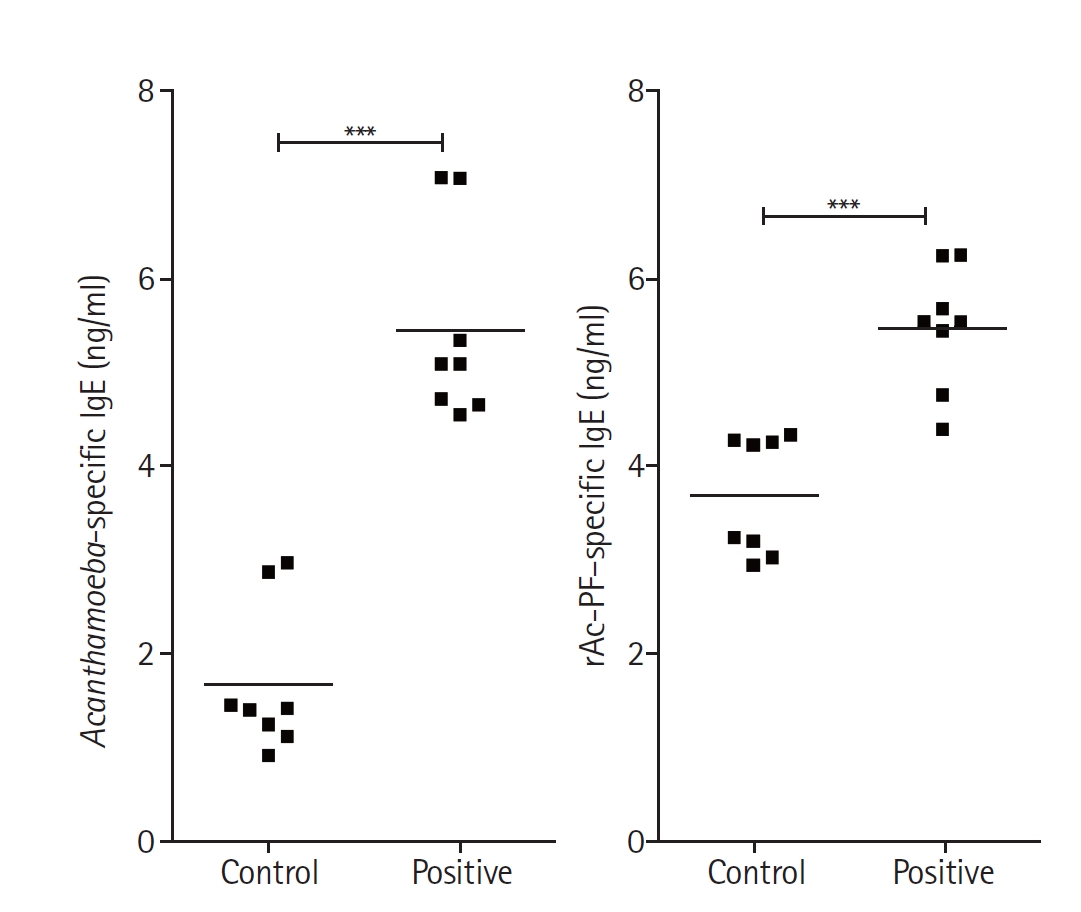
Fig. 2.Cytokine production in peripheral blood mononuclear cells (PBMCs) stimulated with recombinant Acanthamoeba profilin (rAc-PF) in patients with airway disease. PBMCs isolated from patients with airway disease were cultured (1×10⁶ cells/ml) and stimulated with rAc-PF (1 μg/ml) or phytohemagglutinin (PHA) as a positive control for 72 hours. PBMCs from non-atopic individuals were used as controls. Levels of Th2 cytokines (IL-4, IL-5, and IL-13) and Th17 cytokine (IL-17A) in culture supernatants were measured using ELISA. Data are presented as mean±SD. Statistical significance was analyzed using one-way ANOVA with Dunnett’s post hoc test (*P<0.05, **P<0.01, ***P<0.001).
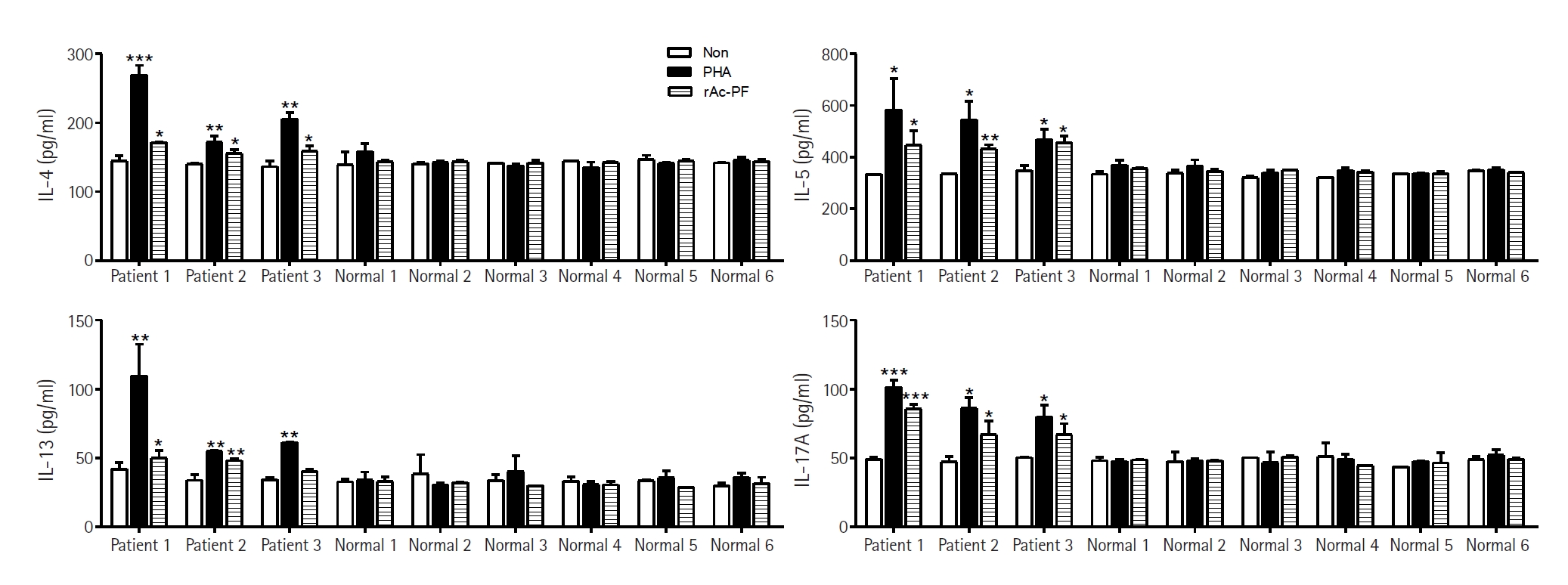
Table 1.Clinical characteristics of study population (n=176)
Table 1.
|
Characteristics |
Value |
|
Age (yr) |
45.5±16.4 |
|
20–30 |
46 (26.1) |
|
31–40 |
27 (15.3) |
|
41–50 |
27 (15.3) |
|
51–60 |
31 (17.6) |
|
61–70 |
39 (22.2) |
|
71–80 |
6 (3.4) |
|
Sex |
|
|
Male |
58 (33.0) |
|
Female |
118 (67.0) |
|
Atopy (%) |
103 (58.5) |
|
Diagnosis |
|
|
Allergic rhinitis |
37 (21) |
|
Asthma |
107 (60.8) |
|
Eosinophilic bronchitis |
13 (7.4) |
|
Nonallergic rhinitis |
11 (6.3) |
|
Chronic rhinosinusitis |
8 (4.5) |
|
Total IgE (IU/ml) |
209.5±291.6 |
|
FeNO (ppb, n=161) |
37.2±43.56 |
|
FEV1 (%) |
86.2±15.9 |
Table 2.Inhalant allergen skin test results in recombinant Acanthamoeba profilin positive patients
Table 2.
|
Positive inhalant allergens |
|
Dp, Df, tyrophagus, cockroach |
|
Df, alder, hazel, poplar, willow tree, birch, plane tree, ash, gasses, velvet grass, rye grass, orchard grass, Kentucky blue grass, meadow grass, mugwort |
|
Dp, Df, alder, poplar, hazel, birch, beech, mugwort, chrysanthemum |
|
Dp, Df, tyrophagus, cow epithelium |
|
Alder, hazel, willow tree, birch, beech, orchard grass, meadow grass |
|
Birch, beech |
|
Df
|
|
Cockroach, willow tree, elder, dandelion, weed mix |
|
Dp, Df, tyrophagus, dog, pig, cow, Alternaria, Cladosporium, Aspergillus, Penicillium, alder, hazel, elm, willow tree, birch, beech, oak, plane tree, ash, elder, gasses, velvet grass, orchard grass, rye grass, meadow grass, ragweed, mugwort, chrysanthemum, dandelion, nettle, weed mix |
|
Cockroach, oak, orchard grass, rye grass, Kentucky blue grass, meadow grass, ragweed, weed mix |
|
Dp, Df, tyrophagus, cat, dog, pig, cow, horse, cockroach, Alternaria tenuis, alder, poplar, birch, grasses, orchard grass, Kentucky blue grass, meadow grass, Hop Japanese, weed mix |
|
None |
|
Hazel, beech, ash |
Table 3.Positive rates of rAc-PF and mean square contingency (ф) coefficients of rAc-PF and other allergens (n=176)
Table 3.
|
Type of allergen |
Allergen |
SPT positive |
rAc-PF positive |
r (P-value) |
|
Mites |
Dermatophagoides pteronyssinus
|
75 (42.6) |
5 (38.5) |
-0.024 (0.753) |
|
Dermatophagoides farinae
|
85 (48.3) |
7 (53.8) |
0.028 (0.709) |
|
Tyrophagus |
41 (23.3) |
4 (30.8) |
0.050 (0.508) |
|
Animals and insects |
Cat epithelium |
22 (12.5) |
1 (7.6) |
-0.041 (0.586) |
|
Dog epithelium |
18 (10.2) |
2 (15.3) |
0.048 (0.524) |
|
Pig epithelium# |
6 (3.4) |
2 (15.3) |
0.186 (0.013) |
|
Cow epithelium |
17 (9.7) |
3 (23.1) |
0.128 (0.089) |
|
Rabbit epithelium |
4 (2.3) |
1 (7.6) |
0.103 (0.173) |
|
Horse epithelium# |
2 (1.1) |
1 (7.6) |
0.175 (0.020) |
|
Sheep’s wool |
0 (0.0) |
0 (0.0) |
- |
|
Feathers |
0 (0.0) |
0 (0.0) |
- |
|
Cockroach# |
18 (10.2) |
4 (30.8) |
0.191 (0.011) |
|
Molds |
Moulds I |
0 (0.0) |
0 (0.0) |
- |
|
Moulds II |
0 (0.0) |
0 (0.0) |
- |
|
Alternaria tenuis
|
5 (2.8) |
2 (15.3) |
0.213 (0.005) |
|
Cladosporium herbar
|
2 (1.1) |
1 (7.6) |
0.175 (0.020) |
|
Fusarium moniliforme
|
3 (1.7) |
0 (0.0) |
- |
|
Aspergillus fumigatus
|
3 (1.7) |
1 (7.6) |
0.131 (0.083) |
|
Mucor mucedo |
0 (0.0) |
0 (0.0) |
- |
|
Neurospora sitophila
|
0 (0.0) |
0 (0.0) |
- |
|
Penicillium notatum
|
2 (1.1) |
1 (7.6) |
0.175 (0.020) |
|
Rhizopus stolonifer
|
0 (0.0) |
0 (0.0) |
- |
|
Trichophyton
|
15 (8.5) |
0 (0.0) |
- |
|
Pollen |
Alder# |
32 (18.2) |
5 (38.5) |
0.145 (0.049) |
|
Hazel# |
27 (15.3) |
5 (38.5) |
0.181 (0.016) |
|
Poplar# |
5 (2.8) |
3 (23.1) |
0.34 (<0.001) |
|
Elm |
8 (4.5) |
1 (7.6) |
0.043 (0.0571) |
|
Willow tree# |
8 (4.5) |
4 (30.8) |
0.356 (<0.001) |
|
Birch# |
30 (17.0) |
5 (38.5) |
0.161 (0.033) |
|
Beech# |
25 (14.2) |
5 (38.5) |
0.196 (0.009) |
|
Oak |
23 (13.1) |
2 (15.3) |
0.019 (0.797) |
|
Plane tree# |
8 (4.5) |
3 (23.1) |
0.251 (0.001) |
|
Ash# |
7 (4.0) |
3 (23.1) |
0.276 (<0.001) |
|
Elder# |
9 (5.1) |
3 (23.1) |
0.230 (0.002) |
|
Grasses# |
13 (7.4) |
3 (23.1) |
0.169 (0.025) |
|
Herbs |
0 (0.0) |
0 (0.0) |
- |
|
Velvet grass |
8 (4.5) |
2 (15.3) |
0.147 (0.051) |
|
Orchard grass# |
11 (6.3) |
5 (38.5) |
0.379 (<0.001) |
|
Rye grass# |
11 (6.3) |
3 (23.1) |
0.196 (0.009) |
|
Kentucky blue grass# |
15 (8.5) |
4 (26.7) |
0.225 (0.003) |
|
Meadow grass# |
15 (8.5) |
5 (38.5) |
0.303 (<0.001) |
|
Ragweed |
7 (4.0) |
2 (15.3) |
0.165 (0.029) |
|
Mugwort# |
14 (8.0) |
3 (21.4) |
0.158 (0.036) |
|
Chrysanthemum# |
11 (6.3) |
3 (21.4) |
0.196 (0.009) |
|
Dandelion |
8 (4.5) |
2 (15.3) |
0.147 (0.051) |
|
Nettle# |
6 (3.4) |
2 (15.3) |
0.186 (0.013) |
|
Hop Japanese# |
2 (1.1) |
1 (7.6) |
0.175 (0.020) |
|
Other |
Latex |
1 (0.6) |
0 (0.0) |
- |
|
Weed mix# |
12 (6.8) |
4 (33.3) |
0.27 (<0.001) |
References
- 1. Hough KP, Curtiss ML, Blain TJ, et al. Airway remodeling in asthma. Front Med (Lausanne) 2020;7:191. https://doi.org/10.3389/fmed.2020.00191
- 2. Holgate ST. Pathogenesis of asthma. Clin Exp Allergy 2008;38:872-97. https://doi.org/10.1111/j.1365-2222.2008.02971.x
- 3. Lambrecht BN, Hammad H. The immunology of asthma. Nat Immunol 2015;16:45-56. https://doi.org/10.1038/ni.3049
- 4. Pawankar R. Allergic diseases and asthma: a global public health concern and a call to action. World Allergy Organ J 2014;7:12. https://doi.org/10.1186/1939-4551-7-12
- 5. Fahy JV. Type 2 inflammation in asthma: present in most, absent in many. Nat Rev Immunol 2015;15:57-65. https://doi.org/10.1038/nri3786
- 6. Al-Ramli W, Préfontaine D, Chouiali F, et al. T(H)17-associated cytokines (IL-17A and IL-17F) in severe asthma. J Allergy Clin Immunol 2009;123:1185-7. https://doi.org/10.1016/j.jaci.2009.02.024
- 7. Galli SJ, Tsai M, Piliponsky AM. The development of allergic inflammation. Nature 2008;454:445-54. https://doi.org/10.1038/nature07204
- 8. Kim BE, Hui-Beckman JW, Nevid MZ, Goleva E, Leung DYM. Air pollutants contribute to epithelial barrier dysfunction and allergic diseases. Ann Allergy Asthma Immunol 2024;132:433-9. https://doi.org/10.1016/j.anai.2023.11.014
- 9. Kang SA, Yu HS. Microarray-based characterization of airway inflammation induced by environmental Acanthamoeba exposure versus the ovalbumin-alum model. Parasites Hosts Dis 2025;63:327-39. https://doi.org/10.3347/PHD.25050
- 10. Davey RJ, Moens PD. Profilin: many facets of a small protein. Biophys Rev 2020;12:827-49. https://doi.org/10.1007/s12551-020-00723-3
- 11. Valenta R, Duchêne M, Pettenburger K, et al. Identification of profilin as a novel pollen allergen; IgE autoreactivity in sensitized individuals. Science 1991;253:557-60. https://doi.org/10.1126/science.1857985
- 12. Barderas R, Villalba M, Rodríguez R. Recombinant expression, purification and cross-reactivity of chenopod profilin: rChe a 2 as a good marker for profilin sensitization. Biol Chem 2004;385:731-7. https://doi.org/10.1515/BC.2004.089
- 13. Valenta R, Duchêne M, Vrtala S, et al. Profilin, a novel plant pan-allergen. Int Arch Allergy Immunol 1992;99:271-3. https://doi.org/10.1159/000236263
- 14. Song SM, Kang SA, Park HK, et al. Acanthamoeba profilin elicits allergic airway inflammation in mice. PLoS Negl Trop Dis 2018;12:e0006979. https://doi.org/10.1371/journal.pntd.0006979
- 15. Park MK, Cho MK, Kang SA, et al. Acanthamoeba protease activity promotes allergic airway inflammation via protease-activated receptor 2. PLoS One 2014;9:e92726. https://doi.org/10.1371/journal.pone.0092726
- 16. Park MK, Park HK, Yu HS. Toll-like receptor 2 mediates Acanthamoeba-induced allergic airway inflammatory response in mice. PLoS Negl Trop Dis 2023;17:e0011085. https://doi.org/10.1371/journal.pntd.0011085
- 17. Oryszczyn MP, Annesi I, Neukirch F, Doré MF, Kauffmann F. Longitudinal observations of serum IgE and skin prick test response. Am J Respir Crit Care Med 1995;151:663-8. https://doi.org/10.1164/ajrccm.151.3.7881653
- 18. Park MK, Park HK, Yu HS. The recombinant profilin from free-living amoebae induced allergic immune responses via TLR2. J Inflamm Res 2024;17:2915-25. https://doi.org/10.2147/JIR.S450866
- 19. Menz G, Dolecek C, Schönheit-Kenn U, et al. Serological and skin-test diagnosis of birch pollen allergy with recombinant Bet v I, the major birch pollen allergen. Clin Exp Allergy 1996;26:50-60. https://doi.org/10.1111/j.1365-2222.1996.tb00056.x
- 20. Scheurer S, Wangorsch A, Haustein D, Vieths S. Cloning of the minor allergen Api g 4 profilin from celery (Apium graveolens) and its cross-reactivity with birch pollen profilin Bet v 2. Clin Exp Allergy 2000;30:962-71. https://doi.org/10.1046/j.1365-2222.2000.00821.x
- 21. Gunning PW, Ghoshdastider U, Whitaker S, Popp D, Robinson RC. The evolution of compositionally and functionally distinct actin filaments. J Cell Sci 2015;128:2009-19. https://doi.org/10.1242/jcs.165563
- 22. Borish L, Aarons A, Rumbyrt J, et al. Interleukin-10 regulation in normal subjects and patients with asthma. J Allergy Clin Immunol 1996;97:1288-96. https://doi.org/10.1016/s0091-6749(96)70197-5
- 23. Rissoan MC, Soumelis V, Kadowaki N, et al. Reciprocal control of T helper cell and dendritic cell differentiation. Science 1999;283:1183-6. https://doi.org/10.1126/science.283.5405.1183
- 24. Elias JA, Lee CG, Zheng T, et al. New insights into the pathogenesis of asthma. J Clin Invest 2003;111:291-7. https://doi.org/10.1172/JCI17748
- 25. Zhao J, Lloyd CM, Noble A. Th17 responses in chronic allergic airway inflammation abrogate regulatory T-cell-mediated tolerance and contribute to airway remodeling. Mucosal Immunol 2013;6:335-46. https://doi.org/10.1038/mi.2012.76
- 26. Molet S, Hamid Q, Davoine F, et al. IL-17 is increased in asthmatic airways and induces human bronchial fibroblasts to produce cytokines. J Allergy Clin Immunol 2001;108:430-8. https://doi.org/10.1067/mai.2001.117929
- 27. Fossiez F, Djossou O, Chomarat P, et al. T cell interleukin-17 induces stromal cells to produce proinflammatory and hematopoietic cytokines. J Exp Med 1996;183:2593-603. https://doi.org/10.1084/jem.183.6.2593
- 28. Vanaudenaerde BM, Wuyts WA, Dupont LJ, et al. Interleukin-17 stimulates release of interleukin-8 by human airway smooth muscle cells in vitro: a potential role for interleukin-17 and airway smooth muscle cells in bronchiolitis obliterans syndrome. J Heart Lung Transplant 2003;22:1280-3. https://doi.org/10.1016/s1053-2498(02)01234-2