Abstract
Infection characteristics of Diplostomum spp. metacercariae (DsMc) were analyzed in fishes from 9 major water systems of Korea. A total of 15,879 fishes in 79 species were examined by the artificial digestion method for 8 years (2013–2020). DsMc were detected in 48 (60.8%) out of 79 fish species examined. The prevalence was higher in Pseudogobio esocinus (61.5%), Squalidus chankaensis (56.9%) and Zacco platypus (44.8%). The infection intensities were 22.1, 9.4, 7.5 and 6.7 per fish infected in SHemibarbus longirostrisS, P. esocinus, Z. platypus, and S. chankaensis respectively. The higher prevalence was shown in fishes from Yeongsan-gang (59.3%) and the middle reaches of Seomjin-gang (48.0%), and the higher infection intensities were revealed in fishes from above 2 regions and streams in east coast (83.1, 7.5, and 11.3 per fish infected). In index fish, Z. platypus, overall prevalence was 44.8% and the higher prevalence were revealed in the middle reaches of Seomjin-gang (79.6%), Geum-gang (79.2%) and Tamjin-gang (64.7%). The susceptibility index in index fish was highest in fish from the streams in east coast (13.64), and followed by fish from the middle reaches of Seomjin-gang (7.56) and Mangyeong-gang (4.75). This study provides several novel characteristics of DsMc infection in fishes with a report of 30 new second intermediate host of Diplostomum spp. in Korea.
-
Key words: Diplostomum spp., metacercaria, susceptibility index, endemicity, second intermediate fish host
Introduction
Digenetic trematodes (subclass Digenea) are a larger taxonomic group, and they have 2 intermediate and 1 definitive hosts in their life cycle. Various species of vertebrates, i.e., fish, amphibian, reptilian and arthropod, act as the second intermediate hosts, which retained the infective larvae, metacercariae. Digenetic trematode metacercariae (DTM) are mainly inhabited in fish intermediate hosts, and they are microscopically distinguished by the morphological characteristics [
1-
3]. In Korea, since Chun [
4] reported various DTM in 16 fish species collected from streams and ponds in adjacent areas of Nakdong-gang (gang means river), many Korean workers have been investigated the infection status with DTM in fishes from various local areas [
5-
14]. Especially, they have frequently surveyed the infection status of fishborne zoonotic trematodes, i.e.,
Clonorchis sinensis,
Metagonimus spp. including
M. yokogawai,
Centrocestus armatus,
Isthmiophora hortensis and
Clinostomum complanatum, metacercariae in Korea [
15-
32]. Meanwhile, the metacercarial surveys on the infection status of non-human infecting species including
Diplostomum spp. have not been widely conducted in fish hosts of Korea [
4-
14].
In the genus
Diplostomum von Nordmann 1832, more than 40 nominal species have been described in the world [
1,
33]. However, the debate on the species validity existed long time because of taxonomic problems. Recently, several species including
D. spathaceum (Rudolphi, 1819),
D. pseudospathaceum Niewiadomska, 1984,
D. ardeae Dubois, 1969 and
D. baeri Dubois, 1937 were identified with the morphological and molecular studies [
33,
34]. In Korea,
D. spathaceum adults recovered in the intestines of a herring gull,
Larus argentatus, were only reported by Lee et al. [
35]. The metacercariae of
Diplostomum spp. (DsMc) were first described from catfish,
Parasilurus asotus (=
Silurus asotus) by Chun [
4]. After that, several Korean workers reported the infection status of DsMc together with other DTM in fishes from specific limited regions of Korea [
6,
8,
9-
14]. On the other hand, our team had conducted the surveys on the metacercarial infections of
C. sinensis in fishes from 9 wide water systems, i.e., Hantan-gang and Imjin-gang, Han-gang, Geum-gang, Mangyeong-gang, Yeongsan-gang, Tamjin-gang, Seomjin-gang, Nakdong-gang and streams in east coast, of Korea for a long time [
11,
14-
24]. Among the data of these surveys, only the infection data of DsMc were gathered and arranged to report them here after excluding the our previous studies with DsMc data [
11,
13,
14].
Methods
Ethics statement
Not applicable.
Fish collection and examination for DsMc
A total of 15,879 fishes in 79 species were collected and examined from 9 major water systems, i.e., Hantan-gang and Imjin-gang, Han-gang, Geum-gang, Mangyeong-gang, Yeongsan-gang, Tamjin-gang, Seomjin-gang, Nakdong-gang and streams in east coast, of Korea. The information on the fishes examined by the survey localities was detailedly shown in
Supplementary Tables S1-
S13, respectively. The survey localities on the map were nearly included in the map of Sohn [
29].
All collected fishes with ice were transported to the laboratory of the Department of Parasitology and Tropical Medicine, Gyeongsang National University College of Medicine, Jinju, Korea. The fish species was identified, after which individual fish was finely ground in a mortar with pestle. The ground fish meat was mixed with artificial gastric juice, and incubated at 36°C for about 2 h. The digested material was filtered through a mesh (pore size 1×1 mm) and washed with 0.85% saline until the supernatant became clear. The sediment was carefully examined under a stereomicroscope. DsMc were separately collected according to a previously described method [
3]. The morphologies of 45 DsMc from
Pseudogobio esocinus,
Squalidus chankensis and
Zacco platypus were observed under a light microscope (Olympus BH-22, Olympus) with a micrometer after the previously described procedures for specimen [
2,
3]. The measurement unit for the morphologies of DsMc was designated with μm. DsMc detected from each fish were counted to determine the infection rate (No. of fish with DsMc/No. of fish examined × 100) and intensity (No. of DsMc detected/No. of fish infected) by fish species and survey localities. The susceptibility index (SI) of DsMc in index fish,
Zacco platypus was calculated by the formula, prevalence/100 × mean metacercarial intensity per fish infected (PFI).
Results
Morphology of Diplostomum spp. metacercariae (n=45)
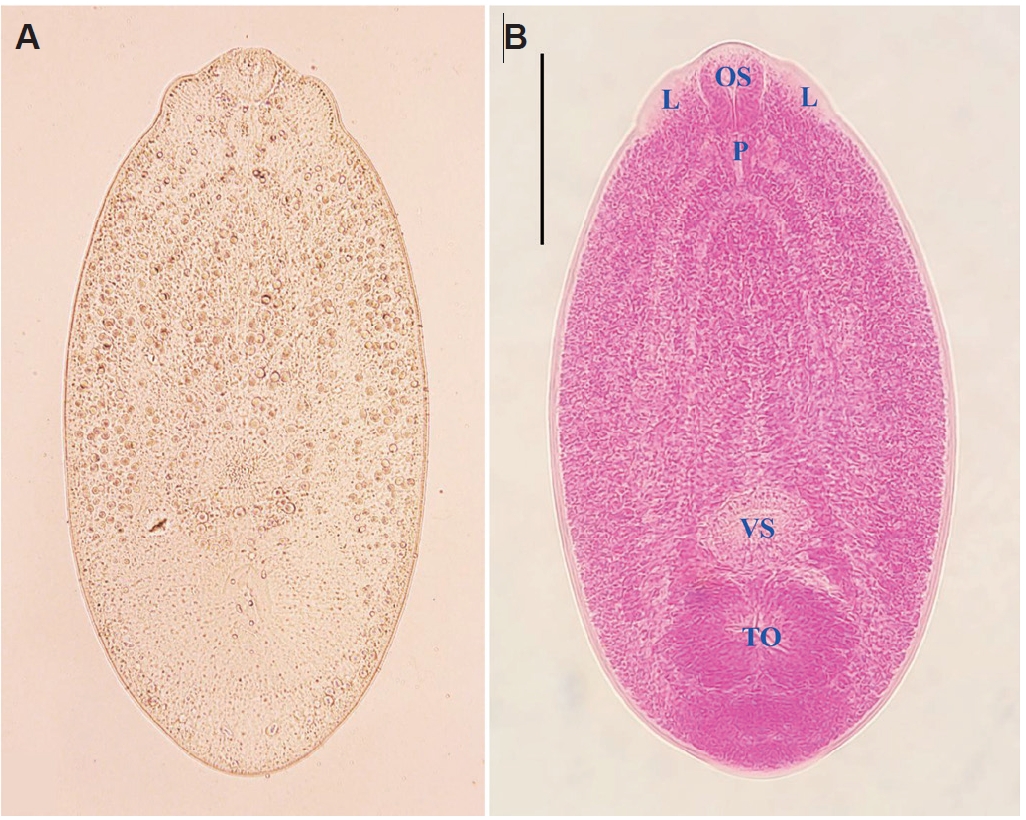
Body elongate-oval, dorso-ventrally flat, 327–480 (376) × 225–297 (263) with a primordial hindbody. Oral sucker oval, 38–50 (45) × 35–50 (43). Two contractile lappets (pseudosuckers) present on each side of oral sucker. Prepharynx very short; pharynx elongate-oval, 15–50 (36) × 13–32 (18); oesophagus short; ceca long, wide, reach posterior to tribocytic (holdfast) organ. Ventral sucker transversely oval, 28–50 (41) × 45–63 (54). Tribocytic organ large, transversely oval, 53–85 (62) × 43–106 (80). Reserve excretory system with numerous, relatively large excretory granules, distributed in a median and 2 lateral fields (
Fig. 1).
DsMc were detected in 3,831 (24.1%) out of 15,879 fishes in 79 fish species examined. The overall infection status of DsMc by the fish species was detailedly revealed in
Table 1. No DsMc were detected from 386 fishes in 31 spp., i.e.
Gnathopogon strigatus (
n=45),
Mugil cephalus (39),
Microphysogobio yaluensis (34),
Ladislabia taczanowskii (34),
Cobitis sinensis (22),
Misgurnus anguillicaudatus (21),
Iksookimia koreensis (20),
Liobagrus mediadiposalis (20),
Erythroculter erythropterus (20),
Liobagrus andersoni (18),
Chaenogobius castaneus (17),
Pseudobagrus fulvidraco (16),
Cottus hangiongensis (13),
Rhodeus pseudosericeus (10),
Iksookimia longicorpa (9),
Liobagrus somjinensis (9),
Culter brevicauda (5),
S. asotus (5),
Cobitis lutheri (5),
Acanthogobius flavimanus (4),
Koreocobitis naktongensis (4),
Hypomesus nipponensis (3),
Cobitis tetralineata (2),
Squalidus multimaculatus (2),
Koreocobitis rotundicaudata (2),
Hemiculter leucisculus (2),
Microphysogobio jeoni (1),
Acheilognathus signifer (1),
Orthrias nudus (1),
Misgurnus mizolepis (1), and
Phoxinus phoxinus (1). The infection status by the fish species and survey localities was detailedly shown in
Supplementary Tables S1-
S13, respectively.
DsMc were detected in 3,831 (24.1%) out of 15,879 fishes examined and their infection intensity was 7.2 PFI in average. The prevalence was highest in fishes from Yeongsan-gang (59.3%) and followed by the middle reaches of Seomjin-gang in Gokseong-gun (gun means county) and Gurye-gun, Jeollanam-do (do means province) (48.0%) and Geum-gang (32.3%). That of remain 10 localities was 1.1%–31.3% respectively. The intensity of infection was also highest, 83.1 PFI, in fish from Yeongsan-gang. That of streams in east coast was 11.3 PFI and those of remain 11 localities were 2.1–7.5 PFI respectively. The infection status with DsMc by the survey localities was revealed in
Table 2 in detail.
DsMc were detected in 1,038 (44.8%) out of 2,319
Z. platypus examined and their infection intensity was 7.5 PFI in average. The higher prevalence was revealed in the middle reaches of Seomjin-gang (79.6%), Geum-gang (79.2%), and Tamjin-gang (64.7%). SI in index fish was highest (13.64) in 69 (48.9%) out of 141
Z. platypus from streams in east coast, followed by the middle reaches of Seomjin-gang in Gokseong-gun and Gurye-gun, Jeollanam-do (7.56) and Mangyeong-gang (4.75). That of remain 10 localities was 0–3.88 respectively. The infection status with DsMc in index fish,
Z. platypus, was detailedly shown in
Table 3.
Discussion
We described the morphologies of DsMc collected from 3 fish species, i.e.,
P. esocinus, S. chankensis and
Z. platypus, which were susceptible hosts to obtain DsMc specimens easily, in this study. Among 14 genus in Diplostominae, 2 ones, genus
Diplostomum and
Tylodelphys, have the possibility to be present in Korean peninsula by the closely related biological factors, the geographical distribution and second intermediate hosts (fish) [
1]. The metacercariae of
Diplostomum spp. have been well known, already reported by many Korean workers and they have been detected only in fishes [
4,
6,
8,
11-
14]. However, those of
Tylodelphys spp. have not been reported yet in Korea and they have been found in fishes and amphibians. The metacercarial morphologies of
Tylodelphys spp. are obviously differentiated from
Diplostomum spp. metacercariae by the more slender body, no lappets on each side of oral sucker and a long elliptical tribocytic organ [
1]. Interspecies differentiation of
Diplostomum spp. metacercariae is not easy only with morphological characters. Several species of
Diplostomum metacercariae, i.e.,
D. spathaceum,
D. pseudospathaceum,
D. ardeae,
D. baeri, and
D. phoxini, were identified with the morphological and molecular studies [
33,
34]. Therefore, the morphological and molecular studies on the species-validity of DsMc detected by the fish species and survey localities should be performed in the future in Korea.
The DsMc were detected from 48 (60.8%) out of 79 fish species examined in this study. Among 48 positive fish species (PFS), 18 ones,
Abbotina revularis,
Acanthorhodeus gracilis,
A. macropterus,
Acheilognathus koreensis,
Carassius auratus,
Cyprinus capio,
Hemibarbus labeo,
H. longirostris,
Hemiculter eigenmanni,
Lepomis macrochirus,
Microphysogobio longidorsalis,
P. esocinus,
Pseudorasbora parva,
Pungtungia herzi,
Rhodeus ocellatus,
Tribolodon hakonensis,
Z. platypus, and
Z. temminckii (=
Nipponocypris temminckii), were already reported as the 2nd intermediate hosts of
Diplostomum spp. in Korea [
4-
14]. The remaining 30 fish species are regarded as new second intermediate hosts of
Diplostomum spp. in Korea. In previous studies, a total of 4 fish species (DsMc negative in this study:
S. asotus,
M. anguillicaudatus, and
E. erythropterus, and not examined in this study:
Hemibarbus mylodon) were revealed as additional second intermediate hosts of
Diplostomum spp. [
4,
6,
8-
11,
14]. Accordingly, a total of 52 fish species is listed as the second intermediate hosts of
Diplostomum spp. by the present and previous studies in Korea.
In this study, the number of fish examined was 2–2,310 (322.8 in average) in 48 fish species of DsMc positive group, but that was 1–45 (12.5 in average) in 31 fish species of DsMc negative group. The number of fish examined was quite different between 2 groups. Fish species in DsMc negative group were not collected a lot in this study. The reason why they might be less prevalent in the water systems surveyed. The fish catching methods, mainly by netting and casting net, and the fish ecology, especially the high prevalence of predatory fish species, i.e., snake head (Channa argus), Mandarin fish (Siniperca scherzeri), Korean aucha perch (Coreaperca herzi), large mouth bass (M. salmoides) and blue gill (L. macrochirus), might be partly affected the small number of fish examined and of even DsMc negative group in some localities. If the fish species in negative group were examined enough, some of them could be convert to the DsMc positive species.
The overall prevalence of DsMc was 24.1% and the infection intensity was 7.2 PFI in average in 48 PFS in this study. Among 48 PFS, the prevalence was highest in
P. esocinus (61.5%) and followed by that in
S. chankaensis (56.9%),
Z. platypus (44.8%),
Nipponocypris koreanus (42.8%),
N. temminckii (38.5%),
H. labeo (38.0%),
Acheilognathus lanceolatus (35.8%), and
Squalidus japonicus coreanus (32.7%). The mean infection intensity was highest in
R. ocellatus (312.0), followed by in
H. longirostris (22.1),
A. rivularis (15.5),
P. esocinus (9.4) and
A. gracilis (8.9). In case of
R. ocellatus, DsMc were detected in 4 (7.0%) out of 57 fish examined and 1,245 DsMc were extraordinally detected from only 1 fish, which will be the cause of the highest infection intensity. The most susceptible fish with DsMc was
P. esocinus (61.5% prevalence and 9.4 infection intensity) in this study. It was previously confirmed by Sohn et al. [
11]. They reported 53.8% and 66.7% DsMc prevalence and 8.1 and 28.0 infection intensity in
P. esocinus from Hantan-gang and Imjin-gang respectively. On the other hand, Sohn and Choi [
8] reported 85.0% and 73.0% DsMc prevalence and 9.5 and 12.0 infection intensity in 2 species of cultrinid fish,
E. erythropterus and
H. eigenmanni, from Junam-jeosuji (jeosuji means reservoir) in Uichang-gun, Gyeongsangnam-do, Korea. Interestingly, DsMc were found in pond smelt,
Hypomesus olidus (=
H. nipponensis) [
9,
10] and sea rundace,
T. hakonensis, from 3 coastal lakes in Gangwon-do [
13]. From the present and previous studies, we can know that the prevalence and infection intensity of DsMc are somewhat affected by the fish species, the susceptible fish species aforementioned.
The prevalence with DsMc was more or less higher in fishes from Yeongsan-gang (59.3%) and middle reaches of Seomjin-gang (48.0% in Gokseong-gun and Gurye-gun in Jeollanam-do). The intensity of infection with DsMc was much higher in fishes from Yeongsan-gang (83.1 FPI) than in fishes from middle reaches of Seomjin-gang (7.5 FPI). Meanwhile in fishes from streams in east coast, the prevalence (21.3%) was similar with the overall prevalence, but the infection intensity (11.3 PFI) was relatively high. On the other hand, Sohn et al. [
11] reported 17.6% DsMc prevalence and 6.9 infection intensity in fishes from Hantan-gang and Imjin-gang. In this study, the prevalence was 20.8%, and the mean infection intensity was 5.2 PFI in fishes from Hantan-gang and Imjin-gang. Sohn and Choi [
8] reported 42.3% DsMc prevalence and 10.5 mean infection intensity in 130 fish of 5 species, i.e.,
E. erythropterus,
H. eigenmanni,
C. auratus,
P. parva and
A. macropterus, from Junam-jeosuji. In the same survey locality, Junam-jeosuji, Sohn and Na [
14] detected a total of 46 DsMc (2.7 in average) in 17 (7.7%) out of 220 fish in 7 species examined. They also reported 33.9% DsMc prevalence and 2.4 mean infection intensity in 127 fish of 7 species, i.e.,
E. erythropterus,
H. eigenmanni,
P. parva,
C. auratus,
C. carpio,
L. macrochirus, and
Micropterus salmoides, from Woopo-neup (neup means swamp) in Changnyeong-gun, Gyeongsangnam-do [
14]. Choe et al. [
12] reported 5.7% DsMc prevalence and 7.3 mean infection intensity in 314 fish of 7 species,
Z. platypus,
C. auratus,
H. longirostris,
P. esocinus,
P. herzi,
L. macrochirus and
M. salmoides, from Daecheong-ho (ho means lake) in Chungcheongnam-do. The prevalence and infection intensity of DsMc were much different by the survey localities in this study. However, those of all survey localities (
Table 2) except for Nakdong-gang (middle reaches: Wi-cheon) were higher than those of previous studies.
The pale chub,
Z. platypus, is widely distributed in the water systems of Korea. They were most dominantly collected in this study. The objective endemicity of DsMc infection was calculated from the index fish,
Z. platypus, which was also recommended as the index fish for the infections of
Metagonimus spp. metacercariae in Sohn [
29]. A total of 2,319 pale chubs were examined, and they were 14.5% of total 15,985 in 48 PFS. The overall DsMc prevalence was 44.8%, the infection intensity was 7.5 PFI and the SI was 3.36 in average. The DsMc prevalence was relatively high in
Z. platypus from Seomjin-gang (middle reaches in Jeollanam-do: 79.6%), Geum-gang (79.2%) and Tamjin-gang (64.7%). The infection intensity was somewhat higher in index fish from streams in east coast (27.9), Mangyeong-gang (10.8) and Seomjin-gang (middle reaches: 9.5). The SI was also higher in pale chubs from streams in east coast (13.64), Seomjin-gang (middle reaches: 7.56), and Mangyeong-gang (4.75). The endemicity of DsMc in the index fish (
Table 3) was not coincided with that in all fish species examined (
Table 2) except for that of Seomjin-gang (middle reaches). In case of all fish species examined, the number of DsMc negative fish is too much included and is affected the prevalence. On the other hand, Sohn et al. [
11] reported 27.3% prevalence, 2.2 infection intensity and 0.60 SI in
Z. platypus from Hantan-gang and Imjin-gang. In this study, the slightly higher endemicity (1.58 SI) was revealed in index fish from the same locality, Hantan-gang and Imjin-gang. Choe et al. [
12] reported 26.0% prevalence, 10.0 infection intensity and 2.60 SI in
Z. platypus from Daecheong-ho, Chungcheongnam-do, Korea. From the findings of present and previous studies, we can suppose that the endemicity with DsMc is much higher in index fish,
Z. platypus, from streams of east coast and Seomjin-gang (middle reaches) in Jeollanam-do, Korea.
Conclusively, it was confirmed that DsMc are prevalent in various species of fishes in Korea although their prevalence and infection intensity are somewhat different by fish species and survey localities. And then the second intermediate hosts of Diplostomum spp. are obviously listed and consolidated by this study in Korea. The endemicity (SI) of DsMc in index fish, Z. platypus, is regarded as a useful comparative datum in the conjecture of epidemiological situation. Further studies are needed with regard to the species-diversity of Diplostomum spp. flukes in Korea. The species-validity for DsMc detected by the fish species and survey localities should be clarified by molecular genomic studies. Morphological characteristics on the adults recovered from the avian hosts, which are naturally and/or experimentally infected with DsMc, should be precisely described for the fauna of this fluke group in Korea.
Notes
-
Author contributions
Conceptualization: Sohn WM. Data curation: Sohn WM, Na BK, Kim JA. Formal analysis: Sohn WM, Na BK. Investigation: Sohn WM, Na BK, Kim JA, Kim HJ. Methodology: Sohn WM, Na BK, Kim JA. Project administration: Sohn WM, Kim JA. Supervision: Sohn WM. Validation: Sohn WM, Na BK. Visualization: Sohn WM. Writing - original draft: Sohn WM. Writing - review & editing: Sohn WM, Na BK.
-
Conflict of interest
Woon-Mok Sohn and Byoung-Kuk Na serve as editors of Parasites, Hosts and Diseases but had no involvement in the decision to publish this article. No other potential conflicts of interest relevant to this study were reported.
Supplementary information
Fig. 1.
Diplostomum sp. metacercariae detected in a pale chub, Zacco platypus, from Deokcheon-gang, a branch stream of Nakdong-gang, in Sancheong-gun, Gyeongsangnam-do, Korea. (A) Fresh unstained and (B) acetocarmin stained. L, lappet; OS, oral sucker; P, pharynx; VS, ventral sucker; TO, tribocytic organ. Scale bar=100 μm.
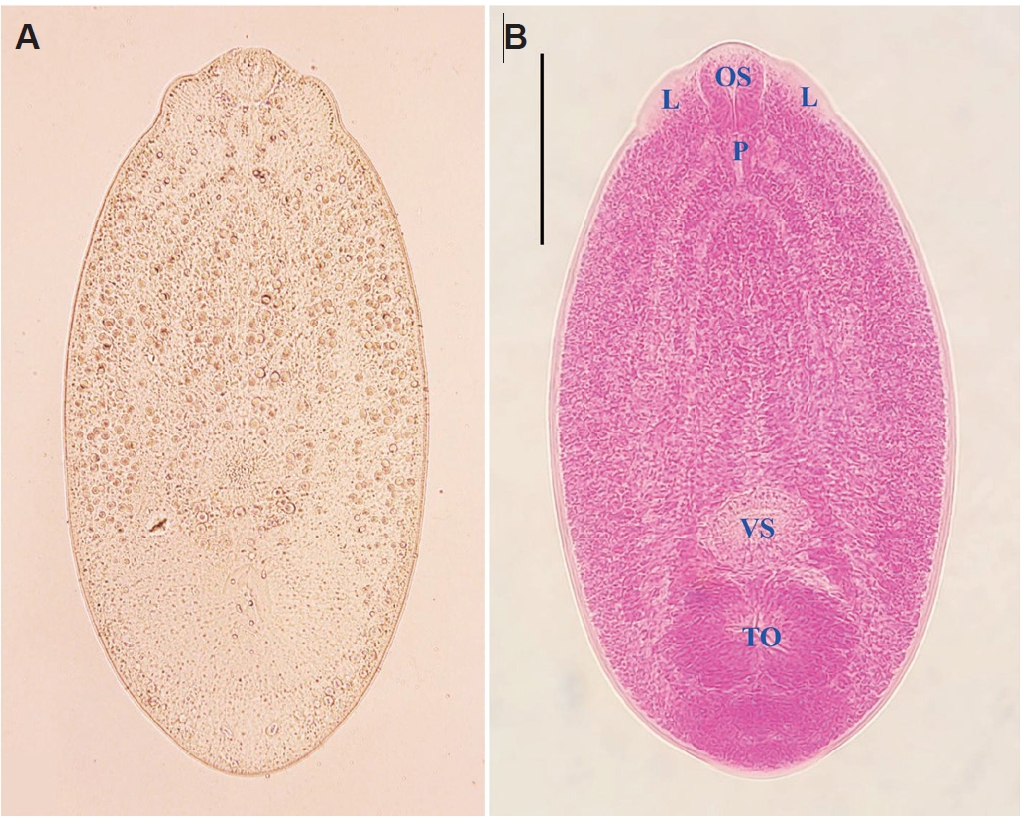
Table 1.Overall
a infection status of DsMc by the fish species
Table 1.
|
Positive fish species |
No. of fish examined |
No. (%) of fish infected |
No. of DsMc detected |
|
Range |
Average |
|
Zacco platypus
|
2,319 |
1,038 (44.8) |
1–282 |
7.5 |
|
Pungtungia herzi
|
2,144 |
124 (5.8) |
1–49 |
3.8 |
|
Nipponocypris temminckii
|
1,033 |
398 (38.5) |
1–60 |
4.1 |
|
Pseudogobio esocinus
|
1,032 |
635 (61.5) |
1–56 |
9.4 |
|
Carassius auratus
|
870 |
63 (7.2) |
1–11 |
2.1 |
|
Nipponocypris koreanusb
|
848 |
363 (42.8) |
1–31 |
5.8 |
|
Hemibarbus longirostris
|
620 |
137 (22.1) |
1–452 |
22.1 |
|
Acheilognathus koreensis
|
551 |
164 (29.8) |
1–94 |
5.1 |
|
Coreoperca herzib
|
532 |
21 (3.9) |
1–7 |
1.8 |
|
Squalidus japonicus coreanusb
|
447 |
146 (32.7) |
1–33 |
6.6 |
|
Sarcocheilichthys variegatusb
|
402 |
3 (0.7) |
- |
1.0 |
|
Odontobutis platycephalab
|
386 |
32 (8.3) |
1–20 |
3.5 |
|
Plecoglossus altivelisb
|
348 |
20 (5.7) |
1–4 |
1.7 |
|
Acheilognathus yamatsutaeb
|
345 |
77 (22.3) |
1–29 |
4.8 |
|
Acheilognathus lanceolatusb
|
330 |
118 (35.8) |
1–28 |
3.5 |
|
Acheilognathus rhombeusb
|
316 |
21 (6.6) |
1–16 |
3.4 |
|
Coreoleuciscus splendidusb
|
256 |
32 (12.5) |
1–7 |
2.4 |
|
Acheilognathus majusculusb
|
213 |
38 (17.8) |
1–13 |
2.7 |
|
Squalidus gracilis majimaeb
|
207 |
57 (27.5) |
1–32 |
3.2 |
|
Hemibarbus labeo
|
205 |
78 (38.0) |
1–14 |
3.5 |
|
Squalidus chankaensisb
|
188 |
107 (56.9) |
1–47 |
6.7 |
|
Sarcocheilichthys nigripinnisb
|
169 |
3 (1.8) |
- |
1.0 |
|
Pseudorasbora parva
|
159 |
5 (3.1) |
1–2 |
1.4 |
|
Micropterus salmoidesb
|
153 |
2 (1.3) |
- |
1.0 |
|
Coreoperca kawamebarib
|
130 |
2 (1.5) |
- |
1.0 |
|
Odontobutis obscurusb
|
125 |
6 (4.8) |
1–4 |
1.8 |
|
Opsariichthys uncirostrisb
|
122 |
18 (14.8) |
1–4 |
1.9 |
|
Rhynchocypris oxycephalusb
|
111 |
12 (10.8) |
1–5 |
3.4 |
|
Lepomis macrochirus
|
105 |
1 (1.0) |
- |
2.0 |
|
Siniperca scherzerib
|
90 |
2 (2.2) |
- |
1.0 |
|
Acanthorhodeus gracilis
|
89 |
7 (7.9) |
1–22 |
8.9 |
|
Microphysogobio longidorsalis
|
82 |
14 (17.1) |
1–12 |
3.0 |
|
Acanthorhodeus macropterus
|
81 |
19 (23.5) |
1–5 |
1.7 |
|
Microphysogobio koeensisb
|
75 |
24 (32.0) |
1–11 |
3.4 |
|
Rhodeus ocellatus
|
57 |
4 (7.0) |
1–1,245 |
312.0 |
|
Hemiculter eigenmanni
|
52 |
4 (7.7) |
1–3 |
1.5 |
|
Abbottina springerib
|
47 |
4 (8.5) |
1–2 |
1.5 |
|
Pseudobagrus koreanusb
|
46 |
1 (2.2) |
- |
1.0 |
|
Tribolodon hakonensis
|
41 |
2 (4.9) |
1–2 |
1.5 |
|
Abbottina rivularis
|
38 |
11 (28.9) |
1–70 |
15.5 |
|
Cyprinus capio
|
38 |
3 (7.9) |
1–4 |
2.0 |
|
Chaenogobius urotaeniab
|
20 |
2 (10.0) |
- |
1.0 |
|
Tridentiger brevispinisb
|
19 |
3 (15.8) |
1–5 |
3.3 |
|
Acheilognathus somjinensisb
|
18 |
2 (11.1) |
- |
1.0 |
|
Onchorhynchus masou masoub
|
14 |
3 (21.4) |
1–2 |
1.3 |
|
Acanthogobius lactipesb
|
10 |
3 (30.0) |
1–6 |
4.3 |
|
Channa argusb
|
8 |
1 (12.5) |
- |
4.0 |
|
Lateolabrax japonicusb
|
2 |
1 (50.0) |
- |
5.0 |
|
Total |
15,879c
|
3,831 (24.1) |
1–1,245 |
7.2 |
Table 2.Infection status of DsMc by the survey locality in Korea
Table 2.
|
Survey locality |
No.a of fish examined |
No. (%) of fish infected |
No. of DsMc detected |
|
Range |
Average |
|
Hantan-gang and Imjin-gang |
1,323 |
275 (20.8) |
1–48 |
5.2 |
|
Han-gang |
707 |
124 (17.5) |
1–54 |
4.2 |
|
Geum-gang |
830 |
268 (32.3) |
1–28 |
4.3 |
|
Mangyeong-gang |
927 |
223 (24.1) |
1–59 |
6.4 |
|
Yeongsan-gang |
86 |
51 (59.3) |
1–1,245 |
83.1 |
|
Tamjin-gang |
2,201 |
563 (26.6) |
1–52 |
5.5 |
|
Seomjin-gang (upper reaches)b
|
1,259 |
347 (27.6) |
1–47 |
6.7 |
|
Seomjin-gang (middle reaches)c
|
1,276 |
613 (48.0) |
1–106 |
7.5 |
|
Seomjin-gang (lower reaches)d
|
1,161 |
363 (31.3) |
1–40 |
4.3 |
|
Nakdong-gang (upper reaches)e
|
1,179 |
269 (22.8) |
1–94 |
6.8 |
|
Nakdong-gang (middle reaches)f
|
1,647 |
18 (1.1) |
1–6 |
2.1 |
|
Nakdong-gang (lower reaches)g
|
2,057 |
456 (22.2) |
1–65 |
4.3 |
|
Streams in east coast |
1,226 |
261 (21.3) |
1–282 |
11.3 |
|
Total |
15,879 |
3,831 (24.1) |
1–1,245 |
7.2 |
Table 3.Infection status of DsMc in the index fish, Zacco platypus, by the survey locality in Korea
Table 3.
|
Survey locality |
No. of fish examined |
No. (%) of fish infected |
No. of DsMc detected |
|
Range |
Average |
SIa
|
|
Hantan-gang and Imjin-gang |
289 |
134 (46.4) |
1–18 |
3.4 |
1.58 |
|
Han-gang |
85 |
28 (32.9) |
1–5 |
2.1 |
0.69 |
|
Geum-gang |
101 |
80 (79.2) |
1–22 |
4.9 |
3.88 |
|
Mangyeong-gang |
100 |
44 (44.0) |
1–59 |
10.8 |
4.75 |
|
Yeongsan-gang |
30 |
3 (10.0) |
1–2 |
1.3 |
0.01 |
|
Tamjin-gang |
266 |
172 (64.7) |
1–49 |
5.2 |
3.36 |
|
Seomjin-gang (upper reaches)b
|
182 |
76 (41.8) |
1–34 |
6.8 |
2.84 |
|
Seomjin-gang (middle reaches)c
|
206 |
164 (79.6) |
1–106 |
9.5 |
7.56 |
|
Seomjin-gang (lower reaches)d
|
185 |
87 (47.0) |
1–21 |
2.9 |
1.36 |
|
Nakdong-gang (upper reaches)e
|
211 |
97 (46.0) |
1–64 |
8.1 |
3.73 |
|
Nakdong-gang (middle reaches)f
|
326 |
6 (1.8) |
1–3 |
1.5 |
0.00 |
|
Nakdong-gang (lower reaches)g
|
197 |
78 (39.6) |
1–65 |
5.3 |
2.10 |
|
Streams in east coast |
141 |
69 (48.9) |
1–282 |
27.9 |
13.64 |
|
Total |
2,319 |
1,038 (44.8) |
1–282 |
7.5 |
3.36 |
References
- 1. Gibson DI, Jones A, Bray RA. Keys to the trematoda. Vol. 1. CABI Publishing and the Natural History Museum; 2002.
- 2. Sohn WM. Invertebrate fauna of Korea. Vol. 6, No. 1. Trematodes. National Institute of Biological Resources; 2013.
- 3. Sohn WM. Fish-borne zoonotic trematode metacercariae in the Republic of Korea. Korean J Parasitol 2009;47 Suppl:S103-13. https://doi.org/10.3347/kjp.2009.47.S.S103
- 4. Chun SK. Studies on some trematodes whose intermediate hosts are fishes in the Naktong River. Bull Fish Coll 1962;4:21-38.
- 5. Rhee JK, Lee HI, Baek BK, Kim PG. Survey on encysted cercariae of trematodes from fresh-water fishes in Mangyeong riverside area. Korean J Parasitol 1983;21:187-92. https://doi.org/10.3347/kjp.1983.21.2.187
- 6. Rhee JK, Rim MH, Baek BK, Lee HI. Survey on encysted cercariae of trematodes from fresh-water fishes in Tongjin riverside areas in Korea. Korean J Parasitol 1984;22:190-202. https://doi.org/10.3347/kjp.1984.22.2.190
- 7. Kong HH, Choi BR, Moon CH, Choi DW. Larval digenetic trematodes from fresh water fish in River Miryang, Korea. Jpn J Parasitol 1995;44:112-8.
- 8. Sohn WM, Choi YS. Infection status with trematode metacercariae in the fresh-water fish from Chunamchosuchi (pond), Uichang-gun, Kyongsangnam-do, Korea. Korean J Parasitol 1997;35:165-70. https://doi.org/10.3347/kjp.1997.35.3.165
- 9. Nam HS, Sohn WM. Infection status with trematode metacercariae in pond smelts, Hypomesus olidus. Korean J Parasitol 2000;38:37-9. https://doi.org/10.3347/kjp.2000.38.1.37
- 10. Cho SH, Sohn WM, Shin SS, et al. Infection status of pond smelts, Hypomesus olidus, and other freshwater fishes with trematode metacercariae in 6 large lakes. Korean J Parasitol 2006;44:243-6. https://doi.org/10.3347/kjp.2006.44.3.243
- 11. Sohn WM, Na BK, Cho SH, et al. Trematode metacercariae in freshwater fish from water systems of Hantangang and Imjingang in Republic of Korea. Korean J Parasitol 2015;53:289-98. https://doi.org/10.3347/kjp.2015.53.3.289
- 12. Choe S, Park H, Lee D, et al. Infections with digenean trematode metacercariae in two invasive alien fish, Micropterus salmoides and Lepomis macrochirus, in two rivers in Chungcheongbuk-do, Republic of Korea. Korean J Parasitol 2018;56:509-13. https://doi.org/10.3347/kjp.2018.56.5.509
- 13. Sohn WM, Na BK, Cho SH, Lee SW. Infection status with digenetic trematode metacercariae in fishes from coastal lakes in Gangwon-do, Republic of Korea. Korean J Parasitol 2019;57:681-90. https://doi.org/10.3347/kjp.2019.57.6.681
- 14. Sohn WM, Na BK. Infections with digenetic trematode metacercariae in freshwater fishes from two visiting sites of migratory birds in Gyeongsangnam-do, Republic of Korea. Korean J Parasitol 2019;57:273-81. https://doi.org/10.3347/kjp.2019.57.3.273
- 15. Cho SH, Lee WJ, Kim TS, et al. Prevalence of zoonotic trematode metacercariae in freshwater fish from Gangwon-do, Korea. Korean J Parasitol 2014;52:399-412. https://doi.org/10.3347/kjp.2014.52.4.399
- 16. Sohn WM, Na BK, Cho SH, et al. Endemicity of zoonotic trematode metacercariae in fish from Deokcheon-gang (river) in Sancheong-gun, Gyeongsangnam-do, Republic of Korea. Korean J Parasitol 2021;59:523-9. https://doi.org/10.3347/kjp.2021.59.5.523
- 17. Sohn WM, Na BK, Cho SH, et al. Survey of zoonotic trematode metacercariae in fish from irrigation canal of Togyo-jeosuji (reservoir) in Cheorwon-gun, Gangwon-do, Republic of Korea. Korean J Parasitol 2021;59:427-32. https://doi.org/10.3347/kjp.2021.59.4.427
- 18. Sohn WM, Na BK, Cho SH, et al. Prevalence and infection intensity of zoonotic trematode metacercariae in fish from Soyang-cheon (stream), in Wanju-gun, Jeollabuk-do, Korea. Korean J Parasitol 2021;59:265-71. https://doi.org/10.3347/kjp.2021.59.3.265
- 19. Cho SH, Sohn WM, Na BK, et al. Prevalence of Clonorchis sinensis metacercariae in freshwater fish from three latitudinal regions of the Korean Peninsula. Korean J Parasitol 2011;49:385-98. https://doi.org/10.3347/kjp.2011.49.4.385
- 20. Sohn WM, Na BK, Cho SH, et al. Prevalence of Clonorchis sinensis metacercariae in fish from water systems of Seomjin-gang (River). Korean J Parasitol 2017;55:305-12. https://doi.org/10.3347/kjp.2017.55.3.305
- 21. Sohn WM, Na BK, Cho SH, Ju JW, Son DC. Prevalence and intensity of Clonorchis sinensis metacercariae in freshwater fish from Wicheon stream in Gunwi-gun, Gyeongsangbuk-do, Korea. Korean J Parasitol 2018;56:41-8. https://doi.org/10.3347/kjp.2018.56.1.41
- 22. Yoon KB, Lim HC, Jeon DY, et al. Infection status with Clonorchis sinensis metacercariae in fish from Tamjin-gang (river) in Jeollanam-do, Republic of Korea. Korean J Parasitol 2018;56:183-8. https://doi.org/10.3347/kjp.2018.56.2.183
- 23. Sohn WM, Na BK, Cho SH, et al. High endemicity with Clonorchis sinensis metacercariae in fish from Yongjeon-cheon (stream) in Cheongsong-gun, Gyeongsangbuk-do, Korea. Korean J Parasitol 2021;59:97-101. https://doi.org/10.3347/kjp.2021.59.1.97
- 24. Sohn WM. Infection characteristics of Clonorchis sinensis metacercariae in fish from Republic of Korea. Korean J Parasitol 2022;60:79-96. https://doi.org/10.3347/kjp.2022.60.2.79
- 25. Yoo WG, Sohn WM, Na BK. Current status of Clonorchis sinensis and clonorchiasis in Korea: epidemiological perspectives integrating the data from human and intermediate hosts. Parasitology 2022;149:1296-305. https://doi.org/10.1017/S0031182022000798
- 26. Song CY, Lee SH, Jeon SR. Studies on the intestinal fluke, Metagonimus yokogawai Katsurada, 1912 in Korea. IV. Geographical distribution of sweetfish and infection status with Metagonimus metacercariae in south-eastern area of Korea. Korean J Parasitol 1985;23:123-38. https://doi.org/10.3347/kjp.1985.23.1.123
- 27. Cho SH, Kim TS, Na BK, Sohn WM. Prevalence of Metagonimus metacercariae in sweetfish, Plecoglossus altivelis, from eastern and southern coastal areas in Korea. Korean J Parasitol 2011;49:161-5. https://doi.org/10.3347/kjp.2011.49.2.161
- 28. Sohn WM, Na BK, Cho SH, et al. Infection status with Metagonimus spp. metacercariae in fishes from Seomjin-gang and Tamjin-gang in Republic of Korea. Korean J Parasitol 2018;56:351-8. https://doi.org/10.3347/kjp.2018.56.4.351
- 29. Sohn WM. Infection characteristics of Metagonimus species (Digenea: Heterophyidae) metacercariae in fish from major rivers of Korea. Parasites Hosts Dis 2024;62:1-29. https://doi.org/10.3347/PHD.23096
- 30. Sohn WM, Na BK, Cho SH, et al. Infections with Centrocestus armatus metacercariae in fishes from water systems of major rivers in Republic of Korea. Korean J Parasitol 2018;56:341-9. https://doi.org/10.3347/kjp.2018.56.4.341
- 31. Sohn WM, Na BK, Cho SH, Ju JW. Infection status of Isthmiophora hortensis metacercariae in dark sleepers, Odontobutis species, from some water systems of the Republic of Korea. Korean J Parasitol 2018;56:633-7. https://doi.org/10.3347/kjp.2018.56.6.633
- 32. Sohn WM, Na BK, Cho SH. Infection status with Clinostomum complanatum metacercariae in fish from water systems of Nakdong-gang (river) in Korea. Korean J Parasitol 2019;57:389-97. https://doi.org/10.3347/kjp.2019.57.4.389
- 33. Niewiadomska K, Laskowski Z. Systematic relationships among six species of Diplostomum Nordmann, 1832 (Digenea) based on morphological and molecular data. Acta Parasitol 2002;47:20-8.
- 34. Lebedeva DI, Chrisanfova GG, Ieshko EP, et al. Morphological and molecular differentiation of Diplostomum spp. metacercariae from brain of minnows (Phoxinus phoxinus L.) in four populations of northern Europe and East Asia. Infect Genet Evol 2021;92:104911. https://doi.org/10.1016/j.meegid.2021.104911
- 35. Lee YI, Seo M, Chai JY. Intestinal flukes recovered from a herring gull, Larus argentatus, in the Republic of Korea. Korean J Parasitol 2020;58:81-6. https://doi.org/10.3347/kjp.2020.58.1.81